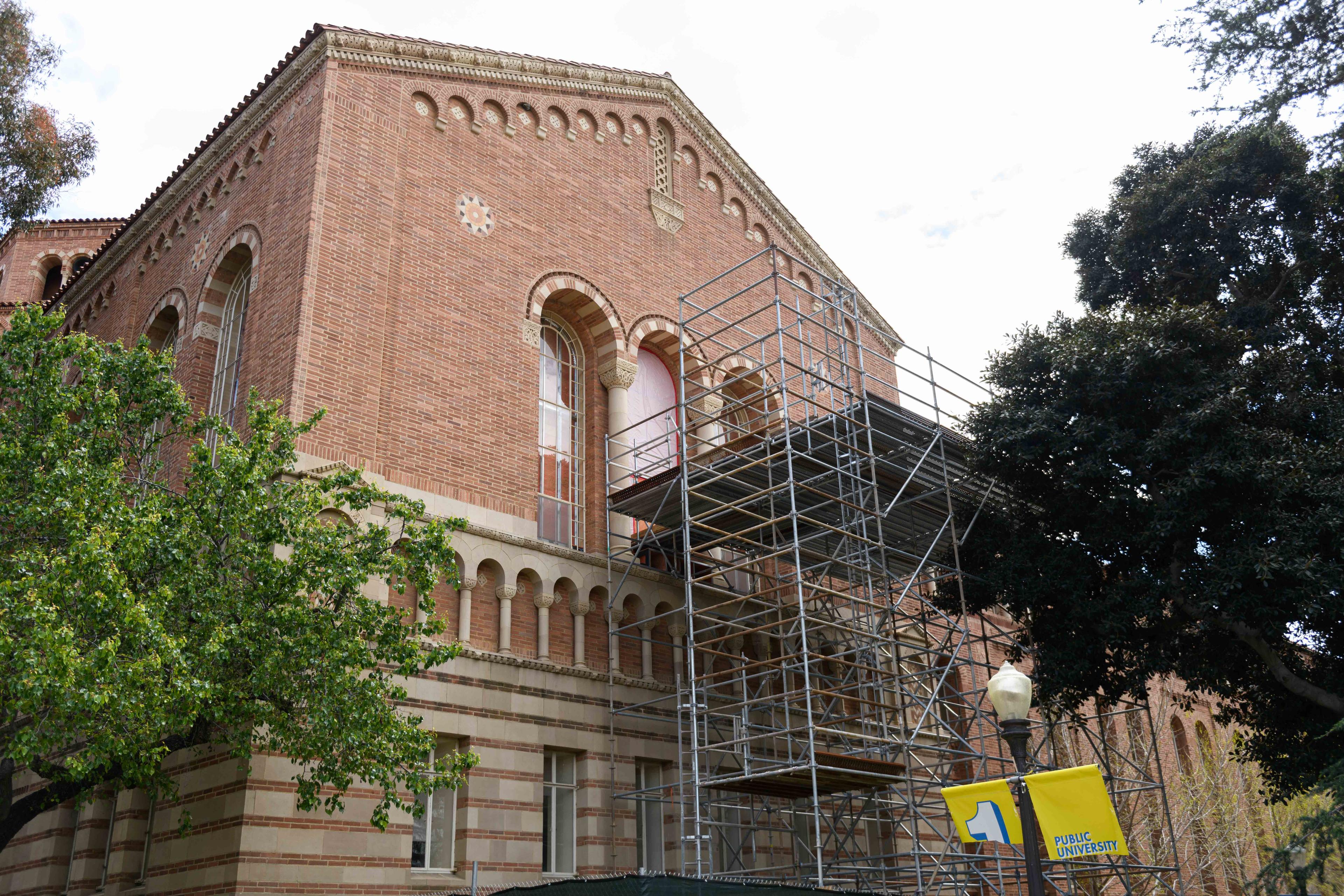
A Difference of Opinion: What could UCLA have done with the $213M it wasted on the failed Ascend project?

(Isabella Andrea Guzman-Quijano/Daily Bruin)


By Sierra Benayon-Abraham, Nick Levie, Makenna Kramer, Alessandra Kahn, Joshua Perry, Bockman Cheung, Dylan Choppin, Lily Rubalcava, Catherine Price, and Sara Green
Feb. 26, 2026 4:19 p.m.
Just days after he alleged that financial mismanagement contributed to the university’s $425 million annual deficit, UCLA announced its chief financial officer, Stephen Agostini, was out. Amid these events and broader conversations about UCLA’s financial woes, these Opinion columnists turned their attention to the Ascend Finance Transformation.
The Ascend project is a failing IT initiative The Bruin revealed has spent $213 million. The investigation found that the project failed to create a single modernization in its first five years and made limited additional progress before administrators put it on pause in 2024. Just days before his exit, Agostini told the Daily Bruin he had stopped the project.
[Related: ‘One timeline after the other was not met’ – UCLA’s $213 million project is failing]
As students report difficulties with the financial aid office, increased tuition and university sustainability efforts, these columnists ponder what could have been, had $213 million not gone to the Ascend project. The Opinion editors and seven columnists take their stances in the latest edition of “A Difference of Opinion Columnists.”
Health Insurance: Free for an Entire Academic Year
Sierra Benayon-Abraham, Opinion editor
Health care in the United States has become a business and commodity.
American health care, instead of viewed as a human right, is perceived to be treatment of the highest caliber and most technologically advanced — if you can afford it. To be enrolled at UCLA, students are required to have some form of health insurance.
Unless they have private health insurance, UCLA students must enroll in the University of California Student Health Insurance Plan. On a quarterly basis, UCLA students must take into consideration an additional cost for UCSHIP when financing college tuition.
Averaging just more than $1,200 per quarter for the 2024-25 academic year for undergraduate students, this adds approximately $3,700 to each student’s Bruin Bill.
But imagine a world where, instead of $213 million being wasted on a failed transformation of UCLA’s digital financial system, UCLA put those funds towards health insurance for its students.
The university could effectively provide UCSHIP plans to approximately every undergraduate student, graduate student, UCLA medicine and dentistry intern and resident, and every UCLA faculty member for an entire academic year.
57,567 people would have access to UCSHIP benefits that include a medical plan, dental plan, vision plan, mental health plan, referrals, urgent care and emergency room care, all for free.
College is stressful enough when you are trying to pay for tuition, textbooks, housing, meal plans and daily coffees to get you through long nights of studying. $213 million could have been spent alleviating a portion of that stress for tens of thousands of students.
UCLA could have bought them all health care.
Study Sanctuary: A New UCLA Library
Sara Green, assistant Opinion editor
The test is in an hour, the paper is due tonight at midnight and all you need is just one seat in the library.
Yet the sea of students before you are in the same situation, flooding every possible study spot.
With the $213 million UCLA spent on Project Ascend, the university could instead build an entirely new library.
In 2023, Cal State East Bay built the CORE Library. This is not just a building with desks and chairs – the U.S. Green Building Council awarded it the Gold Leadership in Energy and Environmental Design certification. While only being two floors, it includes study rooms, presentation rooms, classrooms and a quiet study floor.
The CORE Library, including project costs, construction and furniture, costs $100 million. This is roughly 47% of the $213 million spent.
Assuming it costs $850 per square foot, as it did for the CORE Library, UCLA could build a 250,588 square foot library with $213 million. This new library would only be slightly smaller than the Charles E. Young Research Library, which is 305,919 general square feet.
While this library would not be as elaborate as Powell Library, even a three to four floor building would provide students with a much needed space to study and collaborate.
UCLA could even decide to build a two floor, smaller library – assuming costs were the same as the CORE Library – and add a cafe.
Building a cafe at YRL in 2010 cost $4 million. With $109 million left over after building the library, the university could pay staff and implement new technology.
The possibilities are endless.
Alas, the $213 million is already spent on a dead-end IT project instead, leaving the search for a spot in the library endless too.
Transportation: A Creative Way to Get Around Campus
Makenna Kramer, assistant Opinion editor
UCLA students walk a lot.
Our campus is 419 acres with numerous hills, steep staircases and perpetually broken elevators. But with $213 million, UCLA could implement a solution for the ages – say it with me: hoverboards.
With “premium” hoverboards starting at $400 a pop, the university could buy each undergraduate and graduate student 11 state-of-the-art devices and still have almost eight million left over.
Student bikers navigate a mosaic of staircases and inclines. Scooter-riders endure the looming threat of theft and having to lug their heavy vehicles up particularly steep gradients. Hoverboards, on the other hand, are famously speedy and lightweight.
Now, I know what you’re thinking: 11 hoverboards per student may be a tad bit excessive.
Another stellar option would be buying every student just two hoverboards and putting the remaining over $175 million toward hoverboards for the broader Los Angeles community. With that money, every LA resident aged 18-24 could be gifted a mid-tier, $200 hoverboard.
As absurd as a campus or city full of adolescent hoverboarders may sound, even that has got to be better than nothing.
There is no excuse for a $213 million failed IT project. If UCLA was going to invest in futuristic technology, it should have at least done something sci-fi related.
Bruin Bash: An Iconic Performance
Nick Levie, Opinion staff
As she ascended on a platform during a performance of “Drunk in Love,” Beyoncé serenaded Dubai with a riff reminiscent of an Arabic scale, often dubbed the “Dubai riff.”
Now imagine this scene but at UCLA’s Bruin Bash.
Beyoncé was reportedly paid at least $24 million to perform in Dubai. Although this seems a hefty price, it’s just a fraction of the $213 million UCLA invested in a dead-end IT endeavor called the Ascend project.
Based on her Dubai figures, UCLA could book Beyoncé almost nine times over.
However, if the entire $213 million budget was concentrated on just one year, the sky is the limit – or in a literal sense, however high Beyoncé can reach on her ascending platform. Because, of course, we could afford one.
In fact, with this budget, we could orchestrate a Super Bowl-level production. Beyoncé’s own 2013 Super Bowl performance had pyrotechnics, a multiple-stories tall sparkling silhouette of her body and elaborate choreography with a troupe of dancers flanking her sides.
Yet Super Bowl performances generally cost just $12-$15 million, a fraction of our $213 million.
So, let’s not hold ourselves back.
I’m sure Megan Thee Stallion wouldn’t mind making an appearance to perform the Savage Remix for a few million. Better yet, let’s bring in Kelly Rowland and Michelle Williams for our very own Destiny’s Child reunion.
And even better, we could do it all again the next year.
Of course, renovating student housing or subsidizing students’ tuition would also be worthwhile.
But just imagine: after the most elaborate, star-studded concert of our lifetimes, Beyoncé closes the show with “Drunk in Love,” straps into a harness and begins to rise above the crowd at Pauley Pavilion.
She’s singing an Arabic scale-influenced melody, now dubbed the “UCLA riff.”
Now, that’s a real Ascend project.
Revitalizing Research: A Relief Fund Dedicated to Academia
Bockman Cheung, Opinion columnist
UCLA faced constant funding uncertainty last year.
The California state legislature postponed a $129.7 million payment, along with a $240.8 million general funding increase to the UC until July 2026. The Trump administration also suspended $584 million of federal funding in July 2025, only restoring the funding after a legal battle in September 2025.
The result of funding instability is scaling down our academic departments. In the math department, teaching assistant teaching appointments went from a guaranteed 50% to 25% this year. The financial stress and struggle for graduate students when they need to focus on research is real, and our quality of learning also drops when some of the classes do not have a TA.
But what I am describing is just the tip of the iceberg of the funding threats to the backbone of technology and progress in our community. This instability also disrupts critical life saving research, including brain cancer and concussion recovery.
The lost money could have been an immediate relief fund for our researchers and students.
I was frustrated when I learned about how UCLA spent $213 million on a project that I have not heard of during my two and a half years here. I have not – and I am sure many students have not – heard of who is in charge of the project and what progress has been made.
But deep down, it reveals a problem of accountability at UCLA. Why would the budget overrun from $120 million to a projected $286 million? Why did UCLA fail to modernize its financial system when UC San Diego achieved the same goal spending only $16 million?
Internally, UCLA’s lack of communication with the staff during the reorganization of the project and with academic administrative units who must work with it to implement this system is also problematic. These patterns continued while the Daily Bruin covered the project. A UCLA spokesperson delayed answering questions for a month and then gave a three sentence statement.
If UCLA actually cared about its financial management and its responsibility to serve Californians, we would be far more capable of sustaining the financial pressure created by inconsistent funding.
Ethical Eating: Investments in Alternative Protein Sources
Dylan Choppin, Opinion columnist
UCLA is a cutting edge research institution with a starter investment in researching cultivated meat. But, it should be investing even more.
The university should have used the $213 million to support its efforts and invest further in transforming the food industry.
As of now, UCLA only has one portion of a one-time, $5 million investment from the state of California to research alternative protein. The other two portions went to UC Berkeley and UC Davis. With more funding, UCLA could reduce the current costs of cultivated meat – $63 per kilogram – to match the $6.17 per kilogram cost to produce lean beef.
With UCLA in the crosshairs of the climate crisis, and considering around 80 billion animals are sacrificed each year to feed our campus and the world, UCLA should intensify its efforts to research more into cultivated meats.
Cultivated meats are products that are produced with no animals being harmed. The products reduce the chances of disease – such as bird flu – spread that can occur in factory farms, limit the carbon footprint of meat and remove animals from the process entirely.
Animal agriculture currently contributes to around 16% of greenhouse gas emissions worldwide, and UCLA’s exposure to climate change-driven natural disasters gives it a unique stake in the industry.
This is not just a climate issue but a moral issue. As a society, we should eliminate suffering wherever we find it. Cultivated meats will help us eliminate suffering for animals.
To protect itself against climate change and to prevent animal suffering, UCLA should have spent its money investing in developing cultivated meat as a widely available product.
Comfort On Campus: Prioritizing Student Wellness in Style
Alessandra Kahn, Opinion columnist
It takes drive and commitment to be a UCLA student. But who says you can’t be driven and committed from the comfort of your bed?
If UCLA truly valued student wellness, that $213 million could have gone to providing all 46,676 undergraduate and graduate students with a UCLA-branded “comfy” – a buttery soft, full-body hoodie made of blanket material.
We wouldn’t have to settle for the cheap stuff: if each comfy costs $100, all 46,676 of us could get one for a grand total of $4.67 million.
Who says you can’t have a comfy in every color? With $213 million, each student could receive 45 comfies – and there would still be millions to spare.
Maybe this plan is unfair: it could brew jealousy among staff, faculty and administrators. Perhaps even rightfully so. Why should students get all the fun?
Thus, to balance the benefits, all 46,676 UCLA students and 46,300 UCLA employees could each receive 22 comfies.
On second thought, a “Universal Comfy Initiative” could have grave consequences for the quality of our academics and services. After all, students, teachers and workers alike may never leave their beds.
To make matters worse, purchasing $213 million worth of comfies would likely produce unfathomable amounts of fabric waste and greenhouse-gas emissions.
It’s a relief, then, that the money is all gone.
We dodged a bullet.
Affordability: Discounted Tuition for Undergraduate Students
Joshua Perry, Opinion columnist
College tuition is famously expensive. But with $213 million, UCLA could pay for nearly 13,567 in-state undergraduate students’ tuition or 3,996 out-of-state undergraduate students’ tuition for a whole academic year.
The total cost for tuition at UCLA for a nine-month academic year is around $15,700 for in-state students and $53,302 for students who do not live in California.
Only 6,553 first-year students enrolled at UCLA in the fall of 2025. Out of these students, 75.77% were classified as in-state, 15.53% were out-of-state and 8.70% were international.
Together, excluding financial aid and scholarships, these 4,965 in-state and 1,588 out-of-state students pay the university around $162.6 million in tuition for the complete school year, equivalent to only around 75% of the wasted funds.
Alternatively, the funds could be used to establish an endowment. According to Forbes, the median endowment size for colleges in the 2024 fiscal year was $234 million, with an average net return of 11.2%.
With an endowment of $213 million, this 11.2% return would yield around $24 million per year, enough to establish a permanent scholarship that could cover tuition for 1,519 in-state undergraduate students – around 23% of the class of 2029 – or 448 out-of-state students.
This increase in financial aid would make a significant impact on the financial well-being of students at UCLA. If the endowment returns were divided equally between all out-of-state students in the class of 2029, their annual tuition would drop from $53,302 to around $38,279.
Especially in light of funding cuts and efforts from the Trump administration to reduce international enrollment, an endowment would serve as a timely reaffirmation of UCLA’s commitment to “strive for excellence and diversity.”
Funding Flights: Supporting Out-Of-State and International Students
Catherine Price, Opinion columnist
Going home to see family is a great reward for students after finals. The quarter system sets a brutal pace, and breaks are a necessary reset after the 10-week grind.
But for many students, going home is not as easy – or cheap – as hopping in a car.
International students, out-of-state students and some in-state students must head to LAX and catch a flight to get home.
Flights add another cost to the pile of college expenses, especially for non-California residents, who already pay higher tuition. For shorter breaks, like the one week Bruins get off for spring, students who live far away wonder if it is even worth paying so much for a flight home.
If UCLA were to pay for flights for every out-of-state and international student, it would cost almost $10 million. While that may seem like a lot of money, it would only be about 4.5% of what UCLA spent on the Ascend project.
UCLA has 6,347 international students. Another 13% of undergraduates and 8.7% of graduate students are out-of-state. The average domestic flight originating from LAX costs $413.68, while the average one-way international flight from the U.S. costs around $1,217.
The failed IT project took $213 million of UCLA’s budget. Using the full amount, UCLA could afford to send all non-California residents home for every between-quarter break.
Actually, UCLA could give every current out-of-state and international student about 21 free flights out of LAX – more than they would need for the rest of their time at UCLA.
The Ascend project would have a better chance of taking off if the money were put toward students’ flights.
Accessibility: Speedier Repairs to Mitigate Unequal Access
Lily Rubalcava, Opinion columnist
It appears broken elevators are the latest trend.
In the last few weeks, I have seen one in Dykstra Hall and two in Sproul Hall, which have since been fixed. In fact, a lot of things are broken around the residential areas and campus, such as thermometers and drink dispensers.
So instead of wasting hundreds of millions of dollars, the university could have invested money into fixing the utilities that students pay thousands a year to use.
There is nothing more exhausting than having to take an additional six flights of stairs after hiking up the Hill. Furthermore, the broken elevators pose an issue of accessibility for students with disabilities. For the few days where both of Sproul Hall’s elevators were broken, students – including those who have mobility issues – were forced to take the stairs. This is blatant disrespect to students who attend UCLA in hopes their needs will be met.
The campus community has become skilled at navigating the obstacle of an overly hot classroom, a broken elevator or an unavailable soda dispenser. It should not be this way.
For a school that is constantly in the national spotlight for its rigorous academics and impressive sports teams, it is unfair that maintenance in our shared facilities is lacking.
Every year, UCLA makes billions of dollars. If this is not getting put toward paying employees, fixing utilities for students and ensuring campus stays accessible for the people who line its pockets, then the university is doing something wrong.
Got a better idea? Submit a letter to the editor to share how you think UCLA should have spent the $213 million.