Opinion: UCLA fails to provide accessibility with lack of maintenance, communication
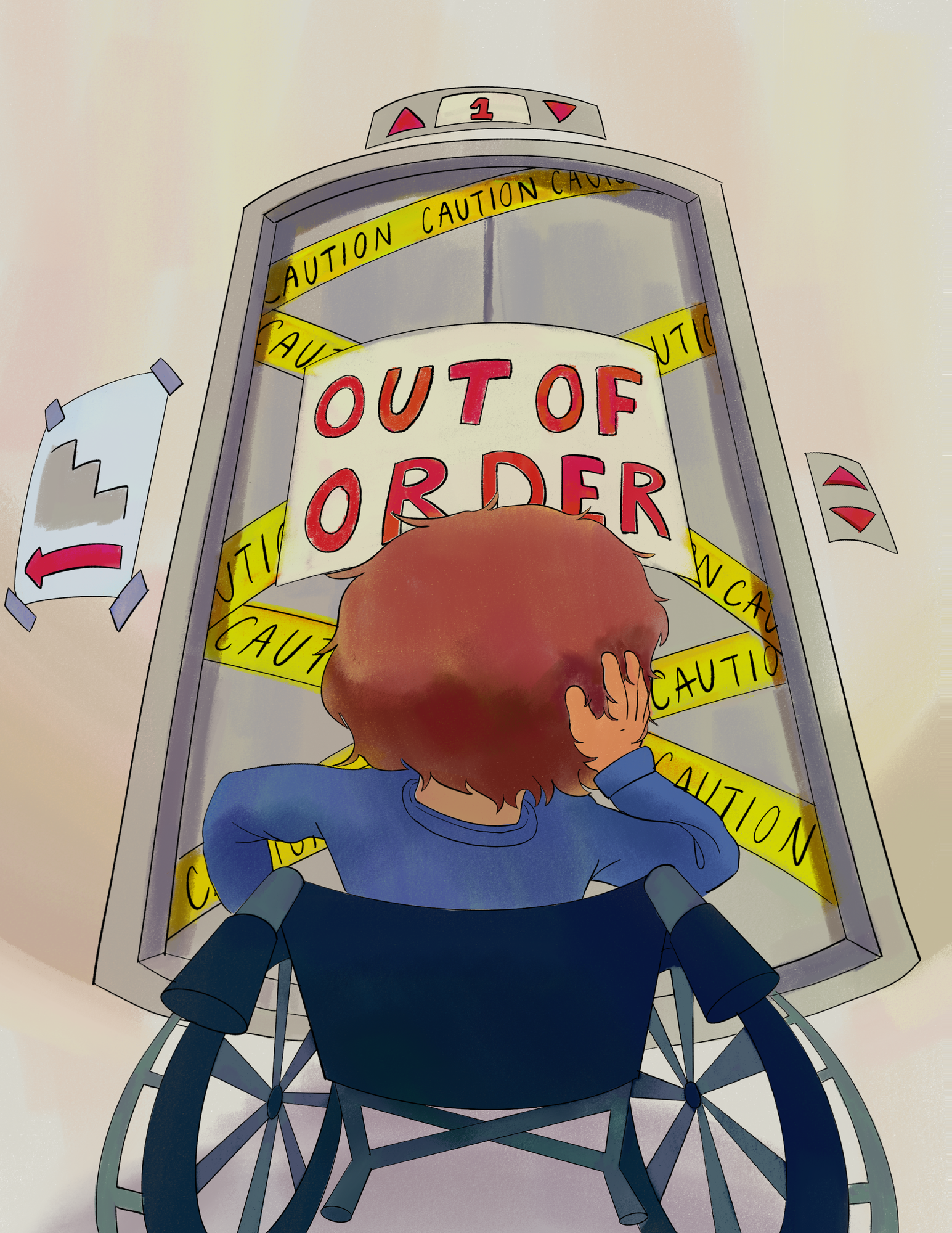
(Kirsten Matsumoto/Daily Bruin)

By Ayla Knorr
Feb. 4, 2026 7:23 p.m.
This post was updated March 1 at 8:30 p.m.
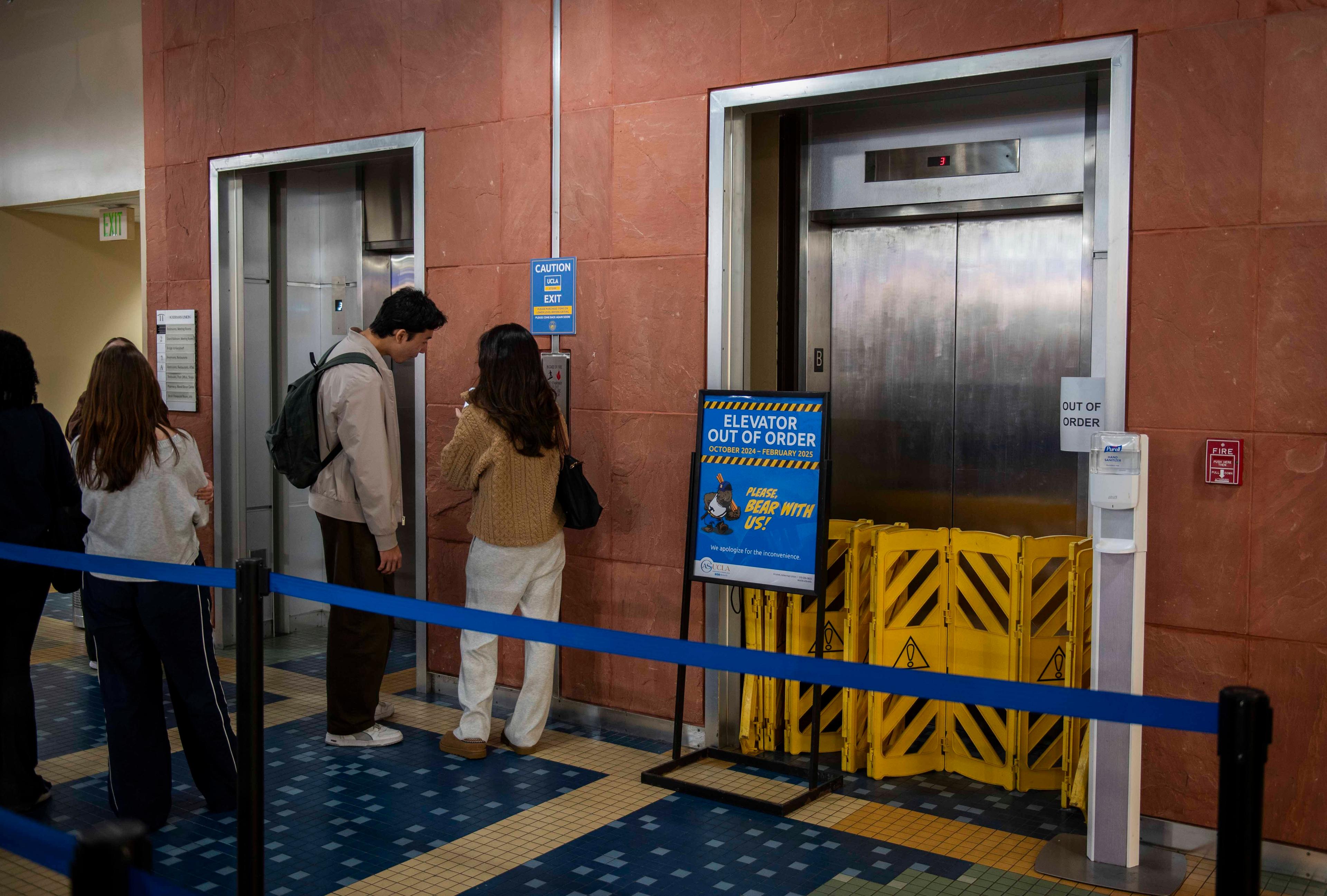
UCLA Parking Structure 2’s elevator has been out of service for at least two months, wrapped in a yellow barrier and marked by a small “Out of Service” sign.
This failure is not isolated.
In April 2025, The Bruin found widespread issues with elevator maintenance across campus and university housing, including stalled elevators, delayed inspections and prolonged elevator permit expirations. These problems left students trapped in elevators for long periods of time.
[Related: UCLA’s neglect of elevator maintenance limits campus accessibility]
For students who rely on elevators to move through campus, an “Out of Service” sign does not indicate a minor inconvenience. It creates a daunting sense of exclusion.
Even on a campus as large and hilly as UCLA, academic buildings, residence halls and parking structures often rely on few elevators to connect classrooms and housing. When those elevators break, students who cannot use stairs are left without a viable alternative route.
For many students with disabilities, broken elevators function as barriers to education itself. This is a failure that demands faster repairs, clearer communication and a broader understanding of accessibility.
Kush Brahmbhatt, a fourth-year molecular, cell and developmental biology and pre-disabilities studies student, said broken elevators are more common than most people realize and can take months to be repaired. He added that many campus buildings have only one or two elevators, forcing everyone to rely on the same limited access points.
“If you have a classroom on the third floor and there’s only one elevator in the building and it’s completely out, you pretty much can’t make it to class at all,” Brahmbhatt said.
The university presents staircases as reasonable temporary alternatives. That assumption ignores how dependent many students with disabilities are on elevators to access classrooms and residence halls. For students who use wheelchairs or have mobility impairments, stairs are not a detour – they are a dead end.
Brahmbhatt added that UCLA rarely communicates elevator outages directly to students who rely on them. In his experience, students often find out only when they arrive face-to-face with a broken elevator.
This lack of communication compounds the harm.
When outages are not announced clearly, students are forced to reroute or miss class and abandon plans entirely. Accessibility becomes something students must constantly plan around rather than something the university guarantees.
Lauren Clark, a professor in the Joe C. Wen School of Nursing who holds the Shapiro Family Endowed Chair in Developmental Disabilities Studies, said she has witnessed the consequences of accessibility failures firsthand.
She recalled a class visit from two community members who used motorized wheelchairs and became trapped inside a campus elevator when it broke.
The incident occurred during the class Nursing M172: “Care Work: Disability Justice and Health Care,” a setting meant to welcome people with disabilities to campus. Instead, it blatantly exposed how fragile that access becomes when infrastructure fails.
“They never showed up,” Clark said. “Why? Because they were trapped inside the elevator, and the elevator broke with them inside of it, and it took quite some time for them to be freed from their elevator.”
Clark said she has also taken community members with disabilities on UCLA’s accessible campus tour, where steep ramps, tight switchbacks and long distances drained wheelchair batteries before tours could even finish. Routes labeled as accessible often proved difficult or impossible to navigate.
Clark said these routes technically meet accessibility standards, yet remain quite impractical in reality, highlighting how the campus’s design ignores how people with disabilities actually move through spaces.
These experiences show that UCLA’s accessibility solutions only satisfy minimum legal standards without ensuring people with disabilities can actually use them. Compliance, in other words, is not the same as access.
“If it was a priority, it would be given the funding that other initiatives on campus get, and there just appears to be a separate set of priorities,” Clark said.
UCLA Facilities Management wrote Nov. 20 in an emailed statement that one of three elevators in Parking Structure 2 is currently closed for maintenance and that replacement work would begin the following week. The statement added that repair requests are prioritized based on the number of elevators servicing a location and noted that students can report outages through UCLA’s 311 app.
However, the sole focus on reporting systems and timelines misses the point.
Seventy-one of more than 80 elevators inspected between August and November 2024 were checked after their permit expiration dates. Some elevators went more than a month without inspection, while one permit remained expired for more than 600 days.
When a single broken elevator blocks students with disabilities from entire buildings, delays are not neutral. They actively restrict who gets to participate in campus life.
Moreover, accessibility extends beyond physical infrastructure.
Brahmbhatt pointed to inaccessible lab spaces, narrow doorways and rigid layouts that prevent students with disabilities from participating in research opportunities. Clark said access includes communication, learning environments and social spaces, not just ramps and elevators.
UCLA often promotes itself as inclusive and forward-thinking, but inclusion cannot depend on whether infrastructure happens to be working that day.
Access must be predictable to be meaningful. Planning routes, conserving energy and managing pain all depend on knowing whether elevators will function. Last-minute paper signs taped to broken doors do not, in any way, constitute adequate communication.
The “Out of Service” sign on Parking Structure 2’s elevator is small and easy to overlook, unless you depend on that elevator to get to class. Until UCLA treats accessibility as urgent rather than an afterthought, that sign will continue to mean the same thing for many students – not simply broken machinery but an exclusionary dead end.