Academic Senate report finds UCLA generates $400 million annual budget deficit
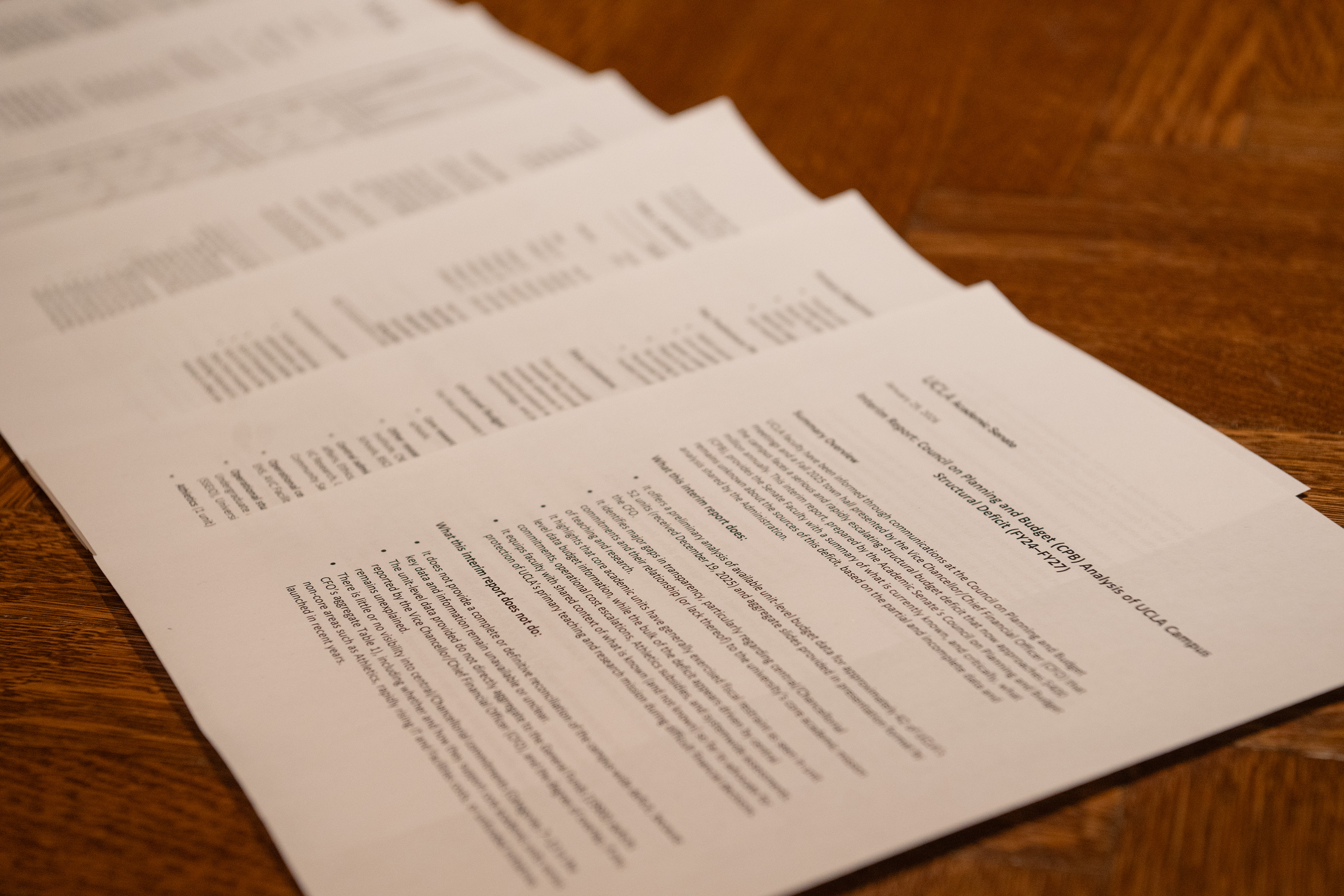
The Academic Senate Council on Planning and Budget’s 14-page report on UCLA’s budget is pictured. The council found that UCLA is generating a nearly $400 million annual deficit. (Leydi Cris Cobo Cordon/Daily Bruin senior staff)

By Natalia Mochernak
Feb. 5, 2026 10:05 p.m.
UCLA is generating a nearly $400 million annual structural budget deficit, according to a Jan. 29 Academic Senate preliminary report.
The report – created by the Academic Senate’s Council on Planning and Budget – said data provided by UCLA administrators showed that the university is projected to run a combined $829.7 million deficit across the 2025 and 2026 fiscal years if it has not taken and does not take any corrective action. The council prepared the report based on what it described as incomplete data from UCLA, following months of back-and-forth between administrators and the Academic Senate faculty who have called on the university to be transparent about its budget crisis.
The university previously was projected to run a $184.6 million deficit in 2024, according to the report. However, UCLA implemented one-time corrective measures – including a $60 million withdrawal from core academic savings and a central hiring freeze.
Despite those measures, UCLA is still running a deficit for the 2025 and 2026 fiscal years.
The main drivers of the deficit, the report said, include central commitments, operational cost escalations, accumulating subsidies to cover UCLA Athletics’ estimated $80 million annual deficit, and facilities and IT costs, according to the report.
Costs of academic instruction and research are not significantly impacting the deficit, according to the report. Academic units, the report said, have exercised “significant fiscal restraint.”
The CPB also alleged in the report that administrators originally told them the budget deficit for the 2025 and 2026 fiscal years was projected to be about $180 to $280 million but never provided reasons for the larger deficit or plans to mitigate it.
UCLA received about $1.6 billion in general funds – which includes state funding and gross tuition – for the 2024, 2025 and 2026 fiscal years, according to the report. Salary and benefits within the general funds increased by nearly $11 million from the 2025 to 2026 fiscal years, while academic and research support, priority programs and strategic initiatives were cut from $152.7 million to $74.3 million, the report said.
The council alleged in the report that the data did not clarify the amount of general funds generated through investments.
The unit-level data provided by APB indicated that UCLA’s 42 units contributed only about $15 million to the general funds deficit in the fiscal year 2025, according to the report – which the council said left uncertainty as to where the bulk of the deficit originates.
The council said in the report that it recommends UCLA conduct an Athletics subsidy review and freeze central chancellorial programs that do not correspond with the university’s academic mission.
UCLA Athletics’ move from the Pac-12 conference to the Big Ten meant UCLA had to pay a $30 million buyout fee over three years to UC Berkeley, which was moved to the Atlantic Coast Conference, to make up for revenue differences between the schools that resulted from the moves. The Los Angeles Times reported in January 2025 that UCLA gave Athletics more than $30 million in the 2023-24 fiscal year, not enough to cover the department’s annual deficit.
The council also recommended that UCLA consolidate administrative functions, defer non-academic projects and funnel funds to instructional support and research in the 2026-27 fiscal year. The council said in the report that these changes could save UCLA about $250 to $300 million while preserving more than 95% of core funds.
“University priorities must unequivocally center on protecting the core teaching and research mission,” the council said in the report. “Non-core commitments must be frozen, rigorously reviewed, and reprioritized—or deferred—until sustainable funding sources are secured and their impacts on academic units are fully understood.”
Chancellor Julio Frenk established the Executive Budget Action Group in November to mitigate UCLA’s budget deficit amid state and federal budget cuts. Frenk said in a Jan. 15 interview with the Daily Bruin that the group would share rationales behind financial decisions, such as cuts to specific programs.
[Related: Q&A: Julio Frenk condemns federal cuts, pledges future budget transparency]
Academic Senate Chair Megan McEvoy – who is the group’s faculty representative – said in a Jan. 23 announcement to Senate members that the group has met four times since December. Senate leadership has been told that the information discussed in the group is confidential, McEvoy said in a letter demanding financial transparency to Frenk and Darnell Hunt, external vice chancellor and provost.
[Related: Julio Frenk announces Executive Budget Action Group to manage UCLA’s monetary concerns]
UCLA Media Relations did not respond in time to a request for comment on the projected roughly $400 million annual deficit, its causes or how the school plans to mitigate it.
The Academic Senate is a campus governing body representing UCLA faculty. Its nearly 4,000 faculty members manage degree and enrollment requirements and advise UCLA administrators on personnel decisions.
The CPB – which includes up to 14 faculty voting members, Chief Financial Officer Stephen Agostini as an ex-officio member, one undergraduate student representative and one graduate representative – discusses budgetary and strategic issues with UCLA administrators.
The council alleged in the report that UCLA has not been transparent about its budget and has only communicated significant financial data verbally, adding that its investigation was based on “incomplete, fragmented data and working assumptions.” The university has not published a campuswide financial report since the 2022-23 fiscal year, the council added.
UCLA previously published the report in June of each given fiscal year.
The council said in the report that UCLA Academic Planning and Budget provided the data Dec. 19 for about 42 out of 52 of UCLA’s academic units from spring and fall 2025. Councilmembers received PowerPoint slides that they manually transcribed because they were not machine-readable, the council added in the report.
The council said the report’s information was bolstered by slides presented by Agostini, who is also a vice chancellor, at a Jan. 12 CPB meeting, which the committee said was not shared with members afterward.
“In the future, machine-readable data, explicit reconciliation methodology, and public dashboards are expected for effective consultation on budgetary matters,” the council said in the report.
The Senate passed a Dec. 3 resolution calling for Frenk and Hunt to include faculty in campus budgetary planning. It also urged administrators to provide the council with comprehensive financial documents for the 2024-25 and 2025-26 fiscal years, detailed documentation of all campus unit financial transfers and analyses of the impact of state and federal funding cuts on the university’s budget before Dec. 19.
The state deferred a nearly $130 million payment to the UC until July 1, 2026 in its final 2025-26 budget – but Gov. Gavin Newsom recently proposed pushing the payment an additional year. It also delayed a $240.8 million general funding increase for the UC to the 2027-28 fiscal year.
[Related: Proposed state budget includes $350 million increase to UC amid federal cuts]
The Trump administration suspended $584 million in federal research funding to UCLA in July, alleging that the university allowed antisemitism, affirmative action and “men to compete in women’s sports.” A federal judge reinstated the bulk of the grants in two decisions in August and September, but the decision will only hold while the case moves through the courts.
Frenk and Hunt said in a Dec. 18 letter to the Senate that they plan to release the financial report for fiscal year 2024-25 in March. They added in the letter that they will not release the 2025-26 report until March 2027, in accordance with “required schedules and information releases dictated by the UCLA Office of the President.”
“We appreciate the Senate’s deep investment in UCLA’s financial health and its commitment to ensuring budget decisions support our shared academic mission,” Frenk and Hunt said in the letter. “We welcome the opportunity to clarify where we are in the budget process, outline the information we can provide, and reaffirm the substantial engagement that has already occurred with Senate leadership and committees throughout this fiscal year.”
The Senate issued a Jan. 20 Corrections of Fact letter in response to Frenk and Hunt’s Dec. 18 letter, alleging that the administration has not been transparent and communicative about UCLA’s budget environment, as Frenk and Hunt claimed. It disputed claims from Frenk and Hunt’s letter – including that CPB and Senate leadership had already received detailed 2024-25 and 2025-26 data – and criticized the allegedly limited information that Agostini shared at CPB meetings.
UCLA Media Relations did not respond in time to a request to comment on the Senate’s allegations against Frenk and Hunt in its Corrections of Fact letter.
“Although CFO Agostini attends the majority of the two-hour CPB meetings for approximately 30 minutes, the time spent has not been productive because CPB does not receive documents for consideration,” the January letter said.
Agostini did not respond in time to a request for comment on his participation in CPB meetings and the materials he has shared with members.
The council also alleged in the report that data previously provided by administrators had major gaps – missing figures and detailed budgets from the David Geffen School of Medicine, Office of Campus & Community Safety, Intercollegiate Athletics, some Grand Challenges, DataX and several central units.
Grand Challenges are two large-scale UCLA research projects – including one dedicated to cutting depression’s impacts on human health by half and one focused on transitioning LA to 100% renewable energy. DataX is an initiative centered on reinforcing education and research in data science and other data studies across more than 40 different UCLA schools and divisions.
The Academic Senate asked Frenk and Hunt to provide the missing data outlined in the report by Jan. 26 in a separate Jan. 20 letter. The CPB said in the report that while Agostini provided them with a verbal presentation Jan. 26, Frenk and Hunt did not provide the additional requested data by the due date.
The Senate said Agostini’s information “recategorized expenditures across categories without further explanation,” but that his new data did not alter the main concerns of the report.
Frenk and Hunt said in a Jan. 26 response letter that all financial data provided by Agostini and APB is accurate, adding that they were the same materials UCLA used to brief UCOP, as well as Frenk and Hunt themselves.
“Given the complexity of the university’s financial structure and the varying levels of familiarity of CPB members with central budget constructs, the decision was made to rely heavily on detailed verbal presentations to walk through the tables, explain underlying assumptions, and respond to questions in real time,” Frenk and Hunt said in their letter. “In this context, additional written materials would not alter the substance of the information conveyed or the discussions that occurred.”
McEvoy did not respond in time to a request for comment on Frenk and Hunt’s Jan. 26 claims.