Financial mismanagement contributed to $425 million annual deficit, UCLA CFO says
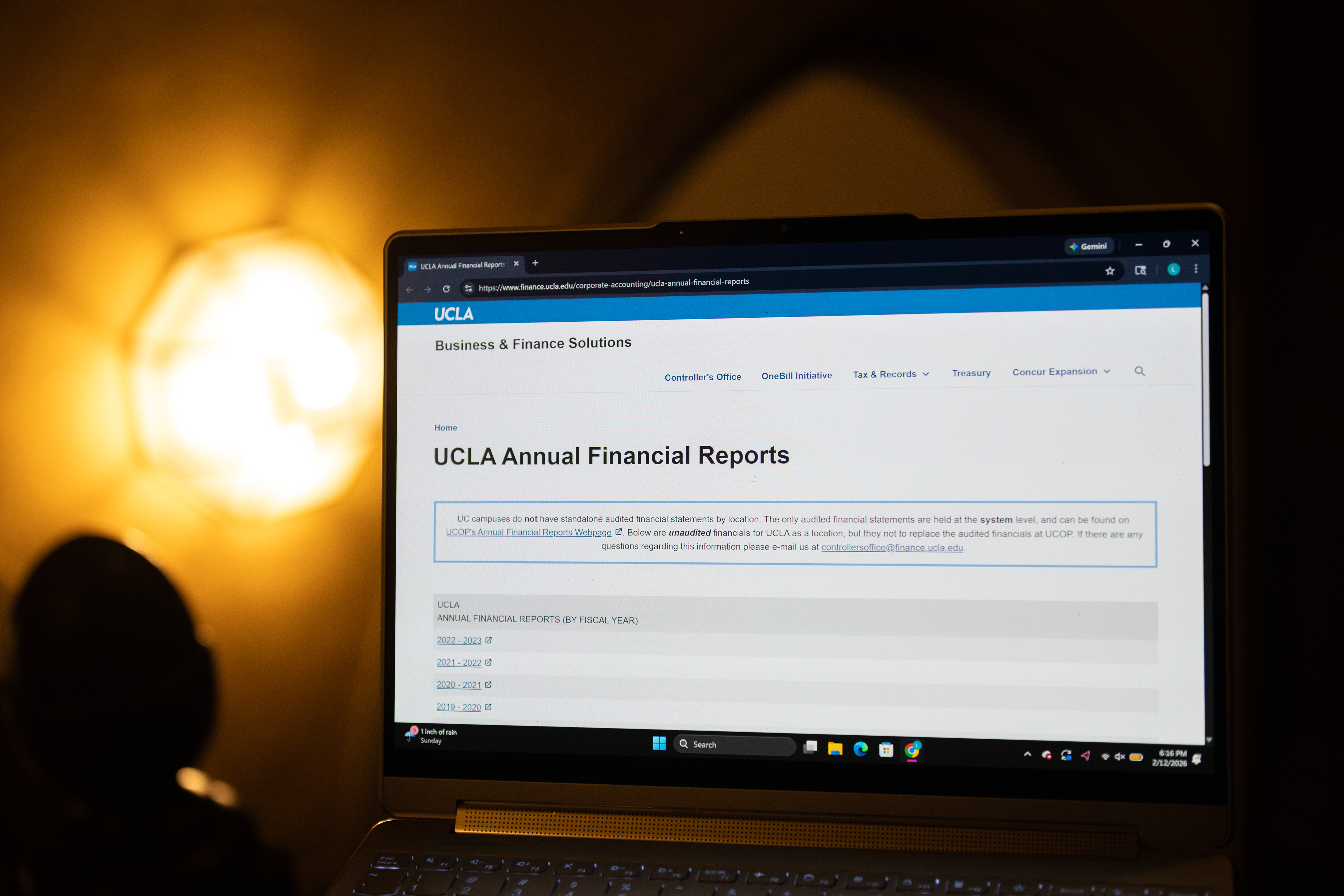
UCLA’s annual financial reports, which were posted from 2002 until 2023, are pictured on a laptop. Chief Financial Officer Stephen Agostini alleged that the reports were erroneous and unaudited, though the school made them seem otherwise. (Leydi Cris Cobo Cordon/Daily Bruin senior staff)

By Natalia Mochernak
Feb. 13, 2026 5:21 p.m.
This post was updated Feb. 21 at 9:52 p.m.
University administrators’ financial mismanagement contributed to UCLA’s $425 million annual deficit, UCLA’s chief financial officer alleged.
Stephen Agostini, who has been UCLA’s CFO since May 2024, alleged that the unaudited annual financial reports the university has posted on its website since 2002 are erroneous. UCLA has not posted the annual reports since the 2022-2023 fiscal year, coinciding with when Agostini became CFO.
Agostini said in an interview the UC Office of the President asked him to stop posting the misleading reports.
“I’m not in the habit of posting information that is incorrect,” Agostini said. “When I looked at that and saw very serious errors for how they were accounting for things, I made the decision, we are not posting something that is wrong. In my prior life, to post something like that is grounds for immediate dismissal.”
Agostini’s team recently added a message on the website with the reports saying that they are unaudited, Agostini said. He added that he had previously only shared the information in the message internally.
“I would prefer not to advertise how badly the place has been managed financially,” he said.
Agostini did not respond to an emailed question after the interview as to when he learned that the posted reports had incorrect information or which data points were incorrect.
He also did not respond to a question about which administrators were involved in the data’s posting.
“I want to clarify that my predecessors have been a welcome resource and providing background and suggestions and I have benefited substantially from their perspectives,” Agostini said in an emailed statement.
UCLA has reduced funding to programs – including certain academic departments, administrative units and campus resources – amid its budgetary shortfalls. The university also implemented a hiring review to approve all department-level positions, two vice chancellors announced in an Aug. 20 email.
[Related: UCLA professors express concern over new hiring review, limited student research]
The UC does not currently have stand-alone audited financial reports for each campus – however, it includes more general data, such as total operating expenses for each campus, in its full UC report.
Agostini said he plans to post UCLA’s financial reports for the 2023-24 fiscal year, but added that he does not intend to post the reports for the 2024-25 fiscal year until the end of the calendar year because UCOP must first review the data.
“I’m going to try to get those out,” he said. “Will I do a glossy one like that one (UCLA’s previous financial reports)? No.”
Agostini, who has worked as a CFO in several federal government offices and was the associate vice chancellor of finance and budget at the University of North Carolina, said UCLA’s financial state surprised him when he arrived. He added that he believes previous and current administrators have mismanaged the school financially.
“I spent a long time in the federal government. … I have rarely seen the kind of financial management flaws and failures that I see here when I got here,” he said. “There are days I’m still amazed how things got this way. I have to fix that.”
Agostini said he believes the Ascend Finance Transformation Project – a plan to modernize UCLA’s finances – is an example of UCLA administrators’ financial mismanagement.
The project – spearheaded by Agostini, Vice Chancellor of Research Roger Wakimoto and Administrative Vice Chancellor Michael Beck – was supposed to move UCLA from its current mainframe system to Oracle Cloud and upgrade all data business applications, according to the 2021 project charter. However, few concrete accomplishments have come out of the project.
Agostini said the project cost the school $150 million. The Daily Bruin reported in May 2025 that the project’s initial budget was $120 million, but the university spent at least $213 million on the project.
[Related: ‘One timeline after the other was not met’ – UCLA’s $213 million project is failing]
“We spent $150 million on the Ascend project, and we have nothing to show for it,” Agostini said. “That was a terrific waste of resources. So I stopped it and said, ‘We’re not spending any more money.’”
Agostini said in an emailed statement that he paused the project indefinitely, adding that it will no longer receive funding from the university. UCLA established a new executive committee to address its aging financial system, which will hold its first meeting Friday, he added.
Beck and Wakimoto did not respond in time to a request for comment on the Ascend project or whether they believe administrators have mismanaged UCLA’s finances.
Agostini said in a Thursday emailed statement that the project’s executive committee, rather than he alone, decided to pause the project.
“The project was complicated and I value the leadership provided by the co-sponsors of the project,” he said in the emailed statement.
Agostini provided financial data to the Daily Bruin that showed that UCLA is forecasted to generate a $425 million deficit for the 2025-26 fiscal year. The university is also projected to run a combined $905.4 million deficit across the 2025-26 and 2026-27 fiscal years if the school does not take any corrective action, according to Agostini’s data.
Agostini said UCLA’s budget shortfalls are likely to increase if certain academic and research support programs are renewed, as the current budget has them set to expire, and thus projects total costs to be $81.3 million for 2026-27, instead of the forecasted $133.4 million for 2025-26. If projects are renewed, the number would be closer to the 2025-26 figure, bringing the total deficit to over $950 million.
The school’s original projected deficit was previously lower, but Agostini said the school has recently received new requests from administrative and academic units for more funding. Data provided by Agostini showed the requests amount to $202.2 million for the 2025-26 fiscal year and $181 million for the 2026-27 fiscal year.
He added that they included requests for new positions within departments, expansions of existing programs and restorations of cuts that were made to balance the 2024-25 fiscal year budget. About 75% of academic units are running operational deficits, and some requested financial assistance, he said.
Agostini said he believes the rising cost of paying for faculty and service industry employee salaries have fueled UCLA’s budget deficit. Subsidizing UCLA Athletics – which runs an annual deficit of at least $80 million – is another contributing factor, he added.
“I inherited a debt structure that I would not have done were I in the seat,” Agostini said. “I would love to get out of that, but I don’t have as many options.”
Agostini said UCLA’s expenditure growth has increased at a much higher rate in comparison to its revenue growth in the last eight to nine years. Most of the UC campuses have similar challenges, he added.
Compensation for UCLA staff has increased $252 million from fiscal year 2020 to fiscal year 2025, according to documents provided by Agostini.
School staff – which includes deans, faculty, human relations and finance for each school – had salary increases totaling 29% or $183 million from 2020 to 2025, according to the documents. Administrative unit salaries also increased $46 million, or 34%.
“There has been an observation made that the reason we have this problem is that their growth has been solely in administrative units,” Agostini said. “That’s not correct. It really has been in schools.”
Agostini said his top priority as CFO is to create a balanced budget. He added that he is considering different potential revenue streams, such as leveraging investment income more productively, reviewing expenditures and duplications, increasing school enrollment and reducing university costs without impacting UCLA’s academic mission.
“If I don’t get this balanced, we can’t do anything else,” he said. “We can’t protect ourselves from the (Trump) administration. We can’t ensure that we’re delivering instruction.”
UCLA was originally projected to generate a deficit of $230.9 million in fiscal year 2024-25, but took corrective actions totaling $267.1 million, leaving the school with a $36.2 million surplus, Agostini said.
However, Agostini added that these corrective actions are often unpopular, and that he has no finalized plans to balance the budgets for the 2025-26 or 2026-27 fiscal years.
“The best way to say it is that it doesn’t necessarily generate consensus, because it means, in some cases, expenditures have to be reduced and understandably, people don’t want that to happen,” he said. “We are at a point where nothing we do will be easy. There are approaches we can take that will, in my view, be appropriate given the scale of the problem, but also that we want to preserve at the core what we are doing in terms of instruction, so that the impacts of this to students are as close to zero as possible.”
Agostini also said he is currently looking at how long UCLA can continue to function and meet payroll without developing a cash reserves problem, as the school is currently spending money it does not have. He added that he is analyzing potential longer-term investments to generate higher income.
“Fundamentally, my office has to function better,” Agostini said. “We have to do a better job. We have to be better partners. We have to balance the budget and stabilize our finances. We have to introduce and make sure that financial management practices across the university are the best that they can be. And then we got to find other industries.”