Film review: ‘Michael’ delivers dazzling dances but poor, omissive writing
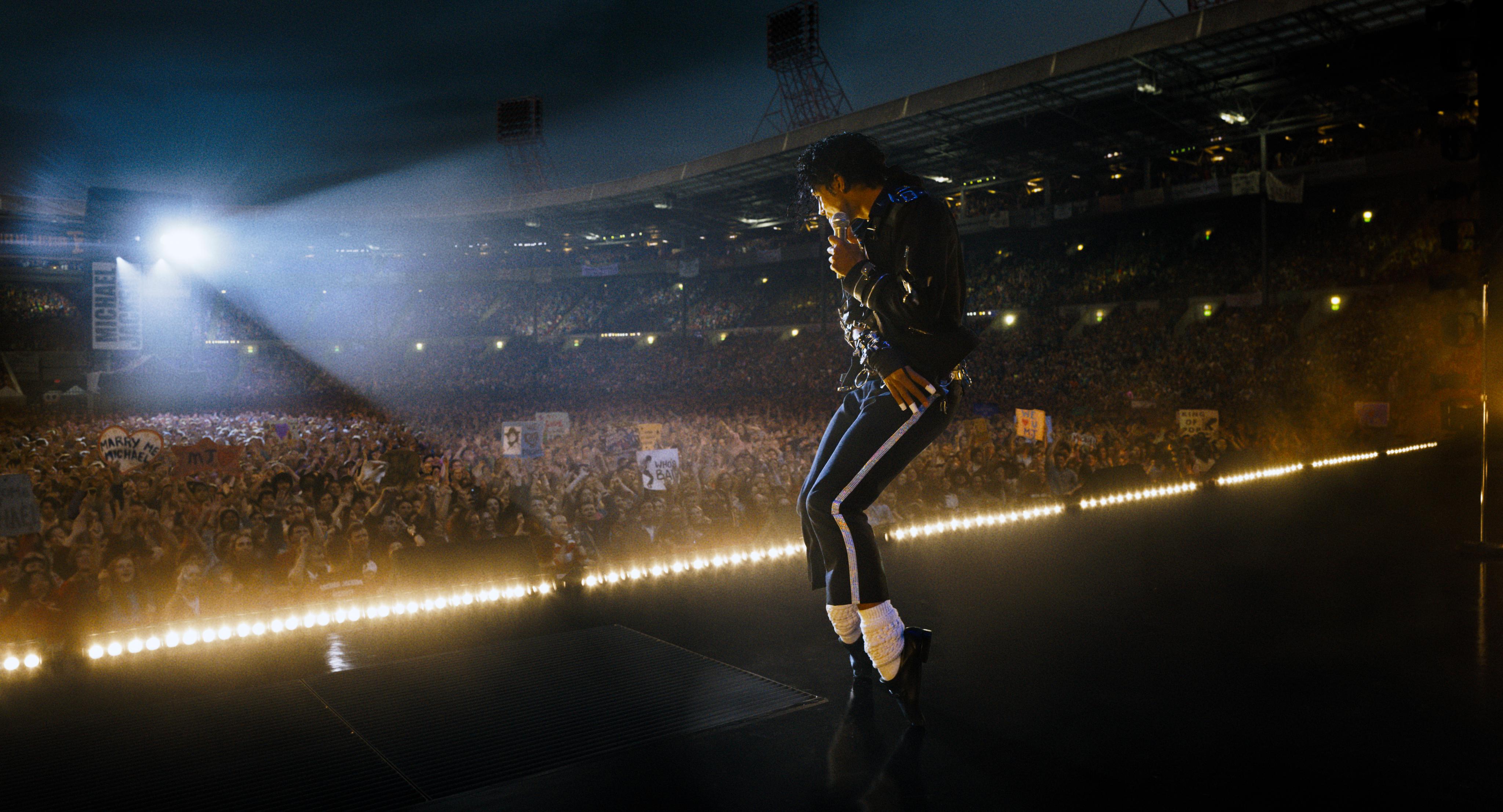
Jaafar Jackson, who stars as his uncle Michael Jackson, poses on his toes as a massive audience cheers behind him. “Michael,” directed by Antoine Fuqua, was released April 24 by Lionsgate and follows the 13-time Grammy winner from 1966 to 1988. (Courtesy of IMDb)
“Michael”
Directed by Antoine Fuqua
Lionsgate
April 24


By Reid Sperisen
April 28, 2026 1:06 p.m.
This post was updated April 28 at 9:21 p.m.
Editor’s note: This review contains mentions of physical and sexual abuse of children.
Warning: Spoilers ahead.
“Michael” captures the glory of the King of Pop’s stage presence but fails dismally at meaningfully telling his story.
It has been almost 17 years since Michael Jackson died at the Ronald Reagan UCLA Medical Center after a cardiac arrest at 50. Now, part of his life is being told on the big screen with “Michael,” directed by Antoine Fuqua and starring Michael Jackson’s nephew Jaafar Jackson in the titular role. The film – released April 24 by Lionsgate after several production delays – follows the 13-time Grammy winner from 1966-88. While successfully entertaining viewers with well-choreographed musical moments that celebrate the late superstar’s showmanship, “Michael” is undone by an abominable screenplay that fails to provide any depth to its subject, as would be expected in the musical biopic genre.
The film begins and ends with Michael Jackson performing at Wembley Stadium in 1988 to rapturous applause before leaping back to spend its first half hour in Gary, Indiana. At 8 years old, young Michael Jackson, played by Juliano Valdi, and his brothers are trained relentlessly by demanding family patriarch Joseph Jackson, played by Colman Domingo, as they prepare for future stardom as The Jackson 5. While these early scenes establish the complicated relationship between Michael Jackson and his father – including the physical abuse the singer suffered at his father’s hands – the brisk time jumps to 1971 produce zero tension. Instead, the band scores chart-topping singles such as “I Want You Back” and “ABC” with seemingly relative ease.
The inevitability of Michael Jackson’s success becomes a recurring pattern as the film progresses, jumping to 1978 as he records his hit 1979 album “Off the Wall.” While his resilience through a difficult childhood is undeniable, the story remains thoroughly confused about who its star is – a charming underdog hustling to break through, or a prodigal talent predestined for the highest tier of fame. As a result of this inconsistency, the sheer magnitude of Michael Jackson’s accomplishments – which included 13 solo number-one singles and over 500 million records sold – are shuffled into the background to create space for a plethora of superfluous scenes involving banal business meetings and repetitive lectures from his father.
[Related: Film review: ‘The Drama’ transcends genre, themes with intentional production, storytelling]
The weakest part of the film is the abhorrent screenplay by John Logan, whose resume – with three Oscar nominations for his screenwriting – suggests he should be capable of superior filmmaking. Logan needs to sharpen his storytelling skills dramatically, because the dialogue of “Michael” feels cringe-inducingly contrived. Michael Jackson repeatedly emphasizes his desire to honor his family and unite people through the power of music, but these messages are delivered so lazily that they cheapen any artistic integrity the musician possessed. Viewers can be forgiven for feeling nauseated by more clichés than a Hallmark movie.
Some moments in the film feel more evocative, such as when Michael Jackson gets his first rhinoplasty to try to look more “perfect.” Many sequences underscore Michael Jackson’s loneliness by placing him with a computer-generated pet chimpanzee as a companion, but this is the extent of the character development the pop titan receives. Two-time Oscar nominee Domingo delivers the strongest acting behind heavy prosthetics, but even he cannot outrun the limitations of the one-dimensional characterization afflicting the entire cast. A quick glance at Michael Jackson’s Wikipedia page probably yields a greater sense of his personality than Logan imbued into this pathetic script.
In spite of such misguided writing, there are some key production components working in the picture’s favor. The costume design from Marci Rodgers is consistently excellent, transporting audiences to the discotheques of the 1970s before beautifully rendering some of Michael Jackson’s most iconic leather jackets and bedazzled gloves. Likewise, the sound design has to be praised for its immersion, seamlessly merging Jaafar Jackson’s vocals with his uncle’s voice to create the illusion that archival footage of Michael Jackson himself is being played during highlights such as “Wanna Be Startin’ Somethin’” and “Don’t Stop ‘Til You Get Enough.”
The film is at its best when leaning directly into concert film tropes, using footage zoomed in close on Jaafar Jackson as he perfectly replicates his uncle’s signature dance moves. Michael Jackson’s “Motown 25: Yesterday, Today, Forever” performance of “Billie Jean” – where he popularized the moonwalk dance move – is especially electric, as is the finale number “Bad.” Other legitimately enjoyable sequences arrive in intricately choreographed routines displaying the making of the music videos for “Beat It” and “Thriller.” Collectively, the film relies entirely upon the strength of Michael Jackson’s discography to provide compelling nostalgia. Without such irresistible grooves to buoy its energy and fill its runtime, any semblance of a motion picture would collapse altogether.
[Related: Film review: ‘Project Hail Mary’ is a stellar adaptation worth watching]
The decision to leave out accusations of child molestation against Michael Jackson is understandable – the allegations first emerged in 1993, after the time frame in which “Michael” is set – but still uncomfortable. Such an omission has drawn the ire of many critics, but with the shallowness of Michael Jackson’s portrayal in the time period the film covers, it is probably for the best that the allegations were not included. As with every other underbaked plot point, such content likely would have been glossed over to get to the next concert scene.
Still, such an unavoidable part of Michael Jackson’s legacy looms off-screen as “Michael” tries to force-feed viewers with a feel-good family movie. It’s an unsettling feeling, especially knowing how valuable Michael Jackson’s catalog remains even after his death – the publishing rights for half his estate were sold in 2024 for $600 million. The film’s removal of any rough edges to Michael Jackson seems tailored to maximize future profitability from his image. The issue with musical biopics like this is the implication to audiences that this is an accurate portrayal of the artist’s life, rather than a theatrical production embellishing some details to fit a narrative.
On the whole, “Michael” manages to transmit some of the magic of Michael Jackson’s music, but never elicits more insight about the man behind the legendary tunes. It would probably be even more informative to watch two hours worth of Michael Jackson videos on YouTube – at least those have some possibility of revealing a person behind the gargantuan celebrity.
Not only do viewers deserve more when heading to the theater, but the King of Pop deserved a better retelling of his peak years.