LA Opera’s ‘Akhnaten’ slowly submerges viewers in sound, detailed visuals
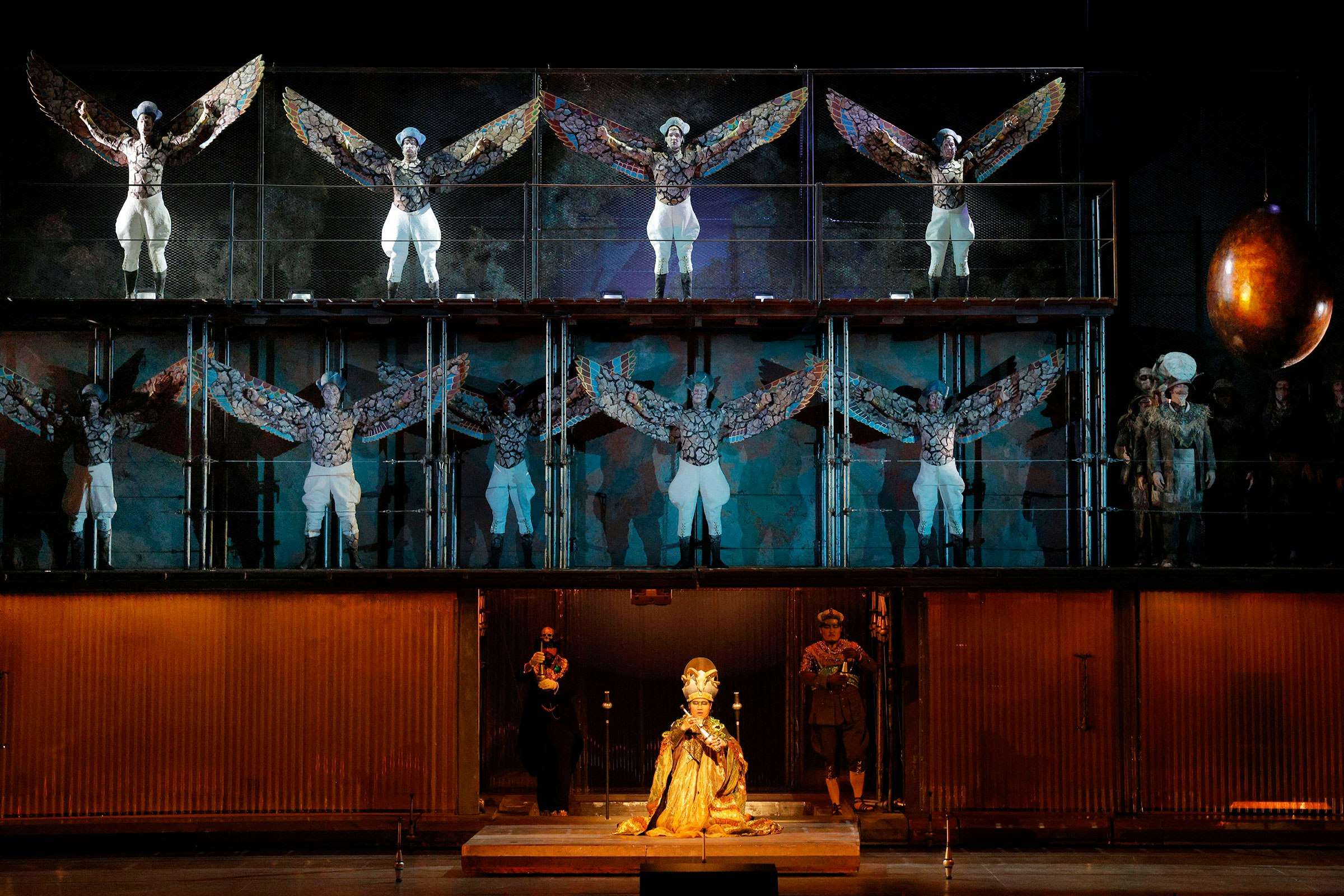
Yuntong Han (center) as the High Priest of Amon sits glowing in a golden hue as the winged ensemble stands in two rows above him. The LA Opera’s newest show, “Akhnaten” will be performed at Dorothy Chandler Pavilion Feb. 28-March 22. (Courtesy of Cory Weaver/LA Opera)
“Akhnaten”
Feb. 28-Mar. 22
Dorothy Chandler Pavilion


By Eleanor Meyers
March 8, 2026 8:45 p.m.
As an audience member accurately put it, “Akhnaten” is quite a trip.
Curtains rose on the LA Opera’s newest masterpiece at Dorothy Chandler Pavilion Feb. 28, where it will remain until its sweeping finale March 22. The opera – sung in English, Ancient Egyptian, Biblical Hebrew and Akkadian – runs for approximately three hours, includes two intermissions and features a cast of 13 actors supported by an over 40-piece ensemble. Epic in both scale and sound, director Phelim McDermott’s show maintains his renowned flair for impact through twirling acrobats, spellbinding jugglers and expansive sets. The opera, written by American composer Philip Glass in 1984, easily transports audiences to Ancient Egypt as it recounts the tale of a doomed pharaoh facing the triumphs and foibles of his 17-year rule. Featuring an ethereal atmosphere, jaw-dropping visuals and music now adapted for the New York City Ballet and even Netflix’s “Stranger Things,” “Akhnaten” may have moved in slow motion but its overwhelming success is likely to spread at lightspeed.
Act One establishes the first year of Akhnaten’s reign, set in the powerful upper capital of Egypt, Thebes. Following the sacramental death of his father, which features words recited from the Egyptian Book of the Dead, the titular pharaoh is crowned and pronounces his intentions to form a monotheistic religion. Named after Aten the sun god, Akhnaten then spends years five to 15 of his rule (Act Two) building a new city – “The City of the Horizon of Aten” – where he imposes the new system of faith. In the opera’s final and most dramatic act, Akhnaten and his wife Nefertiti dwell in their insular, self-designed world with their six daughters. They begin to receive letters expressing worry about the pharaoh’s ongoing isolation. With great turmoil and spectacle, Akhnaten is attacked and assassinated while a swarming, mutinous mass pulls his wife and mother away.
[Related: Theater review: ‘West Side Story’ hits right notes as timeless tragedy with contemporary topics]
Above plot strength or character development, “Akhnaten” seems to pride itself most on its extravagance. Without subtitles, the opera’s storyline may be a bit muddled for audiences unfamiliar with the narrative – though the skillsets on stage undoubtedly captivate any viewers on the fence. Fluctuating between countertenor John Holiday as the lead, mezzo-soprano Sun-Ly Pierce as queen Nefertiti, soprano So Young Park as dowager Queen Tye and Grammy winner Zachary James as narrator Amenhotep III, the spotlight is equally shared – and rightfully so.
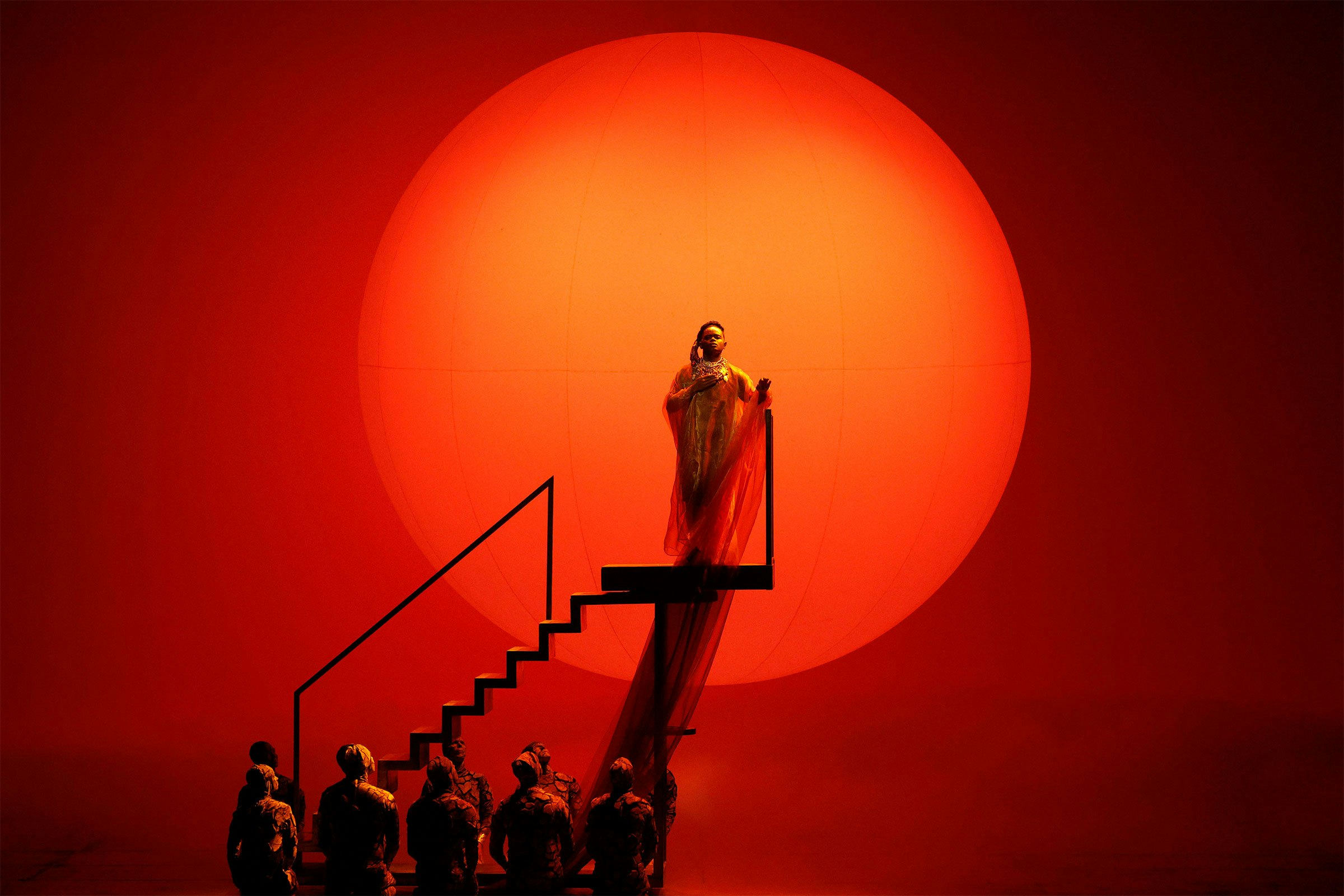
Supporting these enriching performances is Glass’ pensive composition, led by Ukrainian-born conductor Dalia Stasevska. This appropriately reflects the show’s distant and contemplative imagery. For instance, as Akhnaten is “birthed” from a mummy case in Act One – totally nude – and dressed by a dozen attendants. The orchestral support evokes the ideal combination of apprehension and curiosity. Again in the second act, two dreamy extended pieces – a hypnotically rich duet for Akhnaten and his love Nefertiti as well as a solo of the pharaoh worshipping Aten – exemplify the composer’s staggering work yet again.
Given the musical aptitude of “Akhnaten,” however, it is startling to realize only about two-fifths of the show offers operatic numbers despite the cast’s impressive singing capabilities. This is likely due to the show’s categorization as a minimalist opera – a modern style of classical music developed in the early 1960s by the likes of Glass and his contemporaries. While Glass may describe himself as a composer of “music with repetitive structures,” the gaping lack of singing appears to be more of a weakness than an artistic decision.
[Related: Theater review: Flawed foundation, confused goals cause ‘Sylvia Sylvia Sylvia’ to fall short]
The real star of the show, however, shines as the costume design, which was developed by Manchester-trained freelancer Kevin Pollard. A lecturer in costume design and production, Pollard is also an award-winning painter and portrait artist. This versatility comes to life within the detailed glamor of the cast’s attire. On each performer, the costumes shimmer with a detailed, glistening extravagance. Each elaborate garment is layered with jewels, textures, and sculptural shapes that feel both decadent and historically in-touch. Flowing fabrics and ornate silhouettes offer the show movement and sensuality, turning every entrance into a vibrant spectacle of color and light. The visual splendor of the costumes holds the power to make or break a show, and Pollard’s radiant designs successfully breathe life into “Akhnaten.”
Equally fantastical is the set design, where a towering structure of tri-level scaffolding stretches nearly floor to ceiling and frames the action with a sense of monumental ambition. Much of the performance unfolds along a narrow strip of stage before this shifting backdrop – an architectural echo of Akhnaten’s grand temple-building visions. Around it, colorful fabrics sweep across stage, transforming the space with movement that feels both creative and simple. Director McDermott heightens the sense of spectacle with a troupe of jugglers, their precise patterns offering one shock after another as they weave through the courtly scenes. Crucially, Bruno Poet’s lighting production washes the stage in a brilliant, glowing palette – creating a dreamlike memory of an ancient world. The pinnacle, a massive hanging lantern which pulses between colors as the performers are framed in its light, shows a visual language as hypnotic and expansive as the music itself.
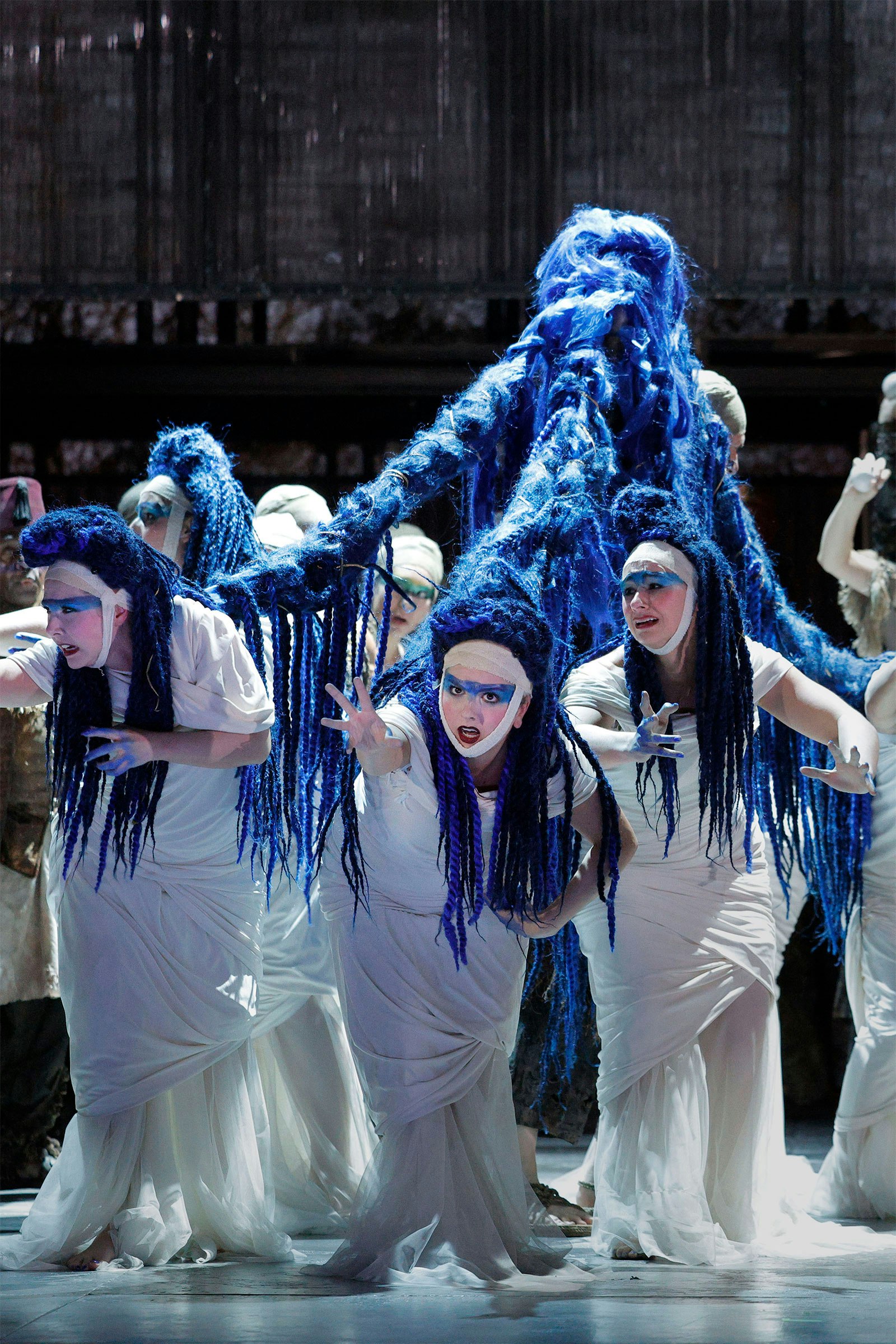
Yet the movement onstage often proves to be far less enchanting. Following particularly long, draggy scenes, one cannot help but wonder: Why is everyone moving so slowly? The dreamlike pacing may have aimed for ritualistic grandeur, mimicking the formal flatness of papyrus paintings, but the lag instead made the show feel almost painstaking at times. Characters drifted across the stage in glacial, lateral motions that lost viewer’s attention and took away from the impact of the opera itself. Though the ever-present jugglers injected bursts of rhythmic life, the principal choreography felt far less imaginative. What could have been meditative instead became dreamlike but tired, stretching moments well past their natural life. In truth, the show could have been an hour shorter than it was.
[Related: Concert review: Del Water Gap’s vocal, emotional range both intimate and loud at The Wiltern]
Ultimately, in the landscape of modern opera, minimalist works carry a particular cultural weight. Few loom as large as “Akhnaten.” Glass’s seminal opera has arrived with an undeniable sense of timeliness, especially following the composer’s recent withdrawal from the planned premiere of his “Symphony No. 15, ‘Lincoln’” at the John F. Kennedy Center for the Performing Arts. In “Akhnaten,” Glass strips opera to its elemental form. Drawn from Egyptian religious texts, the Amarna letters and Psalm 104, language transforms into pure sound and atmosphere rather than literal meaning. The result is a show that moves not through narrative urgency but through scale – celebrating the sheer weight and size of the experience itself. Minimalism, in this context, becomes less about simplicity and more about immersion. It asks audiences to sit with vast stretches of history and sound. Within the broader art world, “Akhnaten” stands as a towering example of how minimalist opera can reshape expectations of storytelling, turning repetition, ritual and spectacle into something quietly monumental.
Melancholy and magnificent, “Akhnaten” unfolds with an air of quiet inevitability – its oracular texts and elegantly soft music linger long after the final note fades. McDermott’s show is a visually arresting and intellectually rigorous production that fully leans into its pacing and repetition. Much of the production’s vitality springs from continuous visual invention: constant shifts in staging, striking tableaux and the playful movement of the ensemble make it so the viewer’s eyes never rests. The opera ends without flourish or resolution, leaving its final image hanging as the curtain drops. In this simple close, the magnitude of the production finally settles in.
Expanding attention spans and enthralling audiences, the LA Opera’s “Akhnaten” is an unforgettable testament to the impact of modern theater.