UC Academic Senate to consider SBAC as potential SAT, ACT alternative

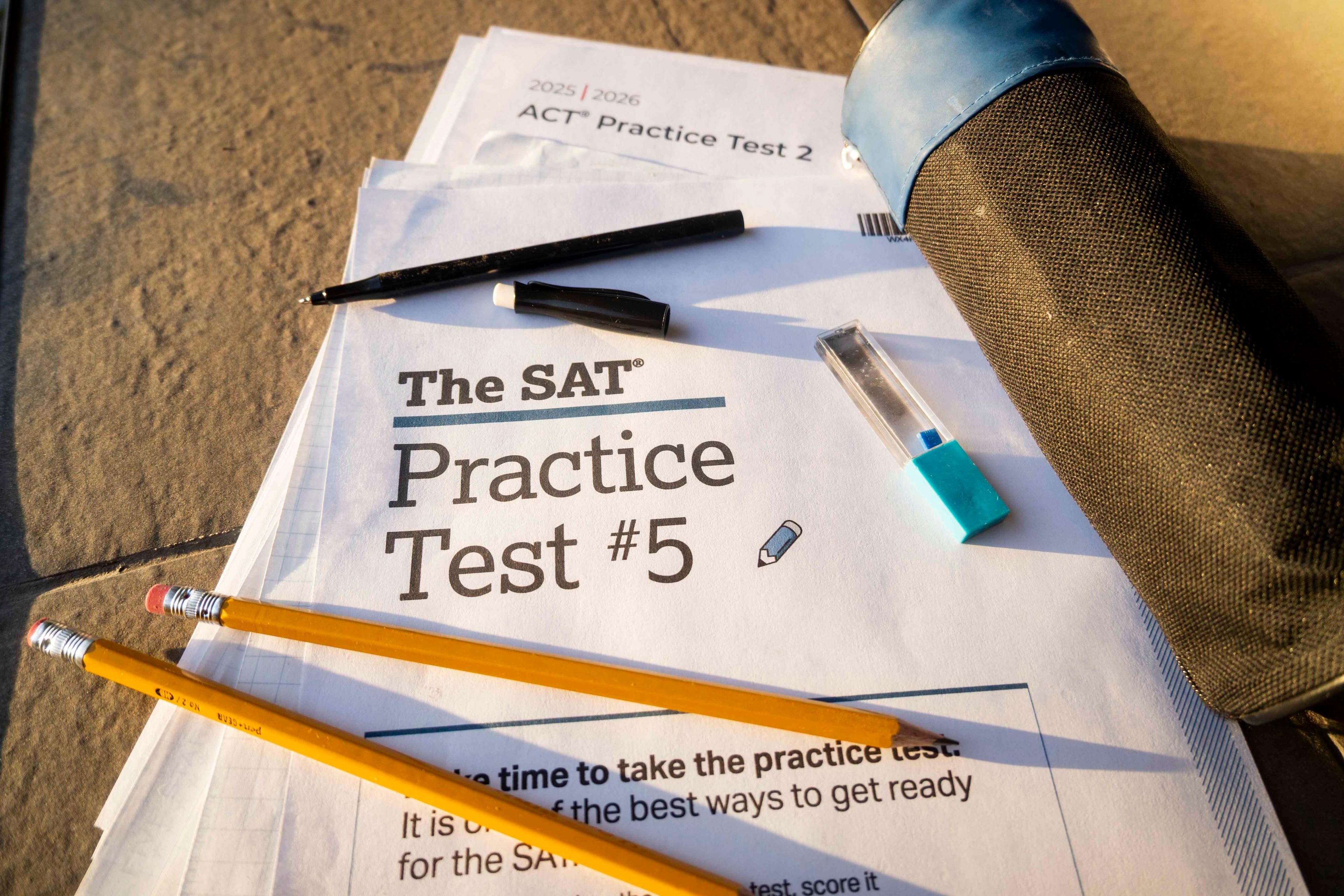
A photo illustration of the Smarter Balanced Assessment Consortium and SAT test prep books is pictured. The UC is considering using the SBAC test, in addition to the SAT and ACT, for first-year undergraduate admissions. (Photo by Crystal Tompkins/Daily Bruin senior staff. Photo illustration by Haley Park/Illustration & Cartoons director)

By Nora Gallagher
Sept. 17, 2026 9:14 p.m.
The UC is considering introducing an alternative standardized test in addition to the SAT and ACT for first-year undergraduate admissions.
The UC Academic Senate will decide whether or not to recommend reinstating the SAT and ACT for undergraduate admissions by June 2027. The University stopped requiring SAT and ACT scores for first-year admissions in 2020 during the COVID-19 pandemic before ultimately becoming test-blind.
[Related: UC Academic Senate to decide on recommending SAT, ACT reinstatement by June 2027]
As part of the senate’s evaluation, the UC Board of Admissions and Relations with Schools will reassess the merits of using the Smarter Balanced assessment, which is administered to all 11th grade students in public high schools in California and 11 other states and territories.
Smarter Balanced tests evaluate proficiency in math and English by categorizing students into one of four levels. Students at or above Level 3 are deemed ready for college and career success based on their scores on a scale of approximately 2,000 to 3,000. The tests are created by the Smarter Balanced Assessment Consortium and fall under the California Assessment of Student Performance and Progress, California’s statewide student testing system.
The review of the SBAC comes after more than 3,000 UC STEM faculty signed a May letter urging the University to reconsider its standardized testing policy, alleging that students lacked math readiness. Humanities and social science faculty signed a separate letter in June calling on the UC to consider reinstating the verbal reasoning portions of the SAT and ACT in admissions.
[Related: Hundreds of UC faculty call to reinstate SAT, ACT requirements for STEM applicants]
The UC Academic Senate is considering multiple options as part of its standardized testing review, said Stett Holbrook, a UC Office of the President spokesperson, in an emailed statement.
In 2020, then-UC President Janet Napolitano assembled a work group to consider using the SBAC to replace the SAT and ACT for first-year UC undergraduate admissions. The group voted against the proposal, arguing in its 2021 report that converting the SBAC into a high-stakes test would reproduce the same inequities as the SAT.
The SAT and ACT, both pay-to-play exams, have posed equity concerns for students from low-income backgrounds or with limited access to preparatory resources, according to the work group’s 2021 report.
[Related: UC’s consideration of standardized testing return raises preparedness questions]
Proponents of the SBAC note that the test is free, aligns with Common Core standards and is convenient because it is already administered at California public schools, said Julian Betts, a professor of economics at UC San Diego.
Linda Darling-Hammond, president of the California State Board of Education, added that the SBAC emphasizes performance-based questions that she believes are a more accurate measure of students’ readiness than the SAT and ACT, whose multiple-choice questions do not encourage students to analyze, evaluate, reason and argue.
“There’s no job that you can take where you go to the office in the morning and fill out a multiple choice test,” she said.
Unlike the SAT and ACT, the SBAC’s Performance Tasks encourage students to engage in higher-order thinking, Darling-Hammond said. One question might prompt students to interpret and solve mathematical constraints from word problems, while another might request an argumentative essay based on analysis of multiple sources, according to questions from two 2019 practice SBAC exams.
However, introducing the SBAC in UC admissions might not fully address equity concerns, Betts said.
Because the SBAC is primarily used to evaluate and rank high schools, students’ scores do not impact them personally and the test feels low-stakes, said Natasha Roberts, a math teacher at Archie Williams High School in San Anselmo, California.
“It was kind of a joke at our school,” said Henry Sethre, a fourth-year genetics and genomics student at UC Davis who previously took the SBAC at Archie Williams. “I just breezed through it as quickly as possible.”
But raising the stakes of the SBAC could favor students with additional resources by encouraging paid preparatory courses, multiple retakes and private tutoring, said Pamela Burdman, the executive director of Just Equations, a nonprofit organization dedicated to educational equity.
“The biggest worry with using a test such as the SBAC would be that, would it develop a culture similar to the culture that we now have around the SAT?” Burdman said.
Moreover, placing more weight on the exam would require schools to expand the exam’s limited test bank, which would make the current exam easily gameable, Betts said.
“If those questions become exposed and shared around, it becomes possible that the test will lose its validity over time,” Betts said.
Safeguarding the SBAC’s validity by bolstering the test bank would require the UC to spend significant funds on psychometricians, who test questions for validity, reliability and cultural biases, he added.
Another complication of implementing the SBAC is that it cannot evaluate minute differentiations between high-performing students, Roberts said. While the SAT provides a finely scaled range within the upper end of scores, the SBAC merely classifies students as proficient or not proficient, she added.
Though the SBAC is limited, it can be used as an effective admissions tool by helping universities determine whether a student is eligible for admission to certain math-intensive majors, Betts said.
“If you’re applying to a given major, which has a given level of mathematical rigor, there’s a cut score on Smarter Balanced,” Betts said. “If you have proficiency at or above that level, then you’re in the pool to be admitted. And if you’re below that, you’re not.”
The California State University system currently uses the SBAC to place first-year students in general education math and English courses as part of its Early Assessment Program, Darling-Hammond said.
While Betts holds hope for the SBAC’s implementation, and precedent exists at other universities, some students are concerned.
Rebranding the SBAC as a high-stakes exam might reduce its efficacy as an accurate benchmark of student comprehension, said Aditi Hariharan, the former president of the UC Student Association and a UC Davis alumnus. Rather than measuring changes in learning by accurately evaluating students’ knowledge, the test might simply become an indicator of how well students can study, she added.
UCSA President Candice Phan said she believes the UC should focus on supporting educational outreach programs at California K-12 schools instead of investing more resources into the SBAC. The UC should work to dismantle learning barriers emphasized by increased technology, social media and AI use, she added.
“The education ecosystem hasn’t made a concrete definition as to what their stance is on AI, which is concerning,” said Phan, a fourth-year sociology student at UC Davis. “Rehashing this conversation about standardized testing is distracting from this larger issue.”
Angela Ledesma-Grattarola, the academic affairs commissioner for UCLA’s Undergraduate Students Association Council, said she believes all standardized tests create barriers for students who do not have access to preparatory resources.
She called on the UC to focus instead on bolstering post-admission resources to help students become more academically prepared.
“How are we ensuring that we’re making and creating the best possible opportunities and resources for our students so that they can not only learn better, but they can be enthused by what they’re learning?” said Ledesma-Grattarola, a fourth-year political science, public affairs and sociology student.
Burdman added that the University’s goal in making admissions decisions should be more than just identifying the students who perform the highest academically.
“The purpose of the UC system as a public university is to serve the broad diversity of students across the state,” she said. “That means not just students who are the best in math or have the highest scores on a specific test, but students who bring a lot of skills and talents to their education.”