UC’s consideration of standardized testing return raises preparedness questions
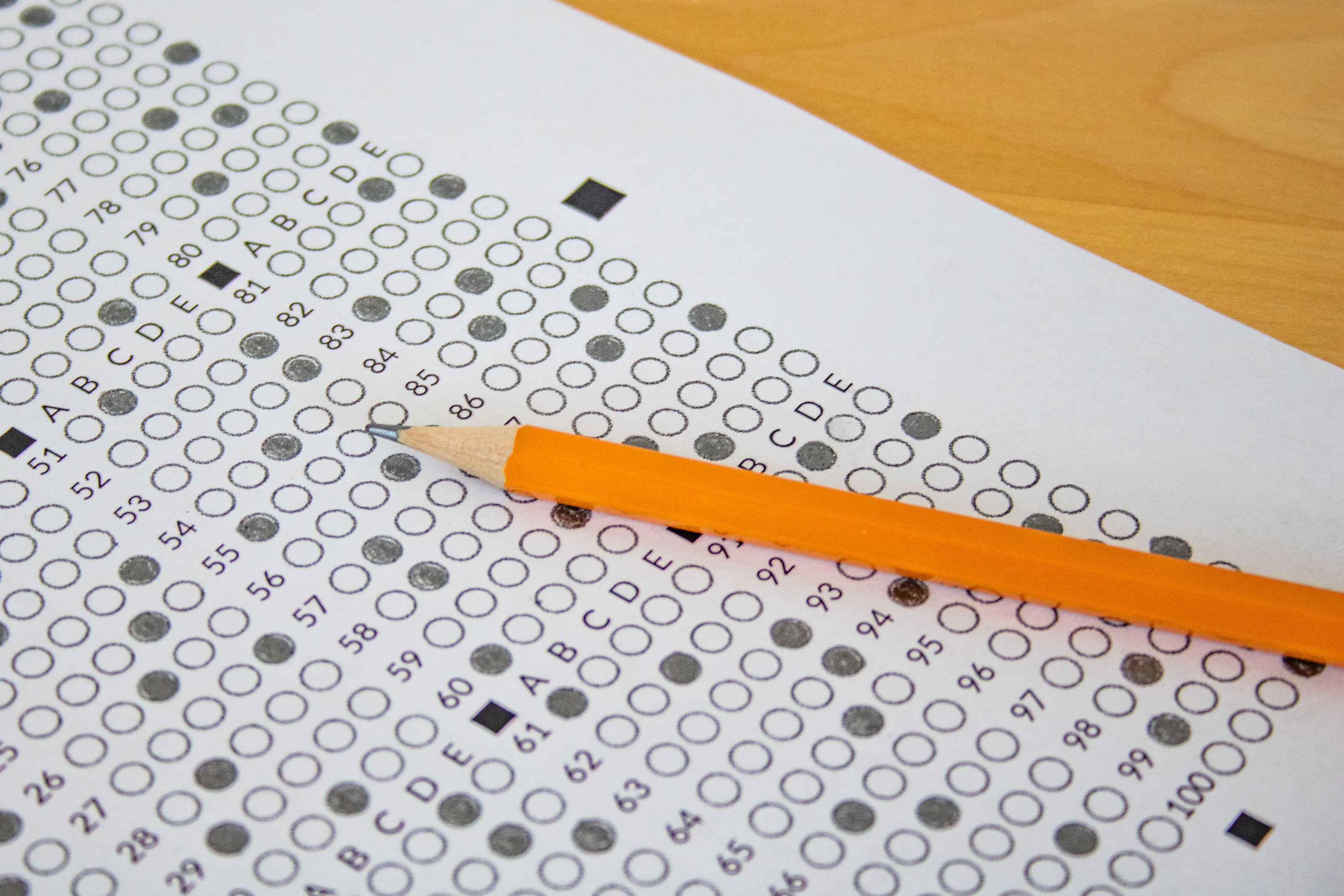
A pencil lies on a completed Scantron. The UC is reconsidering standardized testing amid competing concerns about student readiness and educational equity. (Crystal Tompkins/Daily Bruin senior staff)

By Lauren Trautenberg
Aug. 8, 2026 9:33 p.m.
This post was updated Aug. 9 at 6:37 p.m.
The UC’s decision to reconsider standardized testing requirements has reignited a debate over students’ readiness.
More than 3,000 UC STEM faculty members signed a May letter calling on the University to reconsider standardized testing amid concerns about students’ preparedness in math, writing and verbal reasoning. The UC stopped requiring SAT and ACT scores for first-year admissions in 2020 during the COVID-19 pandemic and later became test-blind.
After the letter’s publication, the UC Academic Senate announced it would decide whether it would recommend reinstating the SAT or ACT to the UC Board of Regents by June 2027. The Regents have the final say on the decision.
[Related: UC Academic Senate to decide on recommending SAT, ACT reinstatement by June 2027]
The May letter cites a 2025 UCSD report, which found that the number of incoming students who placed below the high school math level increased thirtyfold from 2020 to 2025. More than 70% of that group is below the middle school level, representing one in 12 students overall, according to the report.
Non-STEM faculty released a similar letter days later, citing declines in reading comprehension and verbal reasoning as further reasons to reinstate testing requirements.
[Related: Hundreds of UC faculty call to reinstate SAT, ACT requirements for STEM applicants]
A 2021 settlement required the UC to stop considering SAT and ACT scores until fall 2025, though the University has maintained its test-blind policy beyond this period.
Zvezdelina Stankova, a UC Berkeley mathematics professor who co-authored the May faculty letter, said she believes the University’s decision to go test-blind during the COVID-19 pandemic was reasonable at the time.
However, she added that the decision must be reversed because of students’ declining readiness, which has been emphasized by other factors including the COVID-19 pandemic, online learning and artificial intelligence.
“Centers were closing for testing,” she said. “As for whether it was justified to continue it (test-blind admissions), that’s a different question.”
Stankova said disruptions during the COVID-19 pandemic should have lowered student performance overall. Instead, student performances clustered at the extreme highs and lows, which suggests the UC’s decision to stop considering SAT and ACT scores contributed to wider differences in preparation among admitted students, she added.
“This is so unnatural that it points to a human-engineered problem,” Stankova said.
Pamela Burdman, founder of Just Equations, an institute focused on equitable education, said she believes findings from the 2025 UCSD report should not be applied to other University campuses because it only assesses UCSD students’ preparedness.
The Board of Admissions and Relations with Schools rescinded its original review timeline in July before the Regents set June 2027 as the deadline for the senate to make its recommendation.
[Related: UC board rescinds original timeline to reconsider SAT, ACT in admissions]
Li Cai – the director of the National Center for Research on Evaluation, Standards and Student Testing – said in an emailed statement that he disagreed that the UC needs more time to reconsider reinstating the SAT and ACT requirements.
Further review would not provide new information because independent studies have found that considering both standardized test scores and grade point averages among students is a stronger indicator of college readiness than high school GPA alone, said Cai, a UCLA education professor, in the statement.
The UC went test-blind despite the recommendation of the senate’s Standardized Testing Task Force, Cai noted. The task force recommended in a 2020 report that the University continue requiring the SAT and ACT and create a UC-specific admissions exam in the future to replace it.
Gloria Romero, the Republican candidate for California lieutenant governor who spoke at public comment during the regents’ July meeting, said in an emailed statement that she believes admissions officers should consider standardized testing alongside other measures. Steve Hilton – California’s Republican gubernatorial candidate – has also said he supports bringing standardized testing back to the UC.
“A standardized assessment such as the SAT or ACT does not measure a student’s full potential, but it does provide valuable information about whether a student has mastered the foundational skills necessary to succeed in college-level coursework,” Romero said in the statement. “The solution to unequal test scores is not eliminating measurement—it is improving educational opportunity.”
Fiona Ma, the Democratic candidate for California lieutenant governor, did not respond in time to a request to comment.
Standardized test scores provide admissions officers with a more consistent measure of students’ readiness when considered alongside other factors like high school grades, said David Kleinfeld, a UC San Diego professor of physics and of neurobiology, in an emailed statement.
Standardized testing requirements have raised equity concerns, particularly for low-income students and other applicants with limited access to test-preparation resources, Burdman said. She added that declining student readiness is a broader systemic problem that cannot be addressed by changing admissions policy.
Stankova said she believes that while the equity concerns are valid, they apply to other parts of the admissions process, including access to extracurricular activities, private tutoring for advanced placement courses and paid assistance with application essays.
Test preparation resources are widely available through Khan Academy, a supplemental education and test preparation platform, she added.
“A thermometer does not change the temperature – it measures it,” Stankova said. “SAT … is sensitive to inequities in our society. This is not hidden anywhere. But guess what? High school GPA is even more susceptible to inequities.”