‘The Sea Around Us’ installation, class explore kinship between ocean, humanity
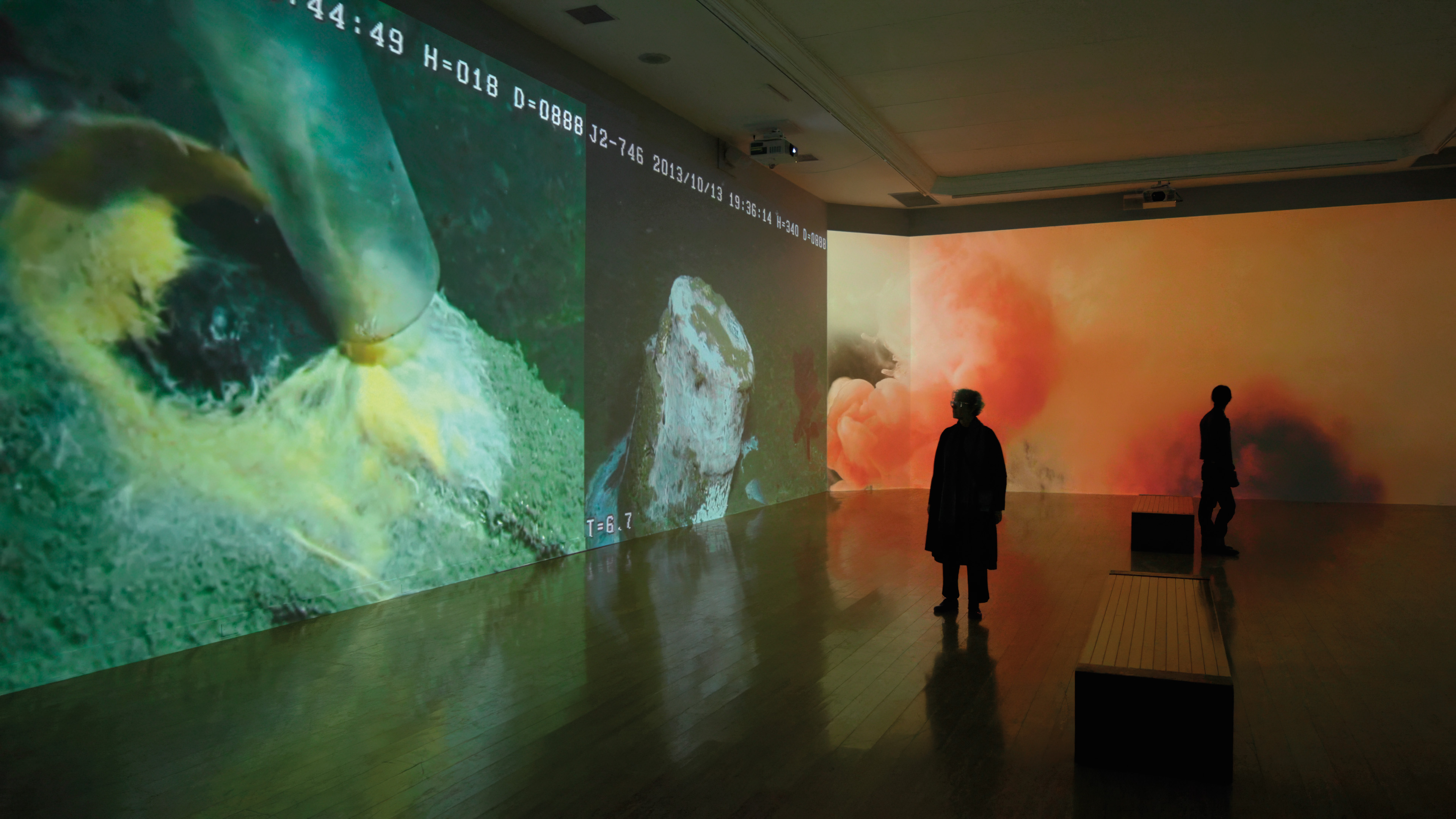
Pictured is the art video installation “The Sea Around Us.” Created by Rebeca Méndez, a professor in the Department of Design Media Arts, the exhibit was inspired by Rachel Carson’s 1951 book of the same name. (Courtesy of Rebeca Méndez)

By Presley Liu
April 7, 2026 3:27 p.m.
This post was updated April 9 at 8:25 p.m.
Submerged in the ocean, an Indigenous woman lifts a luminous abalone shell to her face – hinting at a bond older than memory.
Rebeca Méndez’s video installation “The Sea Around Us” depicts the legacy of poisonous waste dumping off the Southern California coast in an immersive, cinematic experience across six channels. The piece references Rachel Carson’s 1951 book of the same name, and both portray the sacred kinship between the ocean and humanity. Méndez, a professor in the Department of Design Media Arts and founder of the Counterforce Lab, said sharing these stories can awaken community.
“Every piece I make is for me to honor nature – to enter into reciprocity with nature,” Méndez said. “This is my spirituality. I come from the sea. So, therefore, I have chosen to make sure that I protect her.”
Commissioned by the Laguna Art Museum for the 2022 Art & Nature Festival, “The Sea Around Us” is guided by the abalone, a creature Méndez said she was drawn to because of its significance in Indigenous culture. She added that her research into the Acjachemen, Tongva, Chumash and Ohlone cultures illuminated the abalone’s ability to traverse across time and worldviews.
Méndez said the work of Rosanna Xia, an environment reporter for the Los Angeles Times, revealed the local nature of the ecological disasters that flow through her piece. Xia’s stories on the Montrose Chemical Corporation’s dumping of toxic pesticide DDT and radioactive waste – as well as Méndez’s own research were evoked in the installation – she added.
Through her artistic work and her spring 2026 course, also titled “The Sea Around Us,” Méndez said she seeks to inspire students to see the world and the ocean as alive. She added that this knowledge of a world that they have yet to be exposed to inspires them to protect the earth. The installation was exhibited March 31 and April 1 in the Broad Art Center’s Experimental Digital Arts room.
[Related: ‘ICE Out: Arte en Resistencia’ exhibit demonstrates power of speech in art]
Iris Fu, a second-year design and media arts student, said he was captivated by the sense of movement. Fu added that the nonlinear visual language helped capture themes of Indigeneity, poetry and speculation. Méndez’s use of a multi-channel format – presenting multiple video streams simultaneously – and her approach to filming and presentation contributed to the overall flow of the piece, they said.
“It was immersing you in a completely different universe,” Fu said. “As you are traversing with her (the protagonist featured in the installation’s videos), you encounter the DDT vessels that are abandoned at the bottom of the ocean, and there’s this transition from something that feels organic to the reality. … The first interaction the woman has with the DDT is an embrace.”
The scene speaks to the complex relationship between humanity and pollution, Fu said. She added that the moment underscores how such ideas are worthy of further thought. Méndez’s work always exhibits an element of hope, Fu said. Resilience is the overall feeling of the piece, he added.
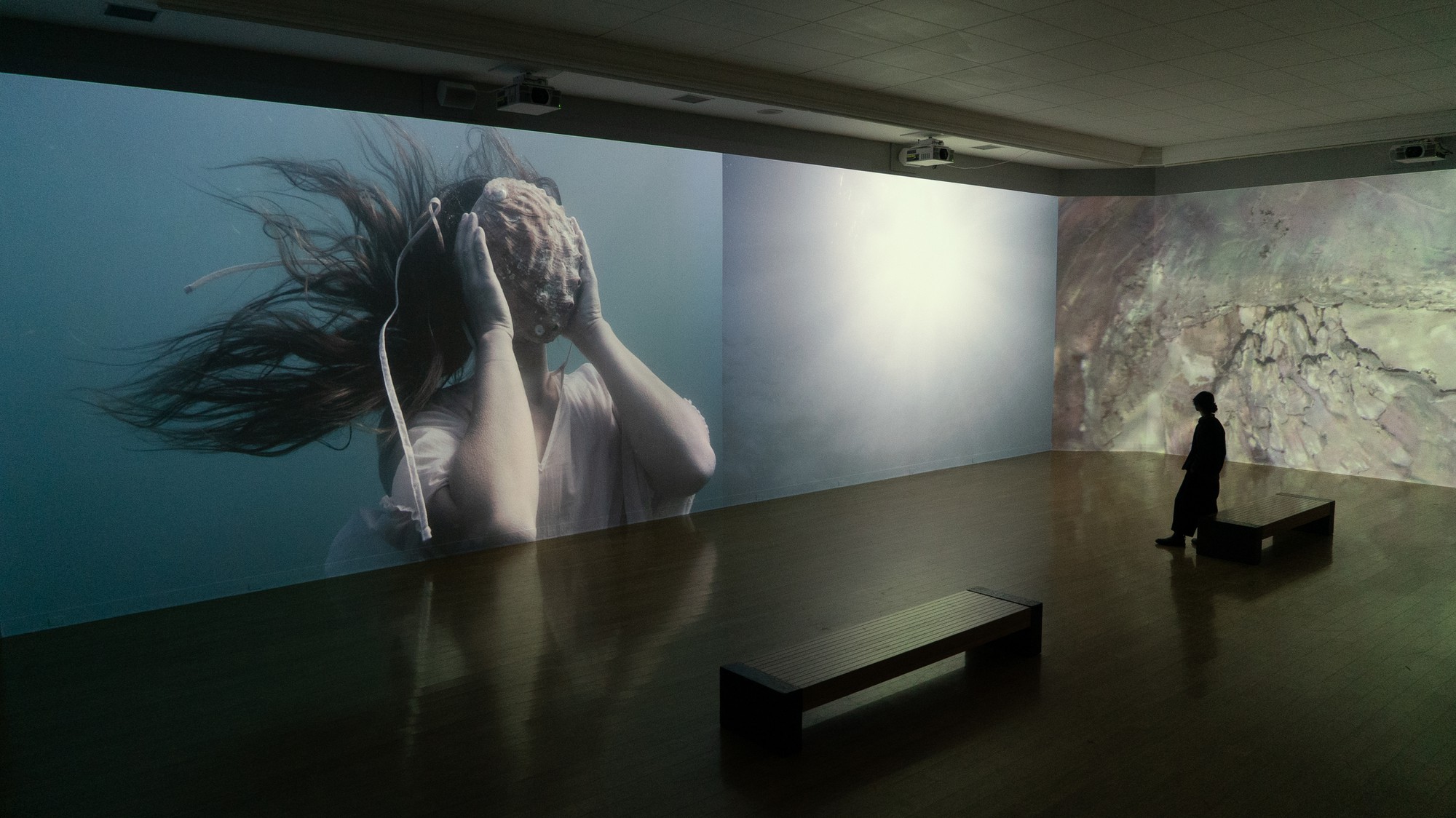
The installation ends with three generations of indigenous women interacting with abalone shells, Fu said. They are used as a type of mask, they said, but the visual of the actors turning the shell outward to the viewer is an unveiling of the internal that awakened a sense of unity and possibility.
Liam Jenny, a fourth-year atmospheric and oceanic science and political science student, said the juxtaposition between humanity, DDT, the beauty of the kelp forest, its destruction and the acceptance of the Indigenous spirit was striking. He added that he was particularly affected by the video’s climactic moment, in which an anchor glides through a lush kelp forest before the music abruptly recedes, revealing a stark, lifeless seascape.
“There’s a level of acceptance that we have to have when it comes to the previous roles that we as humans have played in environmental degradation,” Jenny said. “We need to accept that and hold it in our hearts, but also go forward with purpose – knowing that we’ve done something, but there’s more that we can do to try and resolve it.”
[Related: ‘Virtue and Vice’ art exhibit explores messages of morality through drawings]
Jenny said there is a level of spirituality that he has gained through the piece. As an aspiring oceanographer, he added that having professors who cultivate such exhibitions and lead classes like Méndez’s are particularly valuable because they inspire awareness and societal reform.
It is so easy to feel defeated in our contemporary moment of financial crisis and global warfare, Méndez said. Yet, it took just one person, Rachel Carson, to begin to tell the story of the sea, research DDT and inspire the modern environmental movement, she added.
“I need to believe I can do that,” Méndez said. “I need to believe my students can believe to be that. … Your voice matters. Your ideas matter. It is that level of empowerment that I think is what we need to have in each one of us.”
Elizabeth DeLoughrey, a professor who co-teaches English 184.3: “The Sea Around Us” with Méndez through the English department, said the pair sought to bring the installation to an interdisciplinary class with a broader public. DeLoughrey added that the role of art and literature is to answer complex questions, such as, “How do we develop a relationship of stewardship and care to an ocean that we may not experience directly?”
“We’re in an era that a lot of people are calling the Anthropocene,” she said. “This new generation coming out is going to be facing a lot of ecological challenges that, even 10 years ago, students from UCLA were not facing. So part of it is coming to terms with that. Part of it is trying to find ways to imagine better futures.”
The film crafts a sense of collectivity through care, DeLoughrey said. She added that the most exciting moments of teaching the course were the collaborative elements with Professor Méndez and students alike. She and Méndez will be bringing a single-channel version of “The Sea Around Us” to the Hammer Museum on June 3, DeLoughrey said.
The pair is currently working on a book of the exhibition that further blends art and science, incorporating empirical research and Indigenous stories, Méndez said. She added that she aspires to continue showing the installation and researching transformational objects of Indigenous culture in different areas of the country. Though the future of the piece remains to be determined, Méndez said her care for the ocean will never end and will forever inspire her work.
“Art is able to bring other worlds of knowing, other worlds of telling stories, so narratives (and) ways that we can bring an imagined world and imagine ourselves, moving beyond the catastrophes,” Méndez said. “Art cannot necessarily save us, but it does shed light, to perhaps, some other ways of being, a knowing in the world.”