‘ICE Out: Arte en Resistencia’ exhibit demonstrates power of speech in art
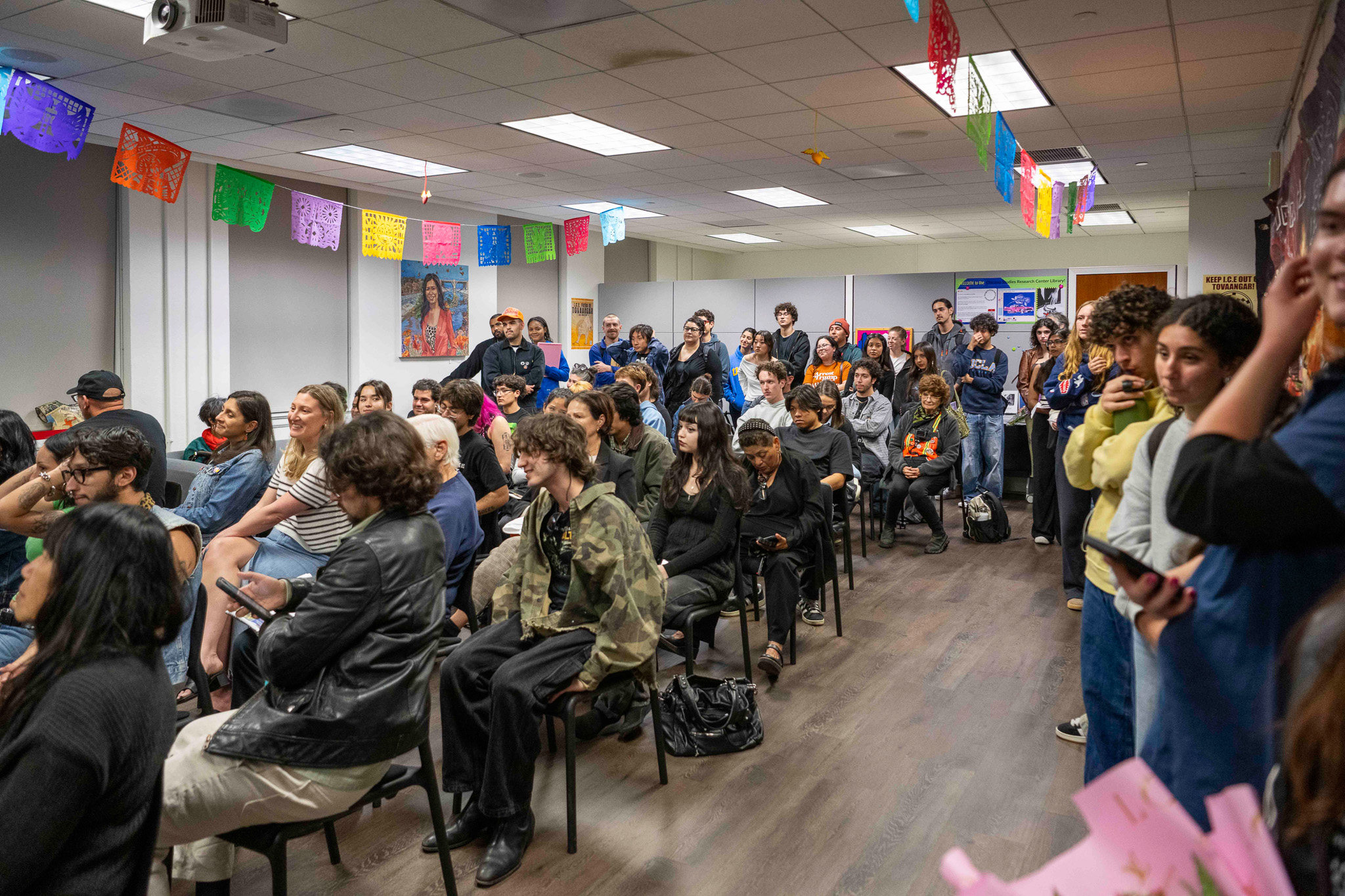
Attendees of the “ICE OUT: Arte en Resistencia” exhibit listen to a discussion panel. On Tuesday, the Chicano Studies Research Library hosted the opening night for the art exhibit. (Pranav Akella/Daily Bruin)

By Alexis Coffee
March 13, 2026 9:34 a.m.
Some exhibits aren’t made for looking at, but rather for looking back.
On Tuesday, the UCLA Chicano Studies Research Center Library transformed into a gallery. The Center for the Study of International Migration and the Chicano Studies Research Center Library filled the space with murals, paintings, photography, music and a community that showed up to heal. Displaying the exhibit, “ICE Out: Arte en Resistencia,” the installation was built around the idea that art isn’t decoration, it’s resistance.
“Art is fantastic for unifying people, especially right now under these conditions of state violence,” said Elías Alvarado, a third-year political science student and co-director of the gallery. “The peaceful way of grassroots organizing, litigation, popular education, arts and culture projects, these are effective ways of creating change. … That’s how we take the next step forward.”
Alvarado said the exhibit was put together partly as a final project for the class Art as Political and Social Commentary, and he created it along with the event’s co-organizer and Alvarado’s longtime friend, Zooey Lê-Baker. Alvarado said to curate the pieces for the gallery, they drew from the archives of the National Day Laborer Organizing Network – one of the country’s leading immigrant rights organizations – to bring decades of resistance history directly onto campus.
Lê-Baker, a third-year history and public affairs student, said getting to look at all the pieces has shown a history of some art pieces being informative, while others are symbolic. She added that art speaks to people in a way academic analysis cannot always achieve.
“There’s this long history of art giving showing visibility,” Lê-Baker said. “It reflects that emotional touch to things that is always necessary.”
[Related: ‘Virtue and Vice’ art exhibit explores messages of morality through drawings]
Through her own organizing work, Lê-Baker said she kept returning to art as the most powerful tool for communities shut out of traditional spaces of power, a tool she feels is sometimes not discussed enough. Art can be a form of oppositional speech, moving people forward, she said.
“As (there is an) increase (in) abductions and disappearances and separations of families, it can be easy to start to feel a little bit hopeless,” Lê-Baker said. “In response to that, it’s important for us to return to the long history of resistance we have in Los Angeles and across the country. This art speaks to that long history, … so we can fight that feeling that this is going to be an endless and hard struggle.”
Alvarado said that being at UCLA, he can see a lot of people frustrated with what they see on the news. The violence gets people angry, motivating them to want to do something in response, he explained.
Multidisciplinary artist and advocate Josiah O’Balles, whose mural is featured in the exhibit, said because museums and galleries are not always the most welcoming spaces, he likes making artwork that is accessible. This, he said, is a way to play a part in social movements for the working class.
“A lot of the art in the art world and our history is not accessible – it’s held behind doors, it’s privatized, it’s bought and sold at prices that working class people can’t afford,” O’Balles said. “If we really want to make artwork that moves people, and that people can be inspired by, the first step is giving them the opportunity to see it.”
[Related: Unmaking ‘Made in L.A.:’ Will Rawls’ ‘Unmade’ highlights the systems behind LA]
O’Balles’ mural, painted on fabric across a huge canvas, is full of deep reds, burning orange, dark navy figures and people wearing luchador masks bursting through the composition with one bearing an NDLON patch on a raised arm. On one side, the questions “In the name of the law?” and “Who do you call?” bleed into the background. On the other, a glowing hand pushed outward against the chaos, surrounded by the words, “Protected? Served? Legal? A Threat?”
The mural, O’Balles said, was never supposed to be what it became. He and his friends started with fabric, originally planning to paste pieces across freeways and buildings. But he said when they spread it all out, they knew it would have a greater impact as one image rather than separate pieces, and now the mural has already traveled all over East LA, up to Oxnard – to meet farmworker communities who he said were under direct attack – and now to UCLA.
Pablo Alvarado, co-director of NDLON and Elías Alvarado´s father, said that the night was about liberation through paintings, photos and music, providing not only the courage to keep fighting, but also joy. He said that injustices will always be present in life, so the fight has to continue, particularly to protect those who are most vulnerable.
“We have to turn these circumstances of oppression into practices of liberation, and that is what art in resistance is all about,” Pablo Alvarado said. “Art, music and culture contribute to the humanization of those who are living under oppression, and at the end of the day, this moment is about dehumanization versus humanization.”