Opinion: UCLA language program cuts undermine commitment to diversity
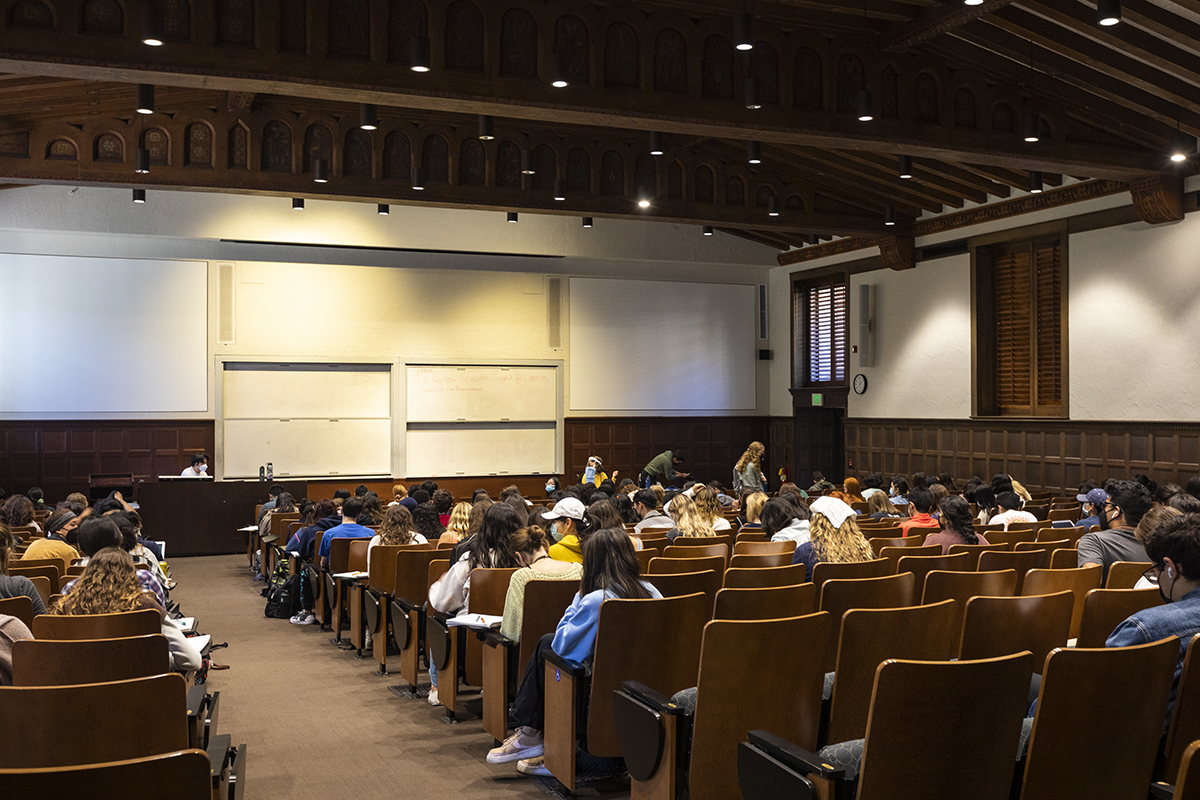
Students sit in a UCLA lecture hall. Columnist Alessandra Kahn argues that by cutting language programs, UCLA damages community and learning. (Daily Bruin file photo)

By Alessandra Kahn
March 3, 2026 6:08 p.m.
This post was updated April 9 at 9:30 p.m.
Studying a new language is more than memorizing words.
It allows learners to hear new perspectives, sheds light on international issues and offers community to heritage speakers. But slashes to state and federal funding threaten students’ access to these opportunities.
UCLA plans to downsize language programs across multiple departments and is considering enrollment minimums to maintain classes. Courses facing elimination include Tigrinya, Amharic and Ukrainian. Languages in the Near Eastern Languages and Cultures department and the Asian Languages and Cultures department are also vulnerable.
[Related: “A Perfect Storm”: How Budget Cuts Have Impacted UCLA]
These plans starkly contrast with the principles in UCLA’s mission and values. The university claims to value diversity among Bruins. By cutting smaller language programs while keeping popular ones intact, the university disadvantages students based on these very differences.
If the university’s mission statement represents more than good optics, our leaders must promptly justify how cuts to language programs reflect a commitment to diversity.
Since lecturers are only contracted for three years – as opposed to professors on the tenure track – lecturer-taught courses in NELC with fewer than 15 students are at risk of future cuts, said the department’s chair in a January interview with the Daily Bruin.
[Related: UCLA foreign language faculty, students criticize language program cuts]
NELC courses at risk include ones focused on Turkish, Arabic, Hebrew and Armenian.
Lilia Antonyan, a second-year chemistry student and heritage speaker of Armenian, said she values the chance to connect with students in her Armenian class who share her background.
“The class doesn’t feel like any other class,” Antonyan said. “Even though it is small, it feels like you’re in your own community.”
Armenian is not the only language course in jeopardy that serves heritage speakers.
Juliana Wijaya, a lecturer in ALC who initiated and runs UCLA’s Indonesian program, said in an emailed statement that many students grow up with Southeast Asian languages in Southern California’s large Southeast Asian diaspora communities.
“These language programs connect students to their communities, one of the reasons we hope UCLA will continue to support them fully,” Wijaya said in an emailed statement.
Wijaya added in the statement that she has not heard of any upcoming cuts to Southeast Asian languages. However, retiring lecturers in her department – also contracted for three years – may not be replaced due to the UC-wide hiring freeze, she said.
In contrast, languages such as French and Italian are alive and well at UCLA.
Nina Bjekovic, director of language programs in the department of European Languages and Transcultural Studies, said she is not aware of any changes to language course offerings in ELTS.
“I think the factors that may be affecting these decisions are numbers,” Bjekovic said. “The dean (of humanities) and the university put value on the actual languages and cultures represented, and they don’t discriminate between those.”
Numbers can appear objective, but the university selectively applies this logic.
Departments such as Athletics seem immune to their debt. UCLA absorbed $30 million of Athletics’ $80 million annual deficit in the 2023-24 fiscal year – and its spending continues to increase.
“The 2024-25 season was our first full season in the Big Ten Conference, and the financials reflect what we anticipated during the transition,” a UCLA Athletics spokesperson said in an emailed statement. “Revenue increased, driven largely by conference media rights and distributions, while expenses also rose due to transition-related costs and increased investments in student-athlete well-being and support.”
If student athletes continue to enjoy added perks while our financially-strained campus cuts classes to foot the bill, the future of our world-class education will not be a long one.
Further, while language lecturers wonder whether their contracts will be renewed, the university is actively denying claims of financial mismanagement.
UCLA’s former chief financial officer, Stephen Agostini, said to the Bruin the school is expected to run a $425 million deficit for the 2025-26 fiscal year.
Days later, UCLA Newsroom published a statement contesting the figure, and Chancellor Julio Frenk shared in a campuswide email that Agostini would be replaced as CFO.
Campus leaders can hide from their spending failures – but students will suffer regardless. UCLA faculty leaders share similar concerns.
Megan McEvoy, a professor in the Institute for Society and Genetics who chairs the Academic Senate, said in an emailed statement that the Senate is actively seeking to protect campus academics.
“We have repeatedly advised the Administration to protect academic programs and instead cut non-academic units when necessary,” said McEvoy, a professor of microbiology, immunology and molecular genetics, in the statement. “We will continue to do so.”
For tight-knit communities of student language learners to survive, the university must take the Academic Senate’s advice seriously.
In all fairness, some terminated language programs will still be available to UCLA students online. The UC Global Language Network allows students to access online versions of some language courses taught at other UC campuses and plans to expand its cross-campus offerings.
“The Global Language Network demonstrates the University of California’s commitment to increasing the availability of foreign language courses to UC students across the system,” said a spokesperson from the UC Office of the President in an emailed statement.
Online learning is better than no learning at all. But language needs conversation and connection.
“UCLA is such a big school, so finding someone that’s also your own culture is a little bit difficult,” Antonyan said. “These classes, not only are you actually learning but you’re actually building a family.”
Communities of language learners deserve to meet in a classroom, not through a laptop screen.
UCLA’s stated mission recognizes that “diversity is critical to maintaining excellence.”
When money is tight, does this truth go up in smoke?