UCLA foreign language faculty, students criticize language program cuts
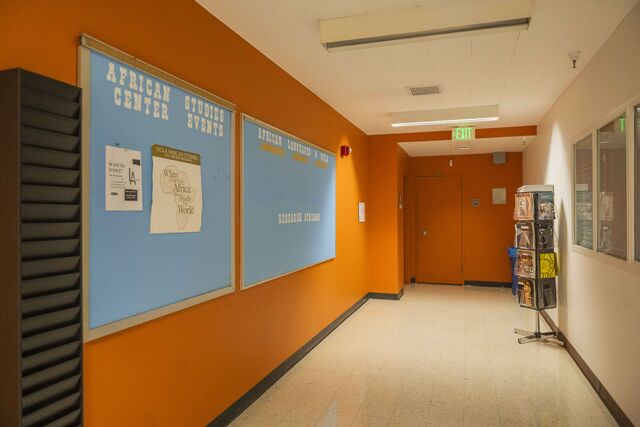
The African Studies Center in Bunche Hall is pictured. Professors, lecturers and department heads from various language programs said UCLA has threatened to – or already has – downsized language programs because of budget cuts, both at the state and federal level. (Joice Ngo/Daily Bruin)

By Phoebe Huss
Jan. 27, 2026 2:56 p.m.
Abraham Adhanom was wrapping up his 14th year of teaching two African language courses when the dean of humanities notified him his classes would be eliminated after spring 2025.
Adhanom, an International Institute lecturer who developed his own Amharic and Tigrinya courses, said the dean told him the department cut the courses due to inadequate funding.
Professors, lecturers and department heads from various language programs said UCLA has threatened to – or already has – downsized language programs due to budget cuts, both at the state and federal level.
Several less commonly taught language courses have also faced low student enrollment, putting the courses at risk for removal, multiple professors told the Daily Bruin. Outside donations and more student enrollment in the courses could help save the programs, they added.
UCLA Humanities did not respond in time to a request for comment.
The U.S. Department of Education withheld grants funded by Title VI of the Higher Education Act for the 2025-26 academic year in 2025. The department had awarded Title VI grants worth $8 million to UCLA in 2022, which covered four academic years, including 2025-26.
These grants went toward the National Resource Center Program, Language Resource Center Program and Foreign Language and Area Studies Fellowship Program, according to the International Institute.
Chancellor Julio Frenk launched the Executive Budget Action Group in November to manage UCLA’s budget deficit amid state and federal budget cuts. Frenk said in a Jan. 15 interview with the Daily Bruin that the group would provide transparency on the rationale behind financial decisions, such as budget cuts to specific programs.
[Related: Q&A: Julio Frenk condemns federal cuts, pledges future budget transparency]
UCLA has also cut the budgets of other departments and programs – including the Mathematics department and administrative units – in recent months.
[Related: UCLA math department TA, grader cuts spark concern over student learning, support]
Torquil Duthie, a pre-modern Japanese literature professor and chair of the Asian Languages and Cultures department, said popular languages with high enrollment like Spanish, Japanese and French are not at risk of elimination at UCLA.
One African language remains
Adhanom said his course cancellations frustrated his students, including remote participants across the UC who had previously joined Adhanom’s courses through UC Online. He added that he worked hard to develop the courses.
“I developed all the resources, all models,” Adhanom said. “I developed this to be a unique program in a way that integrates technology into the language.”
Adhanom said he told Alexandra Minna Stern, the dean of humanities, that he was willing to teach Tigrinya voluntarily, or for “$1” if faculty compensation was required, in emails reviewed by the Daily Bruin. Stern replied that even with those provisions, the course still could not be taught.
“One interesting thing is, because these are African languages, who cares? That’s the reality,” Adhanom said. “At least, I do feel something like that sometimes.”
Stern did not respond to a question on the Tigrinya course cancellation, but said in an emailed statement that the humanities’ department’s World Languages Day event demonstrates “commitment and engagement with languages.”
Harold Torrence, a linguistics professor and the director of the African Studies Center, said the only African language currently taught is Swahili.
Torrence said student interest in African languages has fluctuated over time, and eras of declined enrollment make it “difficult to justify” maintaining lecturers and graduate students in the languages.
However, Torrence added that preserving less commonly taught languages is critical for shaping how the U.S. behaves in global affairs.
“Part of knowing the world … is learning about language, culture and other perspectives,” Torrence said. “The issue is not a call to agree with those other perspectives, but you have to know that they exist, and that’s what studying other languages gives you.”
Adhanom said that while he has had to work within a system that is “archaic and rigid,” he will continue to seek outside fundraising and fight for the reinstatement of Amharic and Tigrinya.
“If funding is the problem, I’m offering to teach these courses in whatever way is necessary,” Adhanom said. “And I do that because I care about the impact, about the language, about the overall value.”
Eastern European and Eurasian department languages shrink over years
The Slavic, East European and Eurasian Languages and Cultures department started offering Ukrainian this academic year. Students and faculty have advocated for a Ukrainian course since Russia invaded Ukraine in 2022, said Roman Koropeckyj, professor of Slavic languages and literature.
However, Koropeckyj added this is probably the first and last year of the program. Stern notified him shortly before the beginning of the school year that the course would be canceled due to a lack of funding, he said.
“Every year we would ask, and every year they would say, ‘no, we don’t have the funds, we’ll do it next year, we’ll do it the year after,’” Koropeckyj said. “This was the year it was supposed to be done, and then suddenly we can’t.”
Koropeckyj stepped up to teach Ukrainian for the 2025-26 academic year, despite already having a full-time workload.
Lilya Kaganovsky, the chair of SEEELC, said in an emailed statement that the loss of FLAS grants will cause less commonly taught language programs in the Slavic department to erode further.
Susan Kresin, a senior lecturer in the Slavic department and the UCLA Russian Flagship Program student coordinator, said that about 12 years ago, UCLA cut Czech courses due to budgetary restrictions. UCLA cut all level four Russian classes this year, she added.
“We tend to have very enthusiastic students, very motivated students because they have personal motivations, but they (the classes) do tend to be very small,” Kresin said.
Kresin brought back Czech for the past five years with a two-unit independent study course for heritage students who grew up with the language.
This year, only one student is enrolled in the class, Kresin said.
“As long as it’s just one person coming in, I can take them under my wing without money,” Kresin said.
Nick Guymon, a graduate student in the Program in Indo-European Studies, said smaller class sizes allow for closer relationships between teachers and students.
“If we have questions about more advanced aspects of grammar or pronunciation or other things like that, we will receive very detailed feedback,” he said.
Guymon has studied Latin, Ancient Greek, French, Portuguese, Italian, and Classic and Vedic Sanskrit at UCLA, and also speaks Spanish. He said the language offerings at UCLA have given him the ability to communicate with friends in other countries, as well as make other friendships and have new experiences.
Kresin said that she has found all those involved with less commonly taught language courses are passionate.
“The perspectives of small nations really matter,” she said. “There’s a lot that they have to offer. Even if we don’t have high enrollment numbers, I would even say it’s in the interest of national security to have people learning these languages, to tap that awareness.”
Low-enrolled Middle Eastern languages at risk
Language classes in the Near Eastern Languages and Cultures department taught by lecturers with fewer than 15 students are slated for eventual removal, said Michael Cooperson, the chair of the department. Lecturers, he added, are only contracted for three years at a time, so not rehiring them can be a cost-saving measure for the university.
Turkish courses would be cut entirely, as well as possibly some Arabic, Armenian and Hebrew courses, if UCLA removed classes following that criteria, he said.
Cooperson said he is seeking outside fundraising to endow lectureships and fund graduate programs. Without funding, he said, there will be reductions in available programs.
If more students continue studying languages after one year of instruction, that would help fill out intermediate level courses and justify their funding, Cooperson said.
The International Institute website lists over 40 languages taught at UCLA. However, several of the listed languages – Yoruba, Zulu, Lithuanian, Old Irish and several Germanic languages – are no longer offered.
Additionally, other languages listed are only available in certain years or quarters due to limited availability of faculty who can teach them.
Gina Konstantopoulos, an associate professor of Assyriology and Cuneiform Studies, said she teaches Akkadian and Sumerian – both ancient Mesopotamian languages – in coordination with UC Berkeley.
Students taking one of Konstantopoulos’ languages can take courses at UC Berkeley during years when the classes are not scheduled at UCLA, she said. However, this system is not well-known among students and requires jumping through bureaucratic hoops, she added.
Demotic, an ancient Egyptian script, and Aramaic, an ancient Semitic language, are also only available during certain quarters due to limited faculty availability, according to emailed statements from Demotic Assistant Professor Solange Ashby and Early Judaism Assistant Professor Catherine Bonesho, respectively.
Language departments fear faculty replacement unlikely
The ongoing faculty hiring freeze – which UCLA implemented in response to financial challenges, according to an August email from campus administrators – has made it difficult to replace faculty in less commonly taught languages, Duthie said. In cases of retirement, he added, positions can remain empty for years, with dramatic effects on entire fields of research and instruction.
“I don’t see my department suddenly cutting an entire language,” Duthie said. “What I can see is, lecturer retires, and it’s hard to replace the lecturer suddenly because there’s no new hires. That’s what I do fear and I do see happening.”
[Related: UCLA pauses new faculty hiring, will consolidate IT teams following funding cuts]
He added that for the past several years, no ALC programs have had any teaching assistants.
Stephanie Jamison, a linguist and professor of Asian languages and cultures, said in an emailed statement that she has taught Sanskrit every other year for 25 years.
“There is real concern … about what will happen when I retire,” Jamison said in the statement. “It is not clear that Sanskrit instruction will continue at that point, and who would take it on if it does.”
Guymon, a student in Jamison’s Vedic Sanskrit course this quarter, said students value Sanskrit for its importance and literary output.
“The students that take Sanskrit, that continue with Sanskrit, we have a really fun time with it, and Stephanie is absolutely amazing,” Guymon said. “It would make me very, very sad if Sanskrit is not continued after Stephanie retires.”
Donka Minkova, a linguist and distinguished research professor emeritus in the English department, began teaching at UCLA in 1983. She said she taught language courses including Old, Middle and Shakespearean English before retiring during the pandemic.
Minkova added that several students have expressed interest in resuming Old English graduate studies, but that the proposed class is likely too small to be economically feasible.
“That will enroll maybe five, six people – which is wonderful,” she said. “It gives the student wonderful opportunities for interaction and learning and all of that. But it’s financially rough.”
Guymon, who was formerly a research assistant for Minkova, said many students – including himself – wish Old English were taught at UCLA for graduate students. He said that since English is his native language, he is interested in its history and how it gained worldwide importance.
“It’s wanting to learn more about a topic that I’ve had just some limited experience with and would like to learn more about,” he said. “And there’s tons of interest from other peers.”
Guymon said that he believes all students should take language courses beyond the general requirements if they have the opportunity because they offer limitless possibilities.
“I really can’t imagine life without studying those languages, or life without language, just because language is also something that is so quintessentially human,” he said.