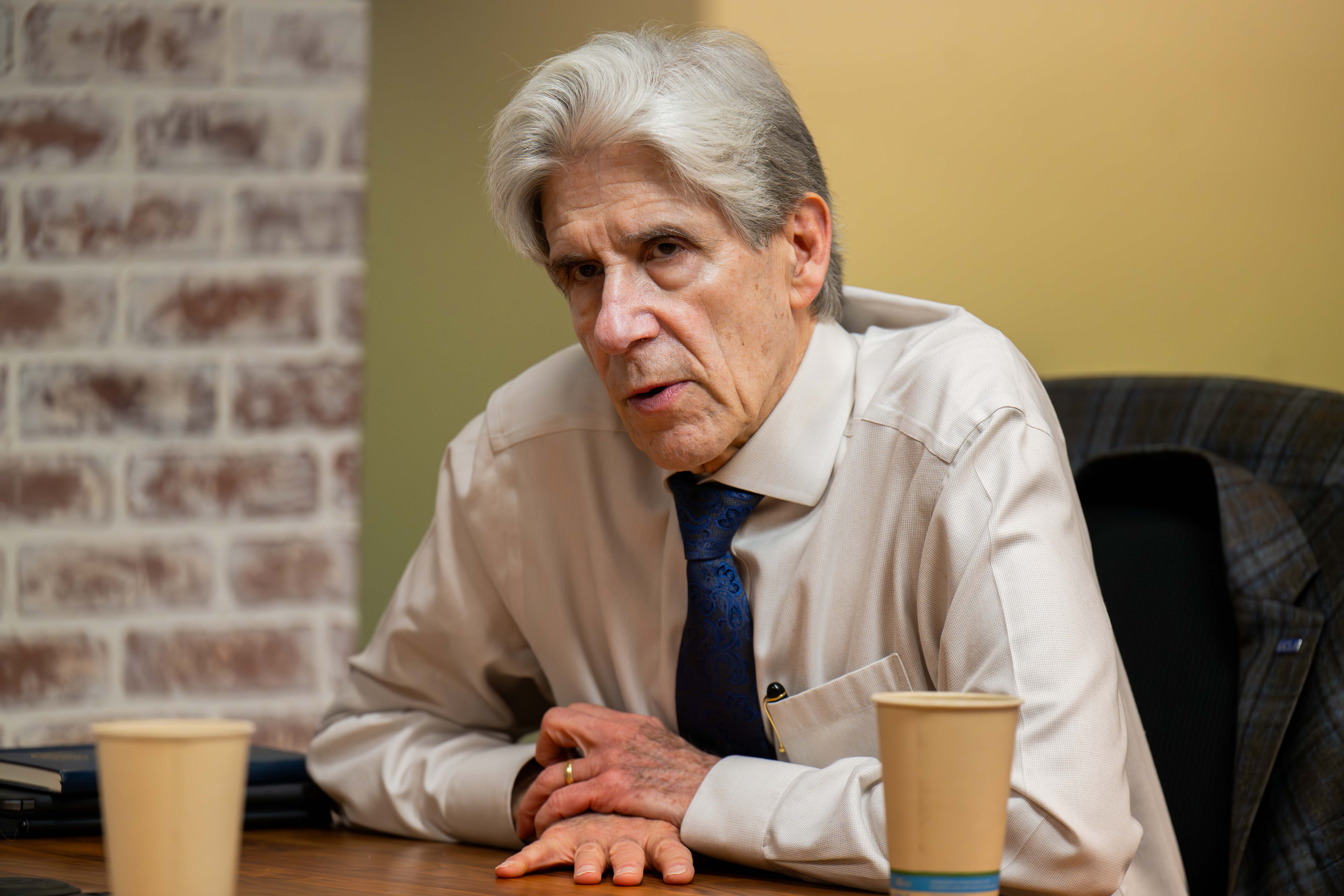
Julio Frenk answers questions in the Daily Bruin office. News editor Alexandra Crosnoe and campus politics editor Natalia Mochernak sat down with Frenk on Thursday to discuss federal research funding cuts, UCLA’s budgetary shortfall, protections for undocumented students and time, place and manner policies. (Andrew Ramiro Diaz/Photo editor)
By Alexandra Crosnoe, Natalia Mochernak
January 15, 2026 at 7:01 p.m.
This post was updated Jan. 16 at 1:36 a.m.
Chancellor Julio Frenk completed his first full year in office Jan. 1.
News editor Alexandra Crosnoe and campus politics editor Natalia Mochernak sat down with Frenk to discuss federal research funding cuts, UCLA’s budgetary shortfall, protections for undocumented students and Time, Place and Manner policies.
This interview has been edited for length and clarity.
Federal funding cuts
Daily Bruin: One of the things that has undoubtedly defined your first year in office was the federal research funding freeze. The Trump administration cited antisemitism, the illegal use of affirmative action and allowing “men to participate in women’s sports” as reasoning for the freeze. In your opinion, is there any merit to those claims?
Julio Frenk: There is no merit to those claims.
Antisemitism is a real problem on campuses and in society, as are other forms of discrimination. I am against any form of hatred or discrimination against any group or identity. Antisemitism has been on the rise, even predating the Oct. 7 attacks in Israel. The University of California started taking actions, and certainly I have made it a very big priority of mine. The indictments reflected a reality that may have been accurate 18 months before the time when those accusations were made – they didn’t take into account everything that had already happened, including the adoption of new guidance for time, place and manner and other provisions that the UC system as a whole had already undertaken.
California has had Prop. 209. It’s, for decades, forbidden the use of race considerations in either admissions or employment. Then there’s the Supreme Court judgment. There may be isolated items that we could work at, but it is not a pervasive issue.
We just don’t have trans athletes. The NCAA, to which we belong, doesn’t allow trans athletes to compete. There’s a policy there, and we need to abide by that.
Even if the claims were true – which they’re not – the measures taken to deal with those claims are not the right measures. You don’t fix antisemitism, inappropriate use of race or ethnicity in selection decisions or supposed violation of Title IX – you don’t resolve that by cutting life-saving research. I said that from my first message since we got the first letter from the Department of Justice.
DB: While a federal judge has reinstated a vast majority of UCLA’s frozen research grants, her order is temporary. How are you supporting UCLA researchers who are in limbo? UCLA has condemned the federal funding cuts in general but has said little on the demand letter. How are you supporting students and community members who feel attacked by the demands on diversity initiatives and things like that? Has UCLA continued to explore a potential settlement with the federal government?
JF: Even before we got the letters, I developed a strategy with four basic components: litigation, negotiation, mitigation and communication.
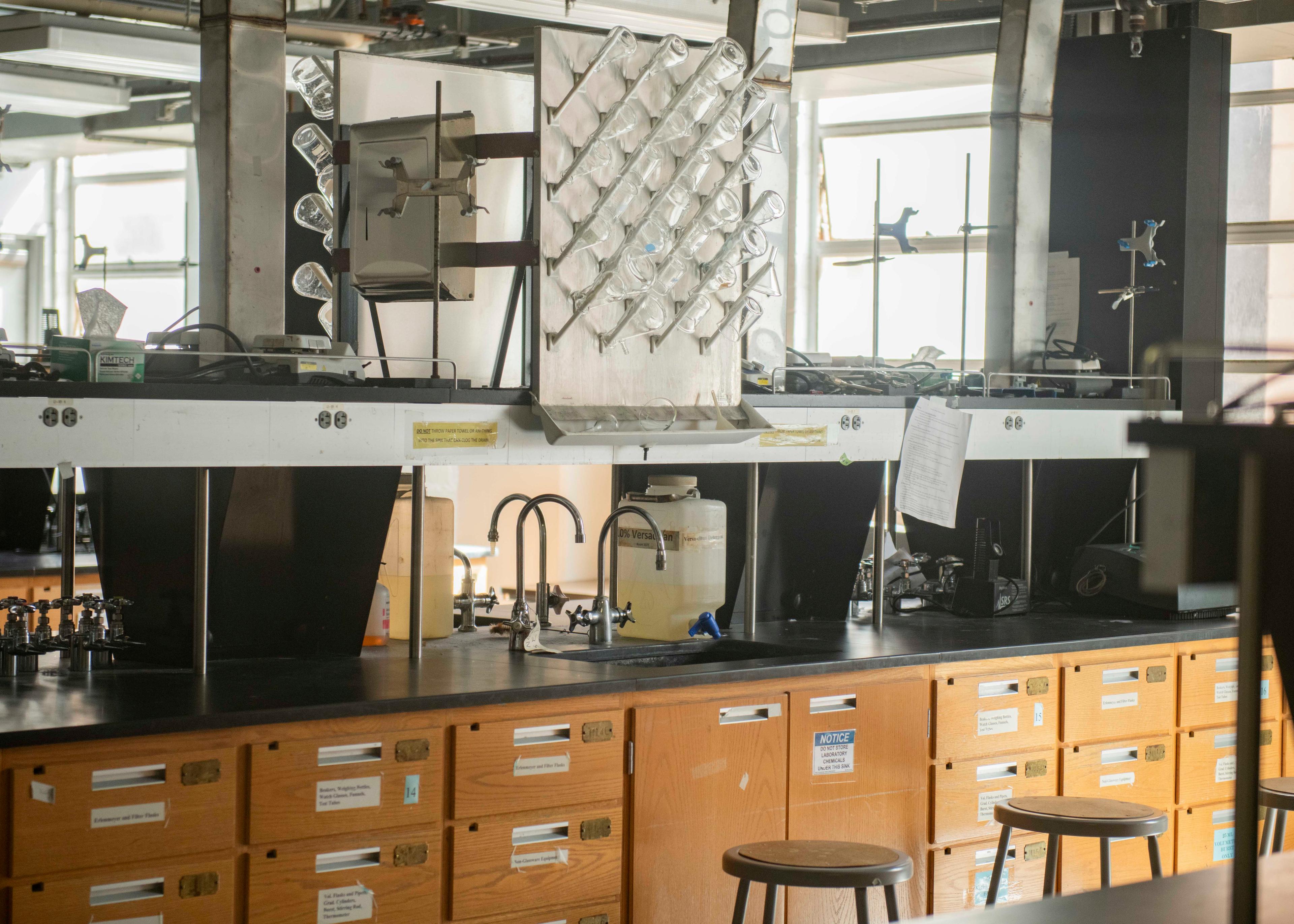
Litigation: fortunately, the latest ruling by Judge (Rita F.) Lin was very favorable to us. It reinstated the 800 grants that were arbitrarily suspended, totaling more than half a billion dollars, and that has definitely reduced anxiety, because that was an immediate threat. Just to make it clear, UCLA cannot sue individually – as an institution, it’s the UC system. In this case, it was a great thing that it was the faculty who led the lawsuits.
When we received the initial letter, it laid out the three indictments which I just discussed, that we have good reasons that we can contest. Then, there was an invitation – whether we would like to talk. Along with (UC) President (James) Milliken who had just arrived, we decided that the answer should be, ‘Sure, you’re inviting us to talk. We can talk. We can engage in good faith conversations, and then we can see what the content of the conversation is.’
That then gave way to the second letter, where there were the demands and the billion dollar fine that was struck down by Judge Lin. The billion dollar fine was clearly an illegal action with no rationale. It’s obviously unaffordable for the university.
We have signaled the disposition to discuss, with very clear understanding that (in) any conversation, there’s three red lines: this university, and no university, can ever give up the core of academic freedom and institutional autonomy, which is the decision of who we admit, who we hire as faculty and what we do research on and teach about.
Since that exchange, which included the letter that we received, there has been no further communication.
There was nothing in that letter that we accepted or agreed to, which is very important to understand, because in talking with students, some students seem to believe that we’ve agreed to what’s in that letter. That is not the case.
If there’s a down-the-line invitation to discuss, we can discuss. We have very strong evidence, in the three indictments, that UCLA is fully compliant with the law and has been and will continue to be. We’re very serious about antisemitism, we do not discriminate in admissions or employment and that we certainly do not act against Title IX.
There’s still uncertainty. We did get those grants restored, but it’s not just an issue of getting back the current grants. It’s an issue of being able to continue to compete fairly and on the basis of the merit of scientific proposals for future grants, and that’s absolutely critical. Judge Lin’s ruling says that explicitly. We do not know if the administration will eventually appeal that.
That’s why we need the third component of our strategy, which is mitigation. Before that ruling, before the grants were restored, we analyzed the 800 (frozen grants one) by one, and we started providing bridge funding. We’re ready to continue to do that if there were cuts in the future.
Of course, the fourth is communication, which is what we’re doing now.
DB: Are you able to say if the UC has formally responded to or rejected the settlement agreement?
JF: There has been no formal request from the administration to respond to that. There’s been no further communication.
I don’t have any visibility as to what is going inside the administration, but what I can tell you is that there’s been no further formal communication.
UCLA’s budgetary shortfall
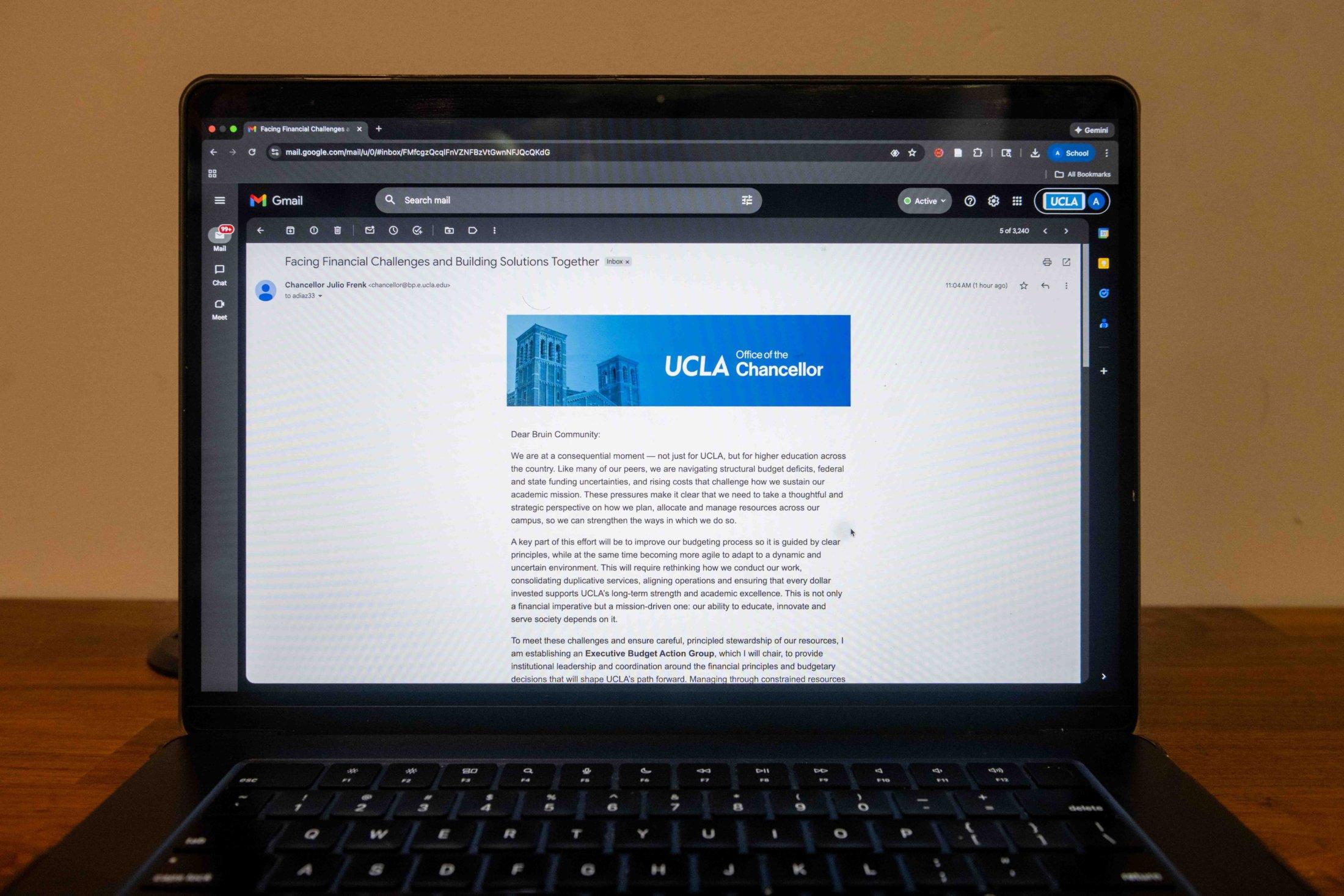
DB: You announced the creation of an executive budget action group in December to manage the university’s shortfall. We’ve seen funding slashed from a number of programs at UCLA from multiple academic departments – such as the Math department – UCLA Enrollment Management and more places. Could you provide a little bit of background on how this deficit came to be and the extent of it? Why have no annual financial reports been posted in the last two fiscal years? How, if at all, is UCLA and the budget group working to mitigate impacts?
JF: UCLA is not unique in this respect. There has been, over years, a structural problem in which the costs of delivering our services have increased faster than our revenues.
A lot of that is just an incredible increase in regulatory elements from the government that has required a number of additional actions. There’s structural costs … UCLA is 100 years old and has huge elements of maintenance that are needed. The UC has committed to a carbon-neutral future, and that’s a very expensive proposition. We try to stay competitive in attracting our top faculty, so salaries have raised. Unions, rightfully – that’s their role – have been demanding salary increases that are not commensurate with the income received. There is a structural deficit.
Now, what’s made it more acute this year? It’s unfortunate that it happened in my first year. I want to make it clear that it did not start when I arrived, that these structural forces were building up. But what has become more acute is the state’s own fiscal limitations, as the state itself is facing similar structural issues, so the allocations have been mainly stagnant.
Then there’s the element of our compact with the state, before I arrived, to achieve two goals that are very valuable and that we totally subscribe to: increase enrollment, because we have something very good, which is the education we impart, and we need to benefit more people with that. And, to increase the proportion of students who are from California. Those two are worthy goals, and we are fully behind them, but they do have financial implications, especially reducing the proportion of out-of-state students. Both out-of-state, including international students, pay higher fees and serve to subsidize the lower traditional tuition of California residents.
On top of that, came the federal cuts. It became a perfect storm when you add the structural deficit that was building up for years with state shortfalls and then with the federal actions.
This is never easy. It’s very difficult because you need to make choices. I value everything we do, but any organization needs to set priorities.
I created (the budget executive group) so that I had full visibility of the process of by which the budget is formulated, and I was sure that we were both aligning it to our strategic priorities and at the same time, creating a transparent way of explaining when we make a choice, and we say we were going to fund A instead of B, that we can explain the rationale. When you’re administering scarcity, it’s very important that people perceive the process to be fair. It’s not because it’s my own preference – it’s not an arbitrary decision. There is a method.
None of these make a chancellor popular, but are decisions that must be taken. We can’t delay them any more.
DB: To follow up, why have no annual financial reports been posted for the last two years?
JF: There are financial statements that are presented and audited. Certainly, as you know, everything gets consolidated at the level of the system and within UCLA, we do have financial statements.
DB: There is normally a public report that comes out every June, but the last one was from the 2022-23 school year. For the last two years, a lot of students feel like there’s no transparency – or the Academic Senate feels this way – because these financial reports have not been posted.
JF: We’re committed to transparency, and we will be reporting. We’ve been very transparent about the size of the deficit. I’ve been reporting, but I will continue to report on the executive budget action committee. This is not to replace the regular budget-making process. It’s to afford me full visibility of that process. Obviously, the budget that we’re in now, I had just arrived. I arrived in the middle of the fiscal year. I had to be dealing with all these emergencies – the fires, the federal actions. It was my first year. I was getting to know the university. Now that I’ve been here, I want to make sure that the next budget, which is the 2026-27, that I am fully aware of what’s going on, that it’s not a black box and that I’m accountable therefore for it.
Time, Place and Manner policies
DB: The university implemented finalized Time, Place and Manner policies at the start of this academic year. The new policies officially limited public expression activities from only occurring in certain places on campus without prior approval, and they fully banned public expression activities altogether from occurring between midnight and 6 a.m. Some students have said they feel that these policies place unfair boundaries on free expression on campus. Can you tell us why you think these policies were necessary, and what you would say to students who believe they take away from the university’s role as a center for free speech?
JF: We are committed to free speech, but it’s a right, and like every right, it is limited by the (rights) of others. Putting some rules around the exercise of rights is in no way meant to curtail it. It’s meant to organize the exercise of that right (of free expression), which we cherish. It’s the core of higher education.
It’s putting some limitations to also safeguard other rights, for example, the right to pursue the reason why you’re here. If you can demonstrate outside classrooms with loudspeakers that make instruction impossible, you are interfering with the rights of the people who are not demonstrating but (are) here wanting to learn – to do so, the right to be in a place that’s safe and free from discrimination and harassment. You cannot just exercise free expression if it involves that. That’s the purpose of Time, Place and Manner.
So why not between midnight and 6 a.m.? Because it would be highly disruptive for students who are here for just four years, who are here to achieve a super important life goal, which is to acquire knowledge and skills that will shape their entire life. It’s important that we don’t interfere with that process. We’re fully committed to free expression within the bounds of the law.
Undocumented students
DB: Immigration enforcement officers have targeted Los Angeles since June. What would you say to undocumented UCLA students who are experiencing fear about immigration raids occurring on campus?
JF: You belong here. We cherish your presence here. You’re part of our community. We will do everything in our power, within the law, to protect you. We will provide orientation, resources. We do comply with the law. I believe in the rule of law, but the rule of law allows us to offer resources, and that’s what we’ve been doing.
I’ve met several times in my first year with DACA (Deferred Action for Childhood Arrivals) students, some of our students that are undocumented, or people who may themselves not be undocumented, but who have family members, because that extends to other parts of your own community. We’re trying to provide resources – both information, legal resources, counseling and other forms of support to our students.
The future
DB: This past year has undoubtedly been a tumultuous one for higher education. As someone who has worked in higher ed for years, what’s your outlook on the future of it?
JF: I remain deeply optimistic that we will come through this. UCLA is now in its 107th year. It has gone through many crises in its history, and it’s always come out well – but we cannot take that for granted. We need to earn the right to be optimists every day by taking decisions – some of which are going to be tough, not necessarily popular – but that will ensure that this institution not just remains, not just survives, but continues to be the great, top comprehensive research university.
We will come out of the current situation, but we need to make sure that when we get through this, UCLA can rightfully claim those three adjectives – a top comprehensive research university. I am very energized by the level of support, by the cohesion of our community, and we will come through all of these current challenges, hopefully even better than before.