UCLA School of Law panel evaluates future of environmental policy after midterms
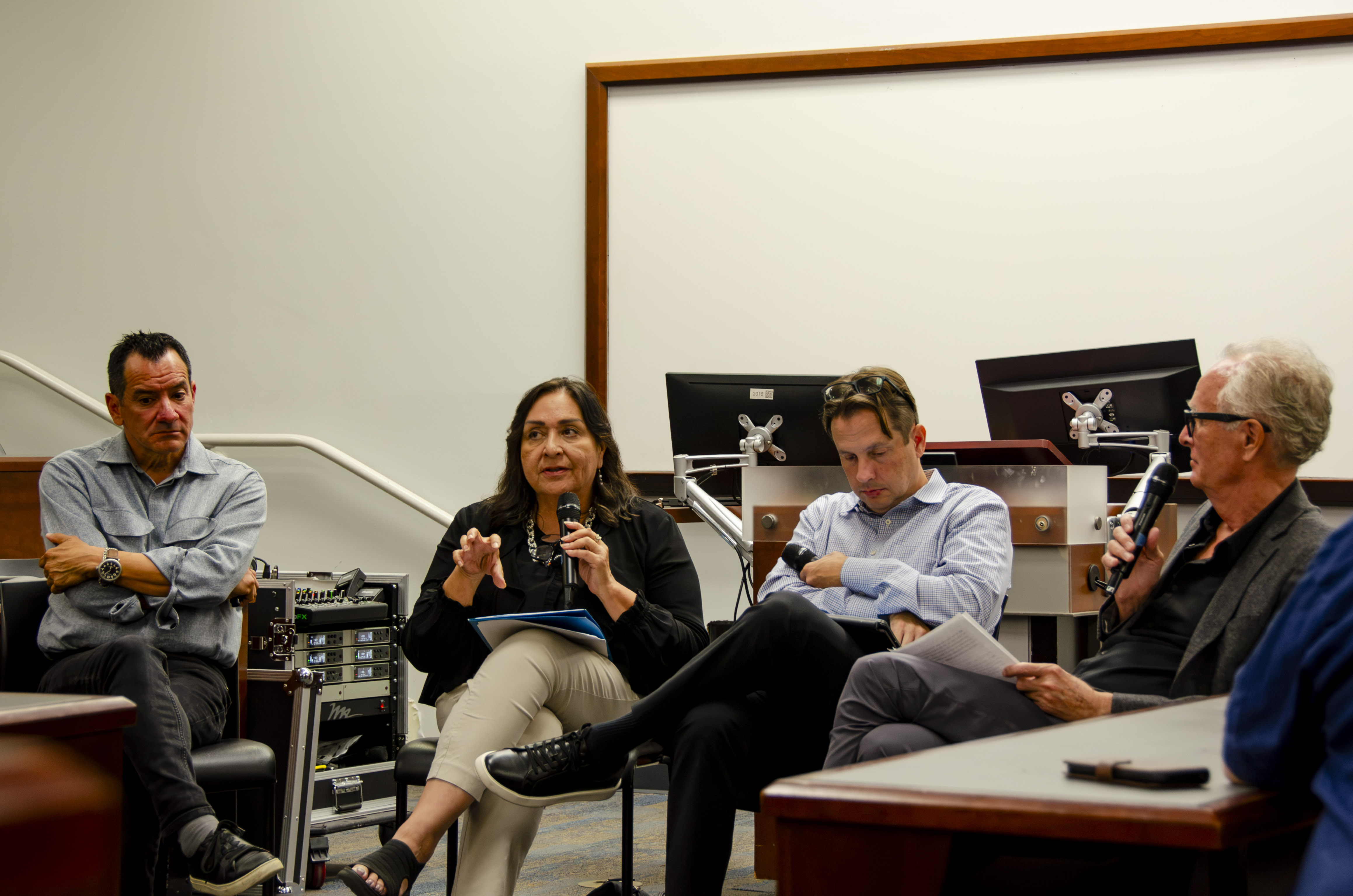
Panelists Anthony Rendon, Marta Segura, Alejandro Camacho and John Christensen discuss how the midterm election results will impact climate policy. The event was hosted by UCLA’s Laboratory for Environmental Narrative Strategies hosted the event as part of its 10-year anniversary series. (William Gauvin/Daily Bruin staff)


The “blue wave” could lead to stronger protective climate policies in Los Angeles, though it remains contested at the federal level, legal experts said at a UCLA School of Law panel Nov. 9.
UCLA’s Laboratory for Environmental Narrative Strategies hosted the event as part of its 10-year anniversary series to unpack how the results of the 2026 midterm elections will affect climate policy in the United States.
Democrats won control over both chambers of Congress in the midterms, flipping eight Senate seats and more than 40 House of Representatives seats in what has been named the “blue wave.” The 55-seat Senate majority would be the second-largest for either party since 1994, according to CNN.
Earlier on the same day of the panel, the U.S. Senate voted to advance the Bipartisan American Affordability and Jobs Act of 2026, which aims to expedite federal environmental reviews and permits for building infrastructure and energy projects.
While some panelists said the bill was rushed and could weaken certain environmental protections from the Biden administration, others said it could help by increasing long-distance power lines.
“The fact that the Democrats, after a generational victory last week, were willing to make a deal with Republicans on a bill that is pretty bad for the environment,” said Alejandro Camacho, a professor of law, “it’s quite remarkable.”
Environmental policymaking in Congress will remain highly contested despite a Democratic majority because polarization in the executive branch will likely continue to complicate the process of reaching agreements, Camacho said.
He added that although the blue wave could lead to a stronger push for affordable clean energy, environmental justice and the regulation of data centers, he is still skeptical of decision-making in Congress.
“Concerns I have are about whether the leaders of the Democratic Party are willing to be sufficiently bold, to take the actions that are in front of us, to actually deal with the major stakes that climate change raises,” Camacho said. “Only time will tell. They have the social capital to do it, whether they actually decide to do it or whether they decide to favor special interests or not.”
California State Assembly Speaker Emeritus Anthony Rendon said at the panel that he believes the effectiveness of policymaking in Congress depends on whether leaders are willing to listen to the voices of younger constituents.
He cited the passage of Senate Bill 32 – which requires the California Air Resources Board to reduce greenhouse gas emissions to 40% below 1990 levels by 2030 – as an example of Democrats and Republicans finding common ground.
“In California, when we did SB 32, we got five Republican votes, which allowed for the two-thirds – we wouldn’t have gotten two-thirds without it, (SB 32) wouldn’t have passed without it,” Rendon said.
Marta Segura, founding chief heat officer for the city of Los Angeles, said she is hopeful for the future of climate change policies in California – especially in LA – because of the progressive visions of the state’s newly elected leaders.
Mayor-elect Nithya Raman, who defeated incumbent Karen Bass in the midterms, plans to expand eco-friendly projects and use various funding streams to fund projects to plant street trees and add cooling centers across the city, Segura said.
The SoCalGas franchise fee, which the Southern California Gas Company pays to operate its gas distribution system in LA, will go to the Climate Equity Account to support climate mitigation, adaptation and decarbonization, according to a 2026 LA County Board of Supervisors letter.
Measure PRK, which passed in the midterm elections, aims to double the current minimum budget allocated to the Department of Parks and Recreation over 10 years, according to voting information hub California Choices.
“I’ve never been more hopeful for the city of Los Angeles,” Segura said.
Elias Jabbe, a climate communication strategist who attended the event, said he is concerned about extreme heat, poor air quality and worsening pollution. He added that he hopes to see newly elected officials regulate artificial intelligence to mitigate their negative impacts on the environment.
“I’ve been writing about climate change for a long time, and I’ve been observing, as a volunteer for nonprofits, extreme heat. … I believe it’s an issue that pertains to us now,” Jabbe said.
People should continue to think critically about the issues around them to make positive change on the environment, whether it be through pushing for or voting on essential policies, Segura said.
“I just want people to follow their dreams, follow their passion, but always be civically engaged,” Segura said. “Do things that reward your soul, because I think that’s what makes life meaningful and purposeful. … Those dreams can become reality.”