UCLA project researches healthcare with veterans who experienced homelessness
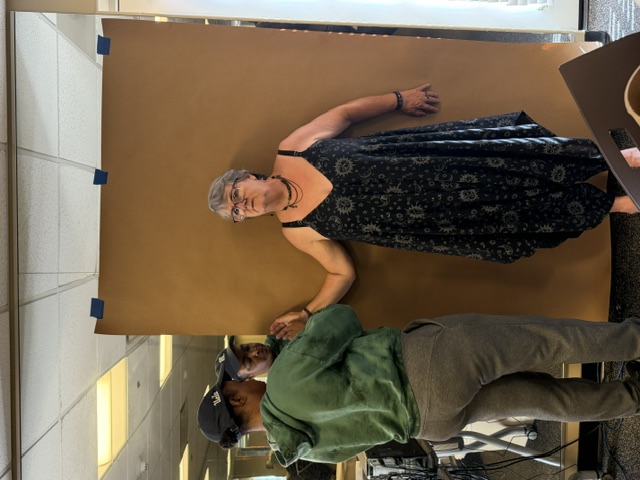
PerfectLove Miller traces Krystal Rains as part of a body mapping exercise. Seven veterans who previously experienced homelessness are being trained by the UCLA/VA Center of Excellence for Training and Research in Veteran Resilience and Recovery on the fundamentals of scientific research and body mapping. (Courtesy of Matthew McCoy)

By Eleni Klostrakis
Nov. 10, 2026 9:37 p.m.
Robert Belie, a veteran who taught university students in China after serving in the United States Army, used to greet one of his students every day by wishing them a happy birthday.
Now, as a participant in a UCLA research project, Belie included the words “happy birthday” on his body map – a form of art therapy where participants create an outline of their body on paper and draw artwork to represent their experiences.
“We said ‘happy birthday’ as a hello each day, because we can celebrate our birth and our life every single day,” Belie said.
The project – administered through the UCLA/VA Center of Excellence for Training and Research in Veteran Resilience and Recovery – aims to guide patient-centered veteran healthcare research through teaching seven veterans who previously experienced homelessness about the fundamentals of scientific research and the principles of body mapping.
According to the 2025 Homeless Count, about 3,050 veterans experienced homelessness on any given night in Los Angeles.
“We want them to have a more active role in shaping research agendas from the beginning so that it leads to research that might better reflect veterans’ needs, and of course, over time, hopefully improve healthcare,” said Matthew McCoy, one of the principal investigators.
A patient-centered approach to healthcare and research places emphasis on the person, leading with their history and preferences with the broad goal of improving patient experiences, according to the National Library of Medicine.
“A lot of times, research is investigator-led, and it’s not necessarily led by the participants, or the key questions or priorities aren’t identified by the people that are impacted by the research,” said Melissa Chinchilla, the other principal investigator.
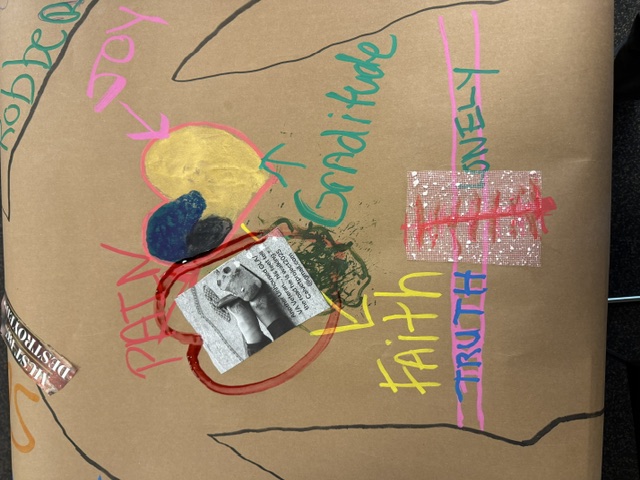
The project is broken up into three sections, where veterans learn the fundamentals of research, explore the therapeutic benefits of body mapping and work with early-career investigators to develop research questions about veteran healthcare.
Kali Kramer – a veteran who participates in the program – drew the Morro Rock, a volcanic rock in Morro Bay, California, on her body map.
“I drew this for the Morro Bay Rock because this is the main area where I was homeless, and it’s a reminder of where I came from,” Kramer said.
The program is funded by a two-year, $296,980 grant from the Patient-Centered Outcomes Research Institute, a nonprofit organization that funds research focused on patient experiences in healthcare, according to its website.
For researchers, body mapping can help provide valuable insights into questions they should explore in veteran healthcare.
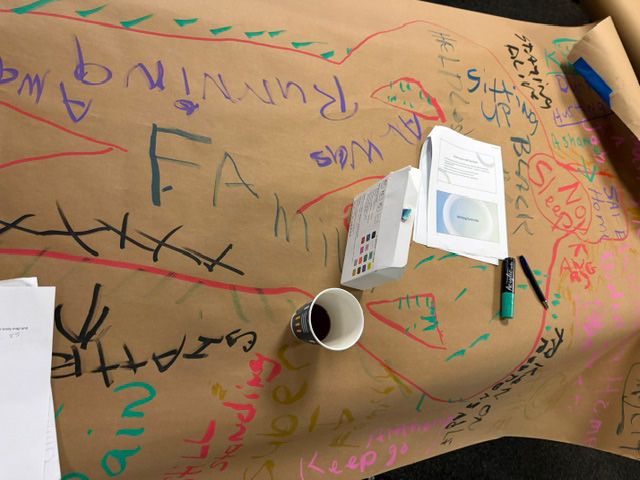
“We hope to identify common themes that are coming up in everyone’s body map and critical questions that should be part of a veteran-centered research agenda,” she said.
In the last phase of the project, veterans work with early-career researchers to explore potential research projects they could pursue if they receive additional funding in the future, McCoy said.
“At some point, the veterans will sit down with the early-career investigators and go over the research and go over the research priorities, and they will together design a research agenda or a project that they could in the future conduct,” McCoy said.
While veteran homelessness has declined by about 50% over the past 15 years, according to the Department of Veterans Affairs, veterans continue to face barriers in accessing healthcare, Chinchilla said.
“There’s still ongoing challenges that the veterans face for accessing the services that they need,” Chinchilla said. “Part of the work we’re trying to do within research is improve some of those processes so that we’re able to meet all veteran needs.”