1,000 issues later, ‘The Amazing Spider-Man’ is amazing again
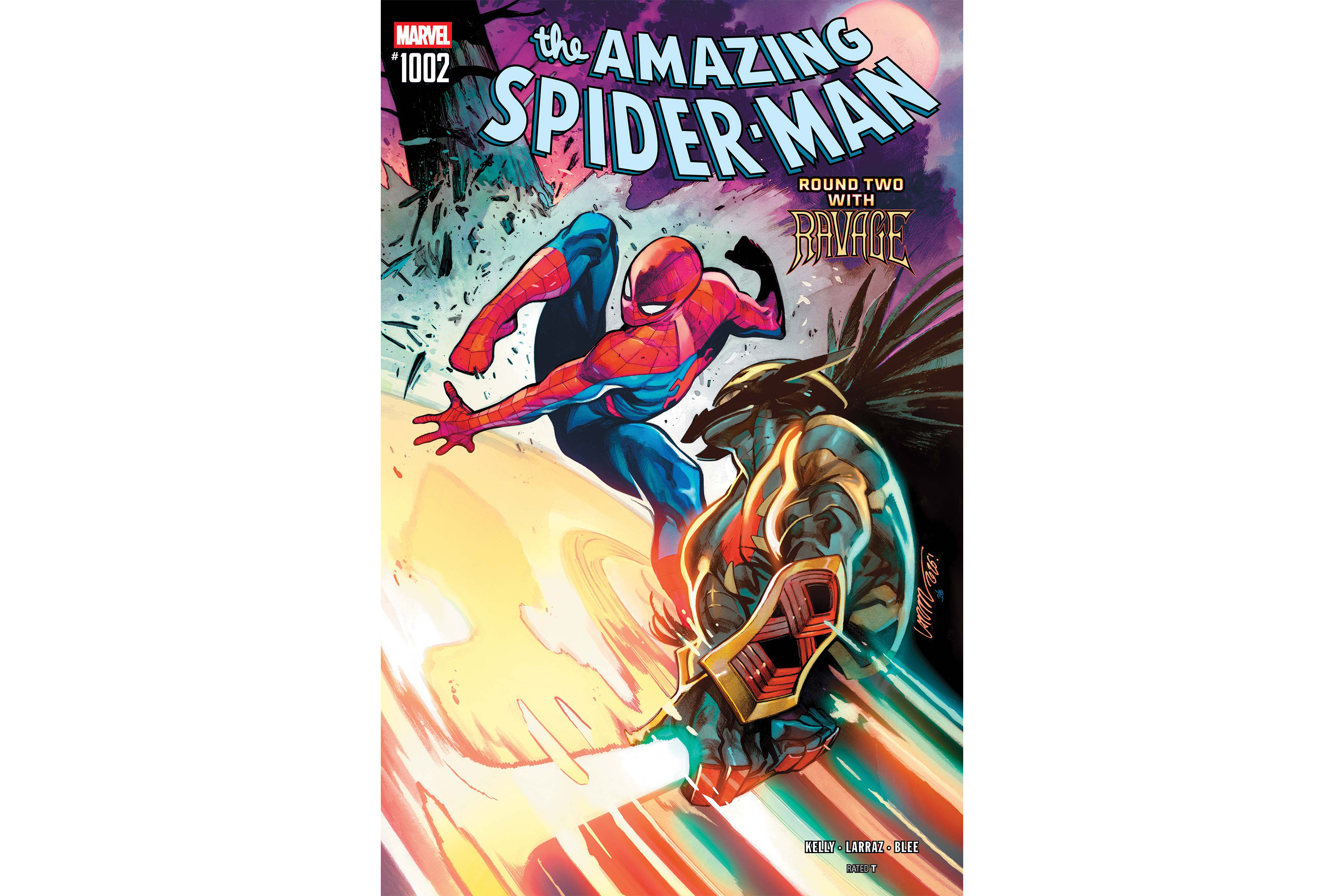
The cover of “The Amazing Spider-Man” No. 1002 shows the web-slinging hero fighting Ravage. A continuation of the milestone 1000th issue, the comic was released by Marvel Comics on Oct. 28. (Courtesy of Marvel)
The Amazing Spider-Man #1000-1002
Joe Kelly
Marvel Comics


By Nicholas Mouchawar
Nov. 10, 2026 6:07 p.m.
Warning: Spoilers ahead.
Peter Parker doesn’t need a black suit to make a fight personal.
In 2007’s “Back in Black” storyline, Peter dons a makeshift version of his black costume to confront Kingpin after an assassin’s bullet intended for Spider-Man leaves Aunt May fighting for her life.
Nearly two decades later, Peter finds another reason to wear his anger on his sleeve – and another enemy who makes the fight deeply personal.
In the mainline Marvel universe, Spider-Man has gone through a lot: He’s had his marriage cosmically annulled by the devil, his body and life hijacked by Doc Ock and his newborn daughter kidnapped by the Green Goblin – not to mention being buried alive by Kraven or cloned by the Jackal.
Yet Peter still finds one villain who takes it too far. Not Norman Osborn. Not Otto Octavius. Not Wilson Fisk. Nor any of his typical villains. His cousin.
“I have never hated another human being as much as I hate this man,” Peter says in his internal monologue during the fight.
And that’s a really high bar to clear.
In writer Joe Kelly’s anniversary arc leading up to the 1000th issue of “The Amazing Spider-Man,” Peter meets his long-lost cousin, Cormac Crane, who is revealed to be Uncle Ben and Aunt May’s biological son.
And who could’ve seen this twist? The long-lost relative turns out to be evil!
Cormac, revealed to be a supervillain named Ravage in issue No. 1000, steals his victims’ memories and shapes them into physical weapons. Stealing Aunt May’s memories, Ravage makes Peter a stranger to the woman who raised him.
Despite the cliché premise and excess of Parker Luck – Peter’s nickname for his bad luck – Kelly’s anniversary arc is the strongest “The Amazing Spider-Man” has been in years. By grounding its spectacle in Peter’s relationship with May, Kelly gives the character’s seemingly endless suffering emotional purpose. Paired with Pepe Larraz’s breathtaking artwork, the arc is a compelling reminder of what makes Spider-Man worth reading in the first place.
As an anniversary story, the arc earns its milestone not by celebration, but by making Peter’s more than 60 years of history matter deeply to the conflict in front of him.
Kelly’s emotional groundwork makes Peter’s latest developments feel compelling again, while the echoes of “One More Day” offer clever metacommentary on a series that often defines its hero through his loss and suffering. And that really says something, given that Spider-Man has already lost so much – close friends and family, as well as good writers helming his series.
[Related: Second Take: The MCU keeps Spider-Man’s name, suit and villains. But where’s Peter Parker?]
A highlight of Kelly’s “The Amazing Spider-Man” run has been his portrayal of Peter and May’s mother-son-like relationship. Whether it’s revisiting Peter’s childhood fear of losing her or depicting their reunion after Peter’s time stranded in space, Kelly understands and highlights the role that May plays in Peter’s life: No matter how many secrets he keeps or how often he disappoints her, she will always welcome him home.
Peter frequently ruminates on and keeps an internal list of his failures, and who can blame him? There’s so much loss in his life – his uncle, his parents, his best friend and the love of his life twice. Kelly chooses to underscore Peter’s vulnerability and grief via narration boxes, which capture those feelings without necessarily having Peter say it aloud in unnatural dialogue. They reveal how he turns loss into guilt, holding himself responsible for the people he’s lost and pulling away from those he still has.
But May sees Peter as more than just the failures he fixates on. As his maternal figure, she reminds him that he doesn’t have to save everyone to deserve love. Kelly puts this part of their relationship on full display numerous times throughout the run. These quieter moments establish what’s at stake long before Ravage enters the picture.
All of these choices make Cormac’s attack particularly cruel. He removes the only person, aside from Mary Jane, who can answer Peter’s worst suspicions about himself. May’s love has never depended on Peter being a perfect son, but Cormac, in their fight spanning issues No. 1000-1002, insists that every absence, every secret, every disappointment is proof that Peter never deserved it. That is what makes Cormac exceptionally easy to hate.
Ravage embodies Peter’s fear of loss and inadequacy – a recurring theme of Kelly’s time on the series. His ability to steal and weaponize memories, quite literally, lets him beat Peter with the very things Peter already beats himself up over. Cormac’s conviction that he knows what is best for May also carries an uncomfortable echo of Peter’s own history.
In 2007’s “One More Day,” Peter and Mary Jane agreed to let the demon Mephisto erase their marriage from history in exchange for saving May’s life and erasing the world’s memory of his identity – a storyline whose consequences continue to shape Peter’s relationships nearly two decades later.
[Related: L.A. Comic Con brings communities together through imagination]
Apparently, knowing what is best for Aunt May runs in the family.
Ravage, as a result, feels like a pointed commentary on a storyline that still hangs over “The Amazing Spider-Man.” Both men, at one point, thought they knew best for May and made an executive decision about her life without consulting her. Peter now suffers the consequences of that reasoning from the other side, and what once served as an editorial crutch becomes the foundation for a villain who is a compelling addition to Spider-Man’s rogues’ gallery.
Kelly’s attention to what fans have been saying about Peter’s suffering is particularly refreshing after the preceding run, helmed by writer Zeb Wells, left many readers frustrated with its treatment of Peter and Mary Jane’s relationship. Peter and Mary Jane were preparing to move in together, only for a sudden six-month time jump to reveal them estranged and Mary Jane raising children with a newly introduced man named Paul Rabin.
Readers waited more than a year for an explanation, only for it to be contrived nonsense involving an alternate dimension where time moved faster.
The explanation did little to convince readers that separating them accomplished anything worthwhile.
Where Wells’ run often made Peter’s suffering feel arbitrary, Kelly’s approach gives it narrative and emotional purpose. His version of Peter isn’t suddenly free from tragedy, but readers are given a reason to care about what he stands to lose. Readers see what Peter and May mean to each other before that bond is threatened, and the man who attacks that bond is a deliberately cruel antagonist whose actions expose the insecurities Kelly has spent the arc developing.
Sure, most anniversaries end with celebrations, cake and candles, but, in typical Parker Luck, Peter’s ends with a family crisis. Kelly’s writing reminds readers why Peter’s relationships matter in the first place.
After years of diminishing returns, “The Amazing Spider-Man” remembering how to be amazing is reason enough to celebrate.