How do university rankings influence prospective students?
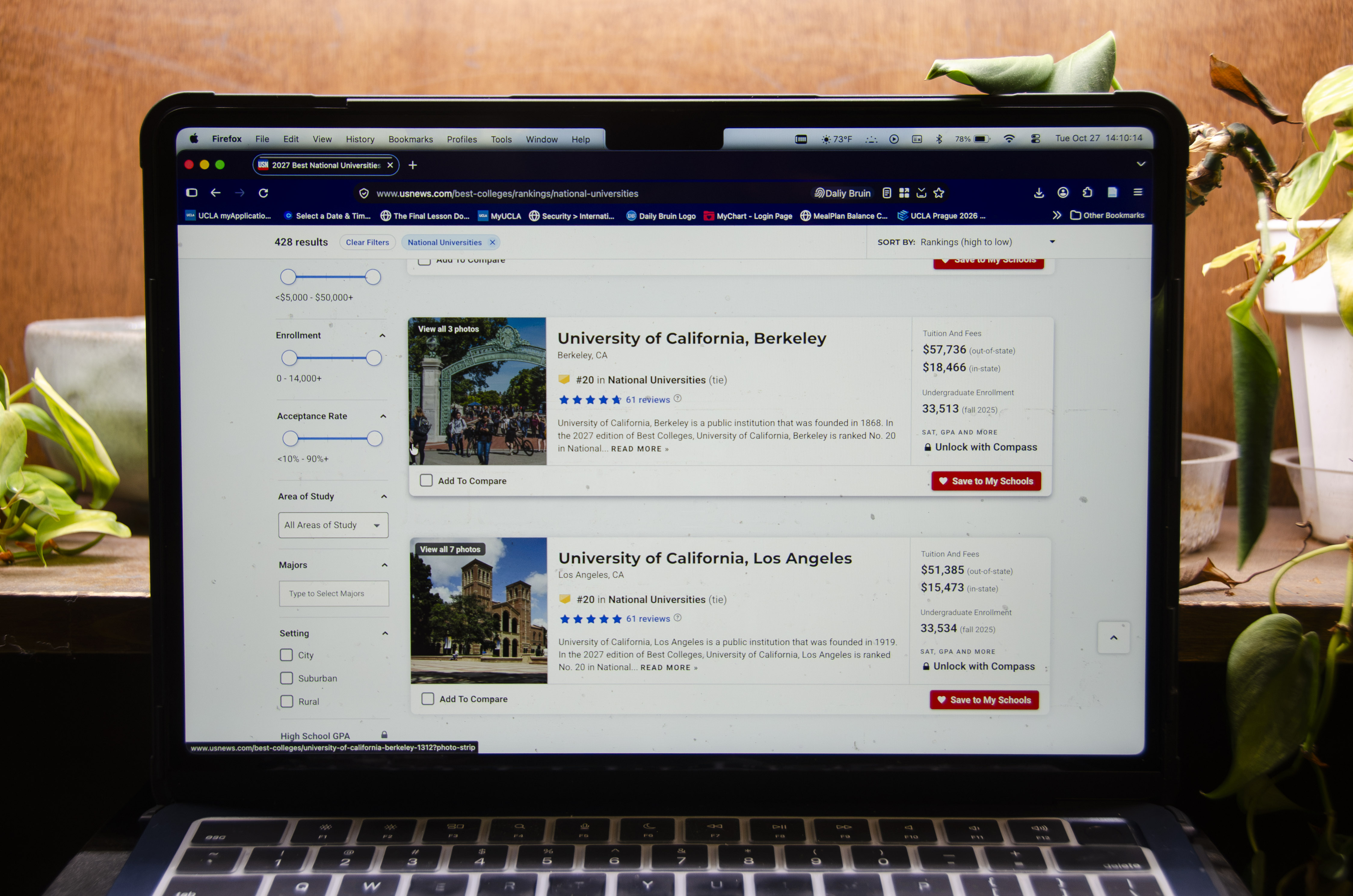
The U.S. News & World Report National Universities 2027 rankings are pictured. College rankings can have affect where students go to college. (William Gauvin/Daily Bruin staff)

By Rori Anderson
Oct. 29, 2026 6:22 p.m.
Students in all stages of education use college rankings to choose which institution to attend.
Multiple websites publish rankings of the over 3,700 degree-granting institutions in the United States. U.S. News & World Report’s annual college ranking is the most prevalent, but other websites, such as Forbes and Niche, offer alternative rankings.
So what factors do these websites consider when creating their rankings?
Eric Brooks, U.S. News’ director of education data analysis, said in a written statement that dozens of staff weigh multiple factors – including completion rates, postgraduation earnings and school resources – when making decisions.
The 17 factors are not weighed equally in a university’s ranking. For the 2027 rankings, financial resources were 8% of the overall ranking, peer assessment was 20% and faculty salaries were 6%, according to U.S. News’ website.
“The primary thing we consider when working on rankings is the people using them to inform a decision,” Brooks said in the statement. “Ultimately, students come to U.S. News seeking information and want to end up with a degree that helps them in their future pursuits.”
After losing the title of U.S. News’ No. 1 public university in 2026, UCLA tied with UC Berkeley for the top spot in 2027. UCLA was also ranked No. 20 in the outlet’s national university rankings.
[Related: UCLA regains No. 1 spot in U.S. News & World Report public universities ranking]
U.S. News sorts colleges by categories such as national universities, national liberal arts colleges and regional universities.
Dozens of U.S. News staff work on the rankings from February through October each year, including by determining eligibility, connecting with contacts on campus and collecting new data, Brooks said in the statement.
Pre-law students Saoirse O’Lionain and Safina Khan both said they primarily considered which university would set them up for success with law school applications when deciding where to go for their undergraduate education.
Khan, a fourth-year philosophy and political science student, said she was more focused on a university’s overall reputation and prestige than its ranking when choosing a college as a high school senior.
For law school applications, though, Khan said she is more focused on rankings, as she is specifically looking at the top 14 schools in the nation.
O’Lionain, a third-year history and political science student, added that she has faced more pressure to consider law school rankings because job recruiters use the metric for hiring.
Brian Backstrom, director of education policy studies at the Rockefeller Institute of Government, said he believes law school rankings are more accurate than undergraduate rankings.
“Because it’s all that specialized, the factors are fewer, and the factors are a little more representative,” said Backstrom, who researches education across the U.S.
Websites can be improved by making undergraduate rankings interactive, where each student can input their preferences and decide how much weight they give each factor, Backstrom said. Websites don’t take schools’ locations into account when creating the rankings, he added.
Rankings are generally swayed by different indicators, such as public pressure, as many colleges look for ways to improve based on what is published about the ranking process, Backstrom said. Universities ranked in the mid-30s could spend over $112 million annually on faculty compensation and student resources attempting to become a top 20 school, according to a 2014 study published in Research in Higher Education.
However, not all publications use the same factors or look into the same things. College ranking website Niche ranks aspects of the college experience such as dormitories and student life so students have more rankings to look at.
“I wouldn’t discount any of them,” Backstrom said. “I would just say look at 20 instead of one or two, because they are very different.”
The rankings can help families who don’t have the resources to travel and visit the colleges they want to apply to, allowing them to narrow down their decisions while saving money, he said.
“It’s a good thing for students to be aware of, especially if it is a student with a lot of potential who may be in a community or school district that has less opportunities, and they have less access to knowledge of rankings,” O’Lionain said. “It’s definitely important that those students become aware of what their options are because obviously there are a lot of benefits to going to a top institution.”