

California’s high-speed rail faces rising costs, delays ahead of 2040 debut
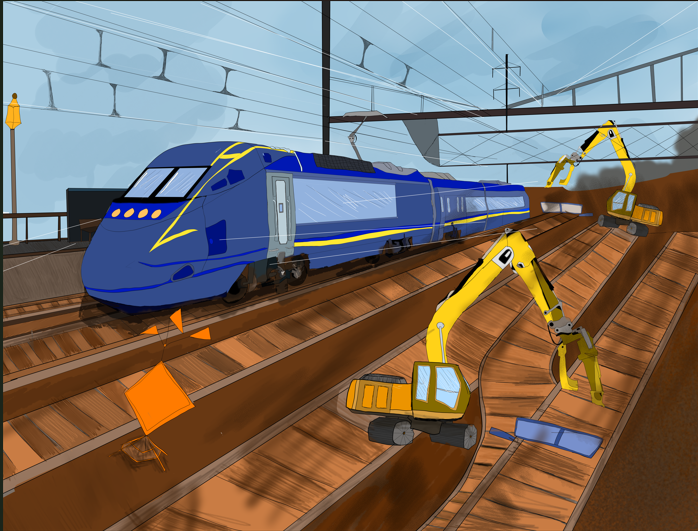
(Britany Andres/Daily Bruin staff)

By Izzy Becker
Oct. 11, 2026 5:06 p.m.
Hundreds of first-year UCLA students were infants when California voters approved the state’s first high-speed rail in November 2008.
Nearly 18 years later, the first phase of the train’s full route is not projected to be operational until 2040, a decade after those students graduate.
The railway – overseen by the California High-Speed Rail Authority – will connect San Francisco and Los Angeles, stretching roughly 500 miles and promising a commute of less than three hours. A planned second phase would extend the system north to Sacramento and south to San Diego.
The rail system aims to reduce emissions from driving and short-haul flights between major California cities.
“This is a dependable, lower carbon source of travel that’s not reliant on the price of aviation fuel, which we’ve seen really go all over the place, especially right now,” said Yu Hong Hwang, an urban planning doctoral student and researcher at the UCLA Institute of Transportation Studies.
The California High-Speed Rail Authority’s 2008 business plan would have cost the state $45 billion. But the authority’s new plan now ranges from $126 billion to more than $200 billion, according to the Fresno Bee.
The increased costs stem from delays caused by initial draft plan misjudgments and lengthy land acquisition negotiations, Hwang said.
At the same time, the loss of federal grants has delayed construction as officials search for additional funding. The Trump administration withdrew about $4 billion in unspent federal funding for the railway in July 2025, followed by about $175 million in August 2025, per the U.S. Department of Transportation.
Hwang said he believes the authority’s initial projections were overly optimistic. Costly land acquisitions, lengthy lawsuits and California’s inexperience with an undertaking of this scale likely contributed to rising costs and delays, he added.
The project’s lack of stable funding is another obstacle, Hwang said.
“We’re drip feeding money into this project, and it’s a highly variable source of funds,” he said.
California’s Cap-and-Invest program, which allows the state to raise funds by auctioning greenhouse gas emissions allowances, allocates annual installments of $1 billion through 2045 for the project, according to its website.
Michael Manville, a professor of urban planning, said ballot propositions tend to be pitched favorably to secure voter approval, so the early cost estimates for the rail system may have been unrealistic.
“The plan now looks nothing like what the voters voted on,” he said.
The railway could also negatively impact jobs along its route, particularly for Central Valley farmers, according to the Los Angeles Times. The authority has instructed some farmers to remove wells or tear out plantings to clear space for the project, per the LA Times.
But its construction is also generating jobs, with more than 19,000 jobs having been created so far, according to the authority. One hundred twenty-nine businesses owned by disabled veterans and 1,014 certified small businesses also worked on the project.
Manville said construction job totals are not the best measure of the railway’s success, though, because they are temporary.
The railway’s ability to compete with existing travel options depends on the populations it connects, said Brian Taylor, a research professor of urban planning and public policy.
Taylor said high-speed trains are most effective when they connect closely spaced major cities, drawing passengers traveling between different stops along the same line. Examples include the train from Boston to Washington, D.C., which has metropolitan areas along its route, he added.
“Even if it’s going 200 miles an hour, an airplane is going 600 miles an hour,” Taylor said. “If you’re going over a lot of open land, it’s hard to compete.”
Upon completion, the project will likely be plagued with questions about ridership, ticket cost and whether it was worth the time and money spent, Manville said.
“It’s just so hard to know what the train ultimately is going to look like,” he said.