Book review: Mariam Rahmani’s ‘Liquid’ lacks fluidity in its traversal through storylines
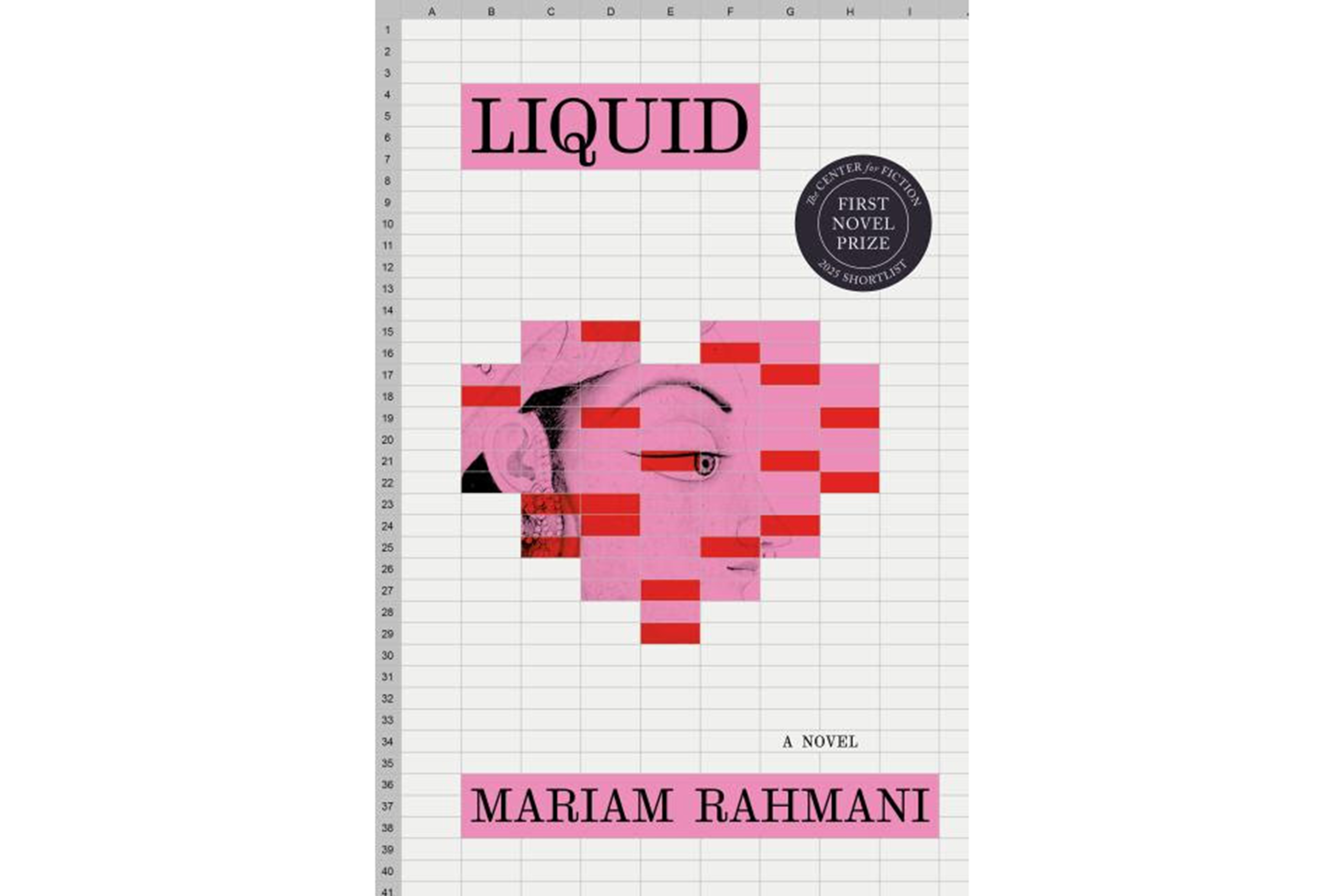
The cover of “Liquid” by Mariam Rahmani is pictured. Published in 2025, Rahmani’s debut novel follows a young Muslim scholar as she endeavors to go on 100 dates in one summer in the pursuit of marrying rich. (Courtesy of Algonquin Books)
“Liquid”
Mariam Rahmani
Algonquin Books
March 11, 2025


By Ava Johnson
Aug. 7, 2026 9:32 p.m.
Warning: Minor spoilers ahead.
Mariam Rahmani’s “Liquid” searches for the meaning of identity while struggling to establish its own.
Published in March 2025, Rahmani’s novel begins as a satirical contemporary romance before evolving into an exploration of identity. While each mode is compelling on its own, the novel struggles to reconcile them as a cohesive whole. “Liquid” unfolds over a Los Angeles summer as an unnamed narrator details her dating exploits, initiated by her ambitious goal of completing 100 dates in one summer. Behind this goal lies the narrator’s intention – marrying rich to support her postdoc life as a struggling adjunct scholar. Rahmani, a UCLA alumnus who completed her master’s degree in comparative literature in June 2017 and a Ph.D in the same field in 2021, draws on the academic world that she is familiar with as she explores intellectual ambition, professional precarity and the bureaucratic rituals of academia. These rituals, the novel emphasizes, can make a university education feel less like a path forward and instead more like an increasingly elaborate trap.
[Related: Woody Brown depicts diversity in communication through bestselling novel “Upward Bound”]
Interspersed with homages to classical rom-coms like “When Harry Met Sally”, the novel chronicles modern dating as a script to be followed, intimacy as a formula to be tracked and marriage as an exchange to be accepted rather than the culmination of love. Anticipating the next stage of one encounter, the narrator remarks she’s already seen “the script,” treating romance as a sequence of familiar beats rather than a spontaneous connection. Her spreadsheet extends that logic into arithmetic. If she completes 100 dates, she seems to believe probability will eventually produce a suitable partner. Marriage, in turn, becomes less the reward for falling in love than the practical endpoint of her experiment, one she appears willing to reach with the right partner whether or not love enters the equation.
“Liquid” reads like the narrator’s unofficial dissertation: a study of the realities of modern American dating, conducted with an appropriately large sample size. Armed with a spreadsheet and the belief that romance can be approached as systematically as research, the protagonist treats each date like another piece of data in a set. This framework shapes an otherwise repetitive parade of drinks, dinners and disappointing dates into a more easily digestible work of literary sarcasm and wit. This structure is one of the novel’s greatest strengths.
The narrator’s fixation on marrying rich is shallow by design, and Rahmani initially makes productive use of her protagonist’s unlikability. She is observant and funny but often judgemental,viewing people as subjects to classify rather than individuals to understand. The narrator is not particularly pleasant company, but she is at least reliably interesting.
As the narrator nears the halfway mark of her 100-date goal, that carefully constructed framework begins to unravel as her summer is disrupted by a family emergency, having her travel to her father’s hometown of Tehran where his ailing health forces her to confront reality. Gone are the dates with American millionaires and parties downtown, replaced instead by a story of familial hostility and Iranian identity formation. The shift in setting effectively replaces the novel’s original organizing structure of dates and spreadsheets that was initially compelling.
As family obligation takes precedence, grief disrupts her ordinary patterns and the clean architecture of the dating experiment begins to dissolve. This structural rupture makes thematic sense due to the crisis she experiences, but as the tone shifts, the main structure and plot of the book change as well and the book struggles to bridge this chasm.
[Related: Leanne Betasamosake Simpson unpacks Nishnaabe stories, decolonization in new book]
The date-by-date structure gives the first half a steady, episodic momentum, even when the encounters themselves begin to blur together. Once the narrator reaches Tehran, there is no replacement of an equally compelling framework as that organizing principle disappears. Rahmani shifts to a repetition of hospital visits, strained conversations and family routines. The effect is an accurate portrait of life during an illness, but one whose fidelity comes at the expense of narrative momentum, and struggles to keep audiences invested in “Liquid”’s story.
The move to Tehran largely sets aside the central premise that made the novel initially distinctive – the 100 date-experiment. This distinct change – presumably intended to reflect the narrator’s evolving understanding of herself – feels like a half-formed idea in and of itself and comes across as though one book has been traded for another midway through.
While perhaps not the love story it is marketed as, the writing is enjoyable, if at times overly academic. The intellectual language is most effective when it exposes the narrator’s need to theorize her way around vulnerability, revealing analysis as a defense mechanism. It is less effective when the analysis becomes a substitute for emotional access, leaving readers with polished observations about intimacy rather than actual depictions of it.
The novel has nevertheless been featured and praised by outlets including The New York Times Book Review, The Atlantic and Vanity Fair. Its critical reception speaks to the novel’s ambition – and failure – to occupy multiple modes at once: romantic comedy, academic satire, Iranian American family narrative and meditation on the distance between intellectual analysis and emotional exposure.
That ambition is the novel’s central difficulty – defining identity and crafting its own. The LA chapters turn the narrator’s transactional approach to romance into a sharp and well-structured comic premise. This first half suggests identity can be quantified – with each date serving as a data point. The Tehran chapters reach toward a more complicated examination of identity, rooted in grief, family and cultural estrangement, but do not give those themes enough relational or structural grounding to fully take hold.
“Liquid” ultimately does not prove fluid enough to move between genres, settings and ideas, lacking the cohesion to carry all of them in the same current.