Three Decades of CLICC
(Leydi Cris Cobo Cordon/Daily Bruin senior staff)


Key Takeaways
- The most circulated items are computers, iPads, and chargers, comprising over 87% of all items borrowed.
- CLICC equipment is available to loan at seven library locations across campus.
- During the 2024-25 school year, a total of 40,698 CLICC equipment loans were made from libraries across campus.
Introduction:
This year marks the 30th anniversary of UCLA Library’s Campus Library Instructional Computing Commons program.
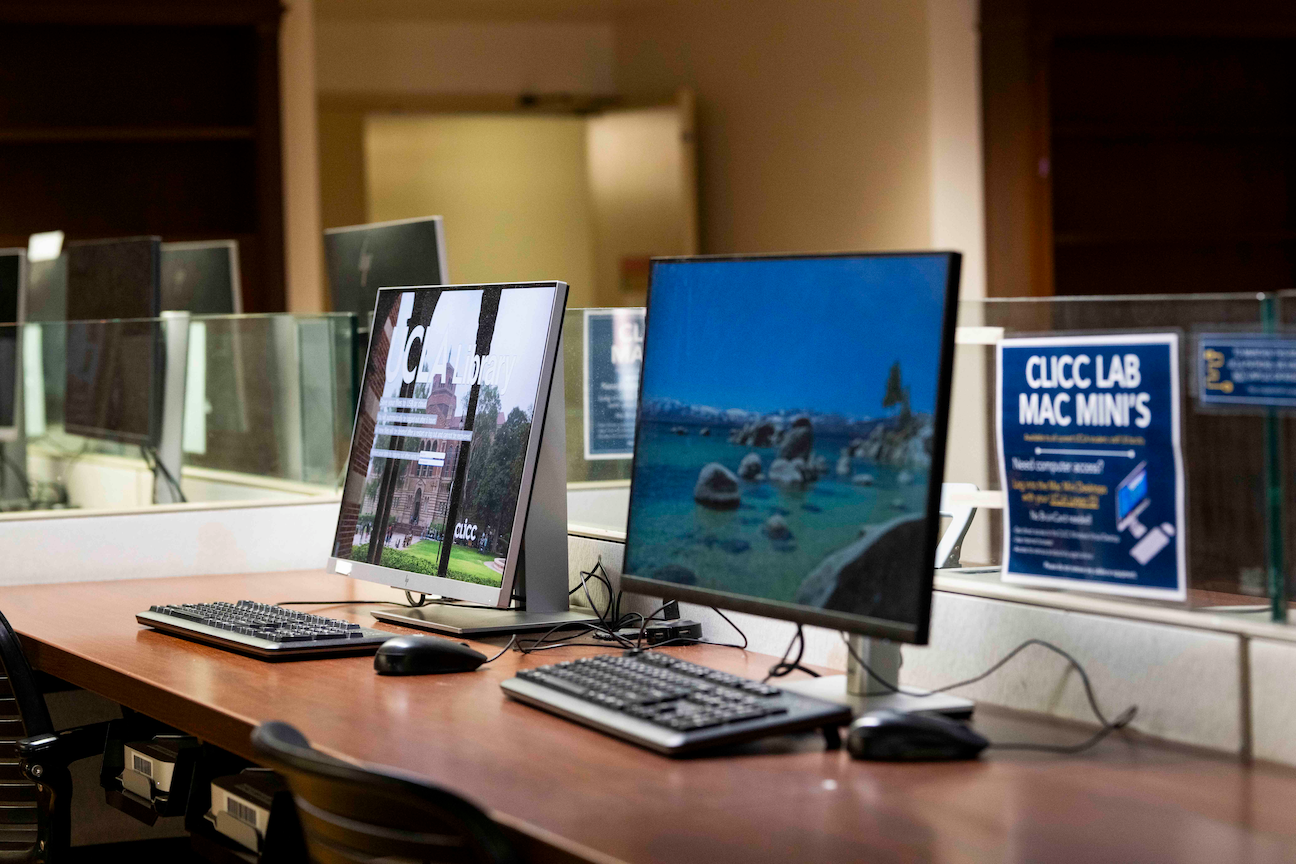
CLICC provides equipment loans and technology services for active UCLA students, staff and faculty, as well as other services such as reservations for rooms and learning spaces. There are CLICC labs located at both Young Research Library and Powell Library, which offer walk-up loans and accessible monitors. CLICC equipment is also available at seven library locations, with the quantity of equipment and types of equipment offered varying per library.
Jessica Mentesoglu, the head of IT operations and services for the UCLA Library, said she has worked to support CLICC services for 26 years.
“CLICC’s mission is to provide services that enable students to have equitable access to technology that supports their learning and academic goals at UCLA, regardless of major or academic program,” Mentesoglu said.
Over the past three decades, the CLICC program has undergone many changes.
Mentesoglu said CLICC services grew from a single lab to include technology-enabled classrooms and a robust equipment lending program. She added that the program has expanded to offer quiet study spaces in reading rooms and group study spaces.
Borrowing CLICC Equipment Campuswide
The circulation desks across UCLA’s campus allow for accessible, convenient, short- and long-term borrowing. All CLICC equipment loans require presenting a physical BruinCard.
A majority of the circulation desks offer a handful of commonly used items. If a student forgets to bring their iPhone charger to campus and is deep in South Campus at the Biomedical Library, situated in the middle of campus at Powell Library or studying in North Campus at YRL, they can borrow cables.
If a student’s calculator battery runs out, calculators are available to borrow at Boelter, Biomedical, Young Research and Powell Libraries. Other equipment, including input/output adaptors, display cables and headsets, are also available at most circulation desks.
An important note is that all “small items” such as USB-C laptop chargers, iPhone cables and expo markers have a loan period of six hours before a student is fined for late returns. All “special equipment” items, including calculators and projection kits, have a loan period of three days. Calculators and other popular items are borrowed more frequently during testing weeks, which may also affect their availability.
Mentesoglu talked about two CLICC equipment types she feels should be more well known to the student body. She said students may not be aware external power banks are available from the self-service vending machines in Powell Library, YRL and other library service desks. Mentesoglu added that chromebooks are available for loan at the BioMedical Library and several other library locations across campus.
A Quantifiable Overview of CLICC Equipment Loans
During the 2024-25 school year, a total of 40,698 CLICC equipment loans were made from libraries across campus.
Of the 40,698 equipment loans, 10,350 of them were for electronic devices (computers and iPads), comprising of 25.4% of the total items borrowed, and 26,443 of them were for chargers (ranging from phone to computer), comprising of 65.0% of the total items borrowed.
Lending periods vary for different items. Windows HP Laptops, for example, are designated for quarterlong loans. Macbooks and Chromebooks are designated for biweekly loans, and chargers and other accessories are loaned in six-hour intervals. This difference may help explain the discrepancy in the number of loans for similar items.
CLICC’s usage increased by 2,000 loans between the 2023-2024 school year and the 2024-2025 school year, with projections indicating continued growth.
Clarissa Uytiepo, a third-year psychology student who has worked at the CLICC Lab for over three quarters, said she attributes this growth in loans to two factors: an increase in inventory offered by the CLICC Lab as well as new lending plans that favor students.
“I think we offer a lot more devices now, and there’s definitely a lot more devices that are available for Long-Term Lending, which is for the whole quarter,” Uytiepo said.
Uytiepo said this increase follows more public awareness regarding CLICC Lab services, especially from incoming students.
“I think a big reason might be because I was at NSA this past summer, and as part of the tour we did highlight the CLICC services and how we offer free Macbooks, iPads and Chromebooks,” Uytiepo said.
How Much Can You Save? The Cost and Benefits of Borrowing CLICC Equipment
Although CLICC charges a $12 per hour late fee for unreturned items, CLICC Lab borrowing can help students save money on learning materials. For some students, the service provides a stopgap when personal devices fail.
Ingrid Leng, a third-year public health student, said she turned to CLICC after her laptop broke. Rather than immediately buying a replacement, she said she borrowed a MacBook from the CLICC lab for over a quarter while waiting for Black Friday deals.
Leng had first discovered the service earlier while borrowing an iPad for about five weeks to use in her Chinese class, which she found more convenient than taking notes in a traditional notebook.
The CLICC Lab also lends more specialized equipment, including Yeti microphone kits for recording, projectors and external CD readers.
History of the CLICC Lab and its role during COVID
The CLICC Lab has changed drastically since its founding three decades ago.
“In 1996, CLICC was a single room of 100 desktop computers with big, boxy monitors,” Mentesoglu said.
“In 1999, CLICC piloted two loaner laptops. And by 2011, CLICC had 500 laptops and other equipment. CLICC now has close to 1,000 pieces of equipment, as well as virtual desktops, which enable students with an internet connection to access software and applications from anywhere without having to install the application on their local device.”
This commitment to providing students with accessible resources has been crucial to helping UCLA adapt to unexpected circumstances. For example, Mentesoglu said CLICC helped thousands of students during COVID to continue their education online when they could no longer pursue it in-person.
“At the height of the pandemic, between March 2020 and September 2021, CLICC coordinated nearly 3,000 long-term loans of laptops, Chromebooks, iPads, and MIFI units, and we shipped them to users’ residences if they were unable to pick them up on campus,” Mentesoglu said.
Future of the CLICC Lab
Recent changes that the CLICC Lab has implemented over the past few years include increased loan periods, surveys to assess virtual desktop services, as well as partnerships with the Undergraduate Students Association Council and ASUCLA.
Mentesoglu said a USAC request led directly to the availability of scientific calculators for loans. She added that CLICC introduced BruinPrint kiosks in library spaces, which are managed in partnership with ASUCLA to address student needs and trends.
As the CLICC program looks to the future, especially with the rapid digitization of learning and incorporation of education technology, it will remain responsive toward present conditions and adapt to student needs.
“CLICC will evolve and expand its services based on usage patterns and student and faculty feedback while remaining true to our mission to provide services that enable students to access technology that supports their learning and academic goals at UCLA,” Mentesoglu said.