Q&A: Incoming dean of UCLA Anderson School of Management reflects on plans, future
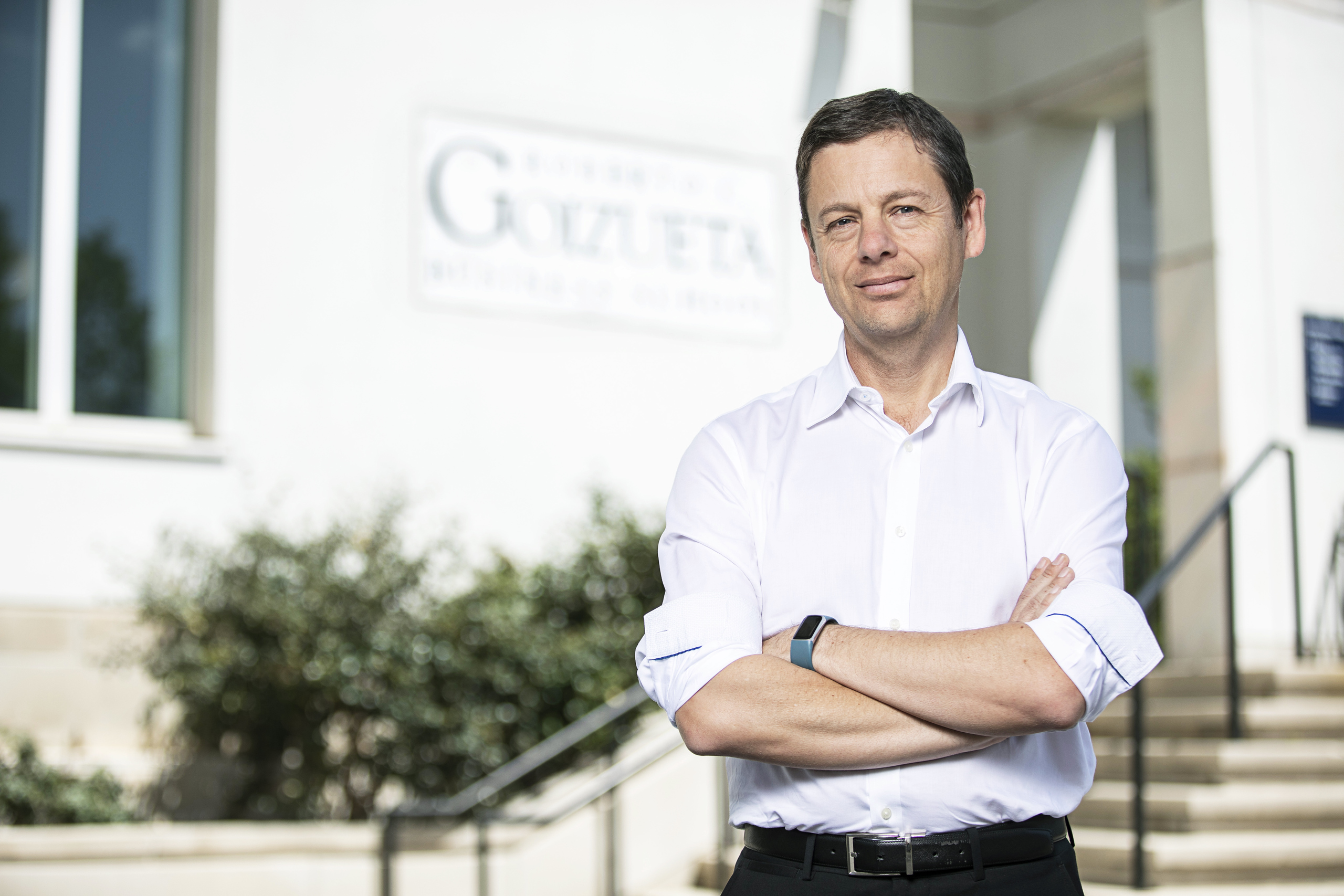
Gareth James, the new dean of the Anderson School of Management, stands in front of a building at Emory University. James, who served as the John H. Harland Dean of the Goizueta Business School at Emory University since 2022, has also held leadership roles at the University of Southern California. (Courtesy of Emory University)

By Natalia Mochernak
May 4, 2026 9:14 a.m.
Gareth James will serve as the new dean of the UCLA Anderson School of Management starting July.
Campus politics editor Natalia Mochernak sat down with James to discuss his background as a statistician and his vision for the school’s future. James, who served as the John H. Harland Dean of the Goizueta Business School at Emory University since 2022, has also held leadership roles at the University of Southern California.
[Related: UCLA Anderson School of Management appoints Gareth James as dean]
This interview has been edited for length and clarity.
Daily Bruin: Why UCLA? What about UCLA and the School of Management stood out to you?
Gareth James: As you probably know, I was at the university across town for a long period of time at the business school there. And so, I got to observe Anderson as the business school from close borders, and Anderson was always the top business school in the Southern California region. It was always a tough competition. The opportunity to get to lead a school like that is obviously an incredible honor, but it’s more than just Anderson itself – it’s also UCLA, which is obviously one of the top two or three public universities in the entire world. … There are a large number of really top-tier other schools at UCLA for Anderson to collaborate with – schools like engineering and law school and places like that. Anderson has already started to move in that direction, but there’s probably still more opportunities.
It all sits within LA, which is a truly global city. I spent 24 years there, so I know the city very well, and it’s great to be coming back home in that sense. All of that sits within California, which is the entrepreneurship and technology capital of the world, the fourth largest economy in the world. You put all of that together, and it’s really a pretty easy decision.
DB: You mentioned that the people you spoke with want (the school) to get better. Can you share what they’ve spoken about?
GJ: Obviously, rankings are always one aspect. I think if you look at the quality of our faculty at Anderson, it’s easily a top-10, if not a top-five, business school in the country. If you look at the MBA rankings for the full-time MBA, which tends to be the ranking that people look at most, it’s 18 at the moment in the U.S. News (and World Report), for example. Like most schools, we believe that we’re better than that ranking. And so, we’d love to continue to move that ranking up. The ranking is based on a number of factors – reputation scores, career placements, the qualities of students we are bringing into the program and things like that. There’s a balancing act and trying to ensure that we have the resources to make that program as strong as possible. We already have great students and great faculty, which is the number one starting point.
DB: What are some things that you’ve learned from your time at Emory and USC, and how do you plan to apply these lessons to UCLA?
GJ: I’ve learned a lot of things from mistakes I’ve made in the past, which are usually the best learning experience even though they’re sometimes painful. One of the really strong lessons I’ve learned is that as you become more and more senior in an organization, there’s less and less that you can directly do yourself – and it becomes more and more important that the people who directly report to you and the people that directly report to them are the strongest possible individuals you can have.
Anderson already has developed a very strong strategic plan. I might make a few edits to it, but on the whole, it’s actually very closely in line with what I would imagine for the school. So there’s already a clear strategy there. We just have to start to figure out how to continue to implement it. It’s already been implemented, but to continue to move it forward.
One other lesson is the importance of culture and how challenging it is to change culture within an organization, which is another reason why I’m very pleased that my early conversations have suggested that the culture is already very strong at Anderson.
DB: You said your vision is very strongly aligned with that vision that is already present at Anderson. What is this vision?
GJ: If you look at Anderson’s strategic plan, they have a number of aspects to it. For example, one of them is to integrate more strongly with UCLA itself. Business schools themselves often are relatively isolated from the rest of the university. They, for whatever reason, sometimes are on the outskirts – both often physically and culturally – of universities. Anderson has already made some big strides to become more integrated with the university. They’ve launched some new minors for the undergraduate program and started working with some of the other schools.
[Related: School of Management to launch new sports leadership minor for undergraduates]
Another aspect I’ve talked about is the possibility of launching some more specialized master’s programs for students, in particular for UCLA undergraduate students after they finish their undergrad – providing opportunities for them to continue in business education, or maybe to start business education. For example, there are a lot of amazing UCLA undergraduates from the humanities, from STEM fields, that maybe have little or no business experience. And some of them may well benefit from a one-year specialized master’s program after they graduate to provide them with some accelerated business training and experience to help them with their first job once they graduate.
[Related: UCLA Anderson School of Management announces real estate minor to start next fall]
DB: How has your background as a statistician influenced you as a leader in higher education?
GJ: On the business side, I have at least a basic understanding of finances and accounting, and marketing and strategy and all those sorts of topics. But the statistics and science training also helped me to think through things in an analytical fashion and try to ensure that any decisions we’re making are at least partly based on quantifiable data.
You can never get perfect information to make some of these decisions, but trying to mix not just gut instinct but a data-driven approach, or at least data-influenced approach, helps. It’s helped me throughout my administrative career as well as my research and teaching career. So, I feel like that has been a personal advantage for me – having that sort of wider background than just business or just science – and I’ve worked very hard throughout my career to continue to expand that knowledge set in both of those areas.
DB: You’re taking the helm of the School of Management at a time where UCLA has faced a lot of turmoil. There’s been attacks from the federal government on our research funding, we’re facing a major budget deficit and the business school has been in a lawsuit with a continuing lecturer at the school for many years. How do you plan to take on challenges like these that may come your way?
GJ: I will say these are not challenges that are unique to UCLA. Many of them are ones all of higher education has experienced – and certainly Emory – we’ve gone through our own turmoil in relation to some of these challenges. I’ll make a few general comments about higher education and business schools in particular.
First of all, it’s a very challenging time for business schools in particular. Not only are there the challenges associated with topics that you raised in your question but while there’s increasing demand for business education at the undergraduate levels we just discussed, there’s some decline in interest in, for example, the MBA programs – which have been a mainstay for many business schools, including Anderson.
We need to figure out in the long run – how do we provide a high-quality product to our students at a price point that the average individual can afford? Because obviously there’s massive not just tuition costs associated with doing a full-time MBA, but the opportunity cost of giving up two years of employment to come back to school to do that program. So we have to ensure that when students do that, they get the best possible experience and end up with great jobs at the end and a great experience during that time period.
Then in higher education, there’s somewhat related questions. Technological advances and changes in cultural norms over the last five years since COVID-19, that over the last 10 to 15 years overall – the student experience is very different than it used to be. When I first started teaching, you would have a lecture, and the vast majority of students would turn up for that lecture as long as it was a good instructor. These days, more and more of my colleagues are frustrated by the challenges of getting students to actually come into the classroom and experience the classes. As a father with two sons in college, I know they have some of the same challenges themselves. And the reality is that there are many more opportunities for students to learn now. There’s a lot of high-quality video and related materials online. If faculty post their lectures online, often students would rather watch it at one and a half or two times speed than sit in the classroom.
As instructors, we have to ask ourselves: What is the value proposition that we’re providing?
We have to be very careful to ensure that there’s an added benefit beyond just sitting in front of a screen and watching that video. … That physical campus experience and the interactivity of the students on that campus is a real value proposition and differentiator that no online video can provide.
DB: You mentioned that something you’re interested in is speaking more with students. How do you plan to hear input from student voices?
GJ: What I’ve been doing at Emory here is that I have regular coffee chats with small groups, maybe six to 10 students at a time, from each of our different programs. We have a number of different programs here in the business school, and so I do multiple of these coffees every semester. And they’re a very casual – a chance for the students to hear from me or share any questions they have about what’s going on in the school, but also a chance for me to hear from them what’s going well in their programs and any challenges that they’re experiencing.
Any one of those conversations might not provide a great deal of information, but when you have a lot of them and you put all that information together, you start to get a very strong sense about which programs are going extremely well, which programs have generally doing well, but have some small issues, and then any programs that might have bigger issues that need to be addressed more urgently. Those are one of the most fun experiences I have in my job as dean, and I think the students get a lot out of it as well. So, I would certainly imagine continuing that and maybe expanding it.
But in addition to that, certainly in my first year, my goal would be to have some more formalized meetings where I’d be specifically trying to learn from the students and each of the different programs… Students are generally pretty good about both emphasizing the positives and also any challenges that they’re experiencing, and it’s much better to hear it in person at the beginning than to wait and then find out later on that you’ve got these challenges to deal with.
DB: What is your general philosophy surrounding facing challenges that might come your way?
GJ: The first one is to take a calm and measured approach. When I was younger, I tended to treat every scenario that came up as an emergency and maybe a disaster and something that needed to be dealt with urgently. As I’ve gotten older and had more experience, you see more and more things go wrong – and realize that sometimes you can actually make things worse by acting in haste. It’s almost never the case that something is so urgent that it can’t wait a few days for you to think through the consequences.
But also, if you see patterns as the leader in the school, then you need to start to try to address them. … It feels like in the last five to 10 years there have been an increase in the number of those sorts of issues occurring – both in higher education and society in general. That only makes it even more important to take a breath, think carefully about what your steps are and then move on.