






IN THE NEWS:
What we're covering here
The Daily Bruin covers breaking news relevant to the UCLA community as it happens. This page includes coverage of the July 2025 trial between plaintiff Gordon Klein, a UCLA accounting lecturer, and defendants Antonio Bernardo, dean of the Anderson School of Management, and the UC Board of Regents. UCLA suspended Klein in June 2020 for an email in which he rejected a student’s request for him to provide grading accommodations to Black students in the wake of George Floyd’s murder. In the email, Klein suggested that providing said accommodations would constitute “special treatment” for Black students and that white students from Minnesota might “be even more devastated” by Floyd’s murder. Klein is requesting over $22 million in damages, alleging that UCLA’s suspension destroyed his reputation and caused him emotional distress. Read the Daily Bruin’s trial preview here for more information.
Zimo Li
9/6/2025, 11:18:52 AM403 Days, 13 Hours, 18 Minutes AgoGoldberg responded to the defense’s arguments surrounding Olivia Truong – a former student of Klein’s who claimed he has a history of sending inappropriate emails – by calling the argument “a weird smear.” He added that Klein was never accused of sexual harassment and said Bernardo’s decision to suspend him was unrelated to Truong.
Zimo Li
9/6/2025, 11:16:26 AM403 Days, 13 Hours, 20 Minutes AgoSandra McDonough, an attorney for the UC Regents and Bernardo, said the publicity from Klein’s email was enough to damage his reputation alone. She added that screenshots of Klein’s emails received around 18 million impressions across platforms before Bernardo informed the School of Management that Klein would be put on leave.
“This court should not allow Mr. Klein to shift the blame to the defendants for his mistakes,” McDonough said.
Zimo Li
9/6/2025, 11:13:03 AM403 Days, 13 Hours, 24 Minutes AgoSteven M. Goldberg, an attorney for Klein, said the central question in the case is Bernardo’s motivations for suspending Klein. Goldberg added that the University acted out of a desire to appear “strong” and “appease students,” calling the move “ill-motivated” and a violation of Klein’s academic freedom.
Victor Simoes
9/6/2025, 11:10:19 AM403 Days, 13 Hours, 26 Minutes AgoThe trial concluded with closing arguments from both sides. Klein’s attorney said Bernardo’s emails misrepresented Klein and hurt his ability to attract new clients, adding that Madsen’s estimate of damages was conservative.
Attorneys for the UC Regents and Bernardo said there was no evidence that showed Klein’s administrative leave was the “substantial factor” in his lost income, contending instead that Klein’s own actions were to blame.
(Zimo Li/Daily Bruin senior staff)
Zimo Li
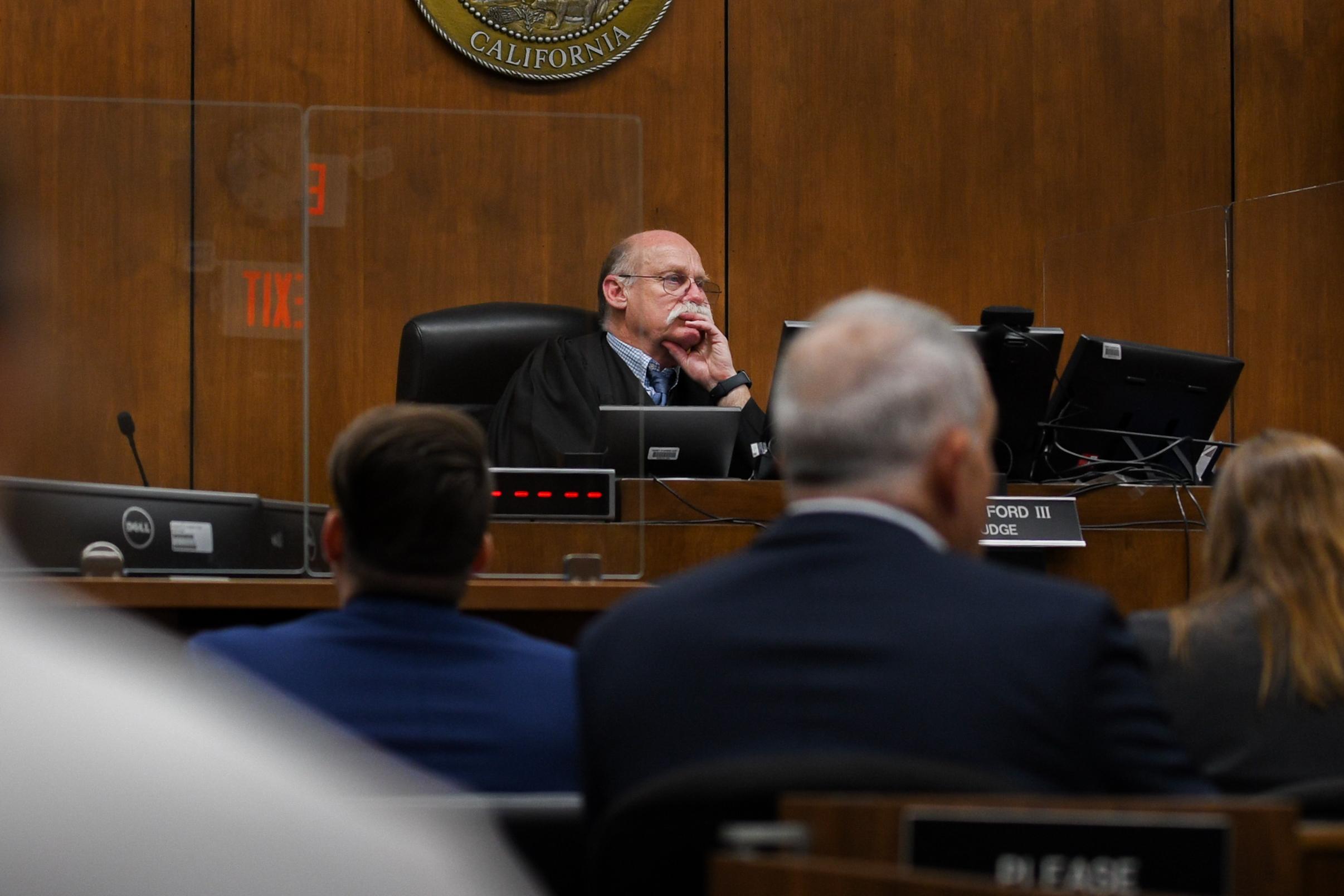
8/18/2025, 5:33:58 PM422 Days, 7 Hours, 3 Minutes AgoJudge H. Jay Ford III said Friday that the trial will resume for closing arguments at the Santa Monica Courthouse on Sept. 5 at 1:30pm.
Zimo Li
8/16/2025, 9:28:23 PM424 Days, 3 Hours, 8 Minutes AgoHeather Caruso, the UCLA Anderson School of Management’s associate dean for equity, diversity and inclusion, testified Friday that she found Klein’s conduct especially concerning due to the broader social context in June 2020.
“It sort of felt like the world was on fire,” Caruso said.
Caruso likened Klein’s email to a neighbor setting off fireworks during the January 2025 Los Angeles County fires. She testified that she was concerned about Klein’s behavior, saying he did not exercise sound judgement when communicating with students and that such conduct was not in line with the school’s high standards for professors.
Victor Simoes
8/15/2025, 10:40:57 AM425 Days, 13 Hours, 56 Minutes AgoVilma Ortiz, the former chair of the Academic Senate’s Privilege and Tenure Committee, testified Thursday. She said the committee, which reviews grievances brought by Academic Senate members who believe that their rights as faculty may have been violated, reached a split vote about whether UCLA violated academic freedom principles by placing him on leave, leading to no formal hearing.
However, Ortiz added that she believed Klein’s email reflected a “significant lapse in judgment,” with a “condescending” and “dismissive” tone where a simple “no” would have sufficed.
Victor Simoes
8/15/2025, 10:39:22 AM425 Days, 13 Hours, 57 Minutes AgoJohn Meyers, who provides vocational rehabilitation consulting services, testified Thursday that Klein earned less money following his administrative leave because of the closure of courts – where he was paid to serve as an expert witness – during the COVID-19 pandemic and general volatility in the expert witness industry. Klein’s administrative leave, Meyers said, was “certainly” explicable to potential clients.
Victor Simoes
8/13/2025, 7:31:49 PM427 Days, 5 Hours, 5 Minutes AgoJustine Farrell, the chair of the marketing department at the University of San Diego’s Knauss School of Business, continued her testimony Wednesday.
She said that, based on impression data from Cision, Klein’s media appearances – including him speaking about his administrative leave on Fox News multiple times – created “substantial media attention” around the situation, while the email announcing his leave which was sent to Anderson School of Management students did not.
Victor Simoes
8/13/2025, 11:10:02 AM427 Days, 13 Hours, 27 Minutes AgoMohammed Cato, the director of Title IX at UCLA, testified Tuesday about a Title IX complaint that was made against Klein.
Cato said the office did not proceed with a formal investigation because the affected parties did not want to come forward. Cato said he reached out to Klein on Aug. 27, 2020 to notify him of the complaint, inform him of potential consequences and best practices to take in response.


searching for more posts...