Dining halls bring home cooking to campus through cultural food nights

(Yejee Kim/Cartoons director)

By Sofia Sheremet
May 3, 2026 2:19 p.m.
To attend UCLA, Aaron Wen had to leave a lot of things back home in China.
Wen, a second-year economics and statistics and data science student, left behind not just personal belongings, but connections as well. Leaving family and friends, international students uproot their lives to move across the world to attend UCLA. Many rarely go back, often missing key cultural events such as Lunar New Year.
“For international students, we didn’t really get a chance to spend time with our families,” Wen said. “We just fly overseas to study and then we will miss every Spring Festival.”
International students make up almost 20% of the undergraduate student body, totaling 6,347 of 33,040 undergraduates, according to UCLA’s website.
“Just imagine you will miss every Christmas with your family, maybe six years in a row if you’re in graduate school and four years in a row if you’re in undergraduate,” Wen said.
UCLA hosts multiple cultural initiatives throughout the year, ranging from special dining nights to Easter egg hunts to craft markets. Many are developed through collaborative efforts between the university and student organizations, like UCLA’s division of the Chinese Union, which Wen is the president of.
In preparation for this year’s Lunar New Year, residential dining hall Feast at Rieber organized a celebratory dinner. The event took place Feb. 17 and featured dishes incorporated from northern and southern Chinese cuisine, including three-cup chicken, mapo tofu and spinach with peanuts. Wen said he wrote recipes for the meal while UCLA Dining prepared it.
Wen said sharing his home-cooked recipes was both a way to feel close to home and share his culture.
“Chinese food restaurants, like Panda Express, or other Chinese restaurants, they’re not authentic Chinese food,” he said. “I just want more people from the United States, or people who are not Chinese, to at least know what the real Chinese food tastes like.”
Lunar New Year night was just one of many initiatives across campus to incorporate student heritage into food.
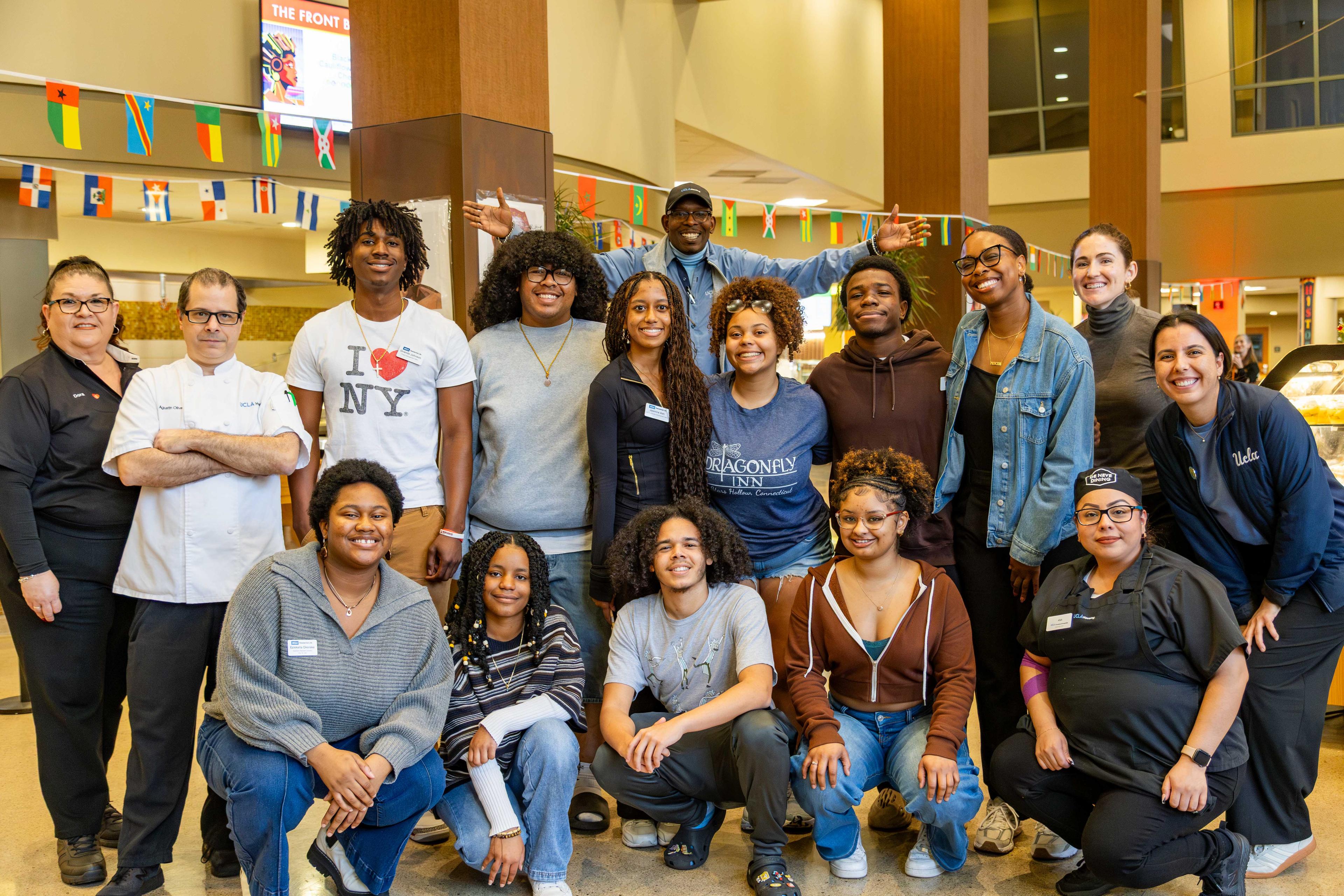
In February, UCLA Dining also celebrated Black History Month, with a special Black History Month Celebration Dinner at De Neve Residential Restaurant. The Afrikan Diaspora Living Learning Community and the De Neve dining staff co-organized the event. In March, Epicuria at Covel Commons hosted Taste of Italy for students to sample Italian cuisine. Later that month, FEAST hosted Pinoy Night to celebrate Filipino food and culture.
[Related: De Neve dining hall Black History Month Dinner celebrates Black culture, soul food]
Cultural nights are not the only initiative by UCLA to celebrate diversity on campus. Programs such as Global Bites and Recipes from Home encourage students to submit recipes and collaborate with Housing and Dining staff. These events spotlight dishes directly from the student’s home, community and cultural background, a UCLA Housing-Dining spokesperson said in an emailed statement. While Global Bites are often organized with student organizations, Recipes from Home offers individual students a chance to tell their personal stories via dishes from their cultural background.
Past Global Bites events included Shish Barak, organized by the Lebanese Student Union; Maqloubeh, organized by the Middle Eastern Student Association; and Jollof Rice, organized by the Nigerian Student Association.
The goal of such initiatives is to bring a sense of home to student dining experiences, while creating opportunities to bring students together and allow chefs to showcase their talents, the spokesperson added.
David Chung, a fourth-year English student, said UCLA Dining’s efforts celebrating students’ cultures helps to build empathy among the student body.
“Not everyone can just drive back home,” Chung said. “If this is the place they’re going to be, they gotta feel like they belong.”
For students who partake in cultural nights, it’s also a way to try new foods and obtain exposure to cultures they may not have experienced before.
“Growing up as a kid, when you have different kinds of food, or even as an adult, people react with disgust towards people eating food that they’re not familiar with,” said Gloria High, a first-year mathematics of computation student. “It’s good to get used to seeing other kinds of food – you destigmatize a lot of food in your head, just a little small way of getting rid of unintentional prejudice.”
Exposure to diverse cultures and cuisines has been shown to benefit students positively in other ways.
According to Purdue Global, diverse environments help people develop empathy, build meaningful relationships, expand worldviews and increase innovation through collaboration.
For High, the cultural nights are fun.
“It’s just cool for students,” High said. “We’re getting an education or becoming more globally minded through food.”
This year, from April 13 to 16, UCLA Dining hosted Recipes From Home nights, a dining initiative for individual students to share family recipes with their peers. The initiative was first launched in Spring 2024. Students are invited to submit recipes from their home or community and describe why that recipe is meaningful to them, as a way for students to connect back with the feeling of home, according to the UCLA Rothman Family Institute for Food Studies.
Micah Taw, a second-year physiological science student, said he submitted his family’s recipe for chicken and long rice soup, a Hawaiian-style dish.
“It’s not very often for students to just go home and visit home and share a meal around the table with their family,” Taw said. “At college, their new family is really their friends and their community, the UCLA community.”
Last year, UCLA Dining selected Meileen Taw, Micah Taw’s sister, for the same initiative. She said she shared ohn no khao swe, a Burmese coconut soup, to reflect some of her family’s Burmese culture – and because it’s one of her favorite things to eat.
“UCLA opening up their kitchens and their dining halls and their venues is really nice,” said Meileen Taw, a fourth-year human biology and society student. “Because they could just choose what they want to serve, but instead, they’re giving an opportunity to students to share their recipes with them and the students to actually be able to try them.”
[Related: UCLA Dining’s ‘Recipes From Home’ initiative cooks up cultural meals, memories]
Taw’s chicken and long rice soup concluded a week of flavorful home dishes. This year’s initiative started April 13 with lahanodolmade, a form of stuffed cabbage rolls from Greece. It was followed by fan qie chao dan, a Chinese dish. Students also sampled a variation of black bean and potato saute, originating from second-year molecular, cellular and developmental biology student Imogene Gaede’s home state, Colorado.
The saute is her mother’s adaptation of a recipe originating from a restaurant in the Telluride Ski Resort, which Gaede said was recently torn down.
“It’s torn down now, so people can’t really go there and experience it and try the dish anymore,” Gaede said. “I’m able to keep the place alive through the food that they served, and being able to share it with my classmates and such a wide audience is really meaningful.”