Immigration enforcement in ways ‘never been done before’: A look at Trump’s DHS
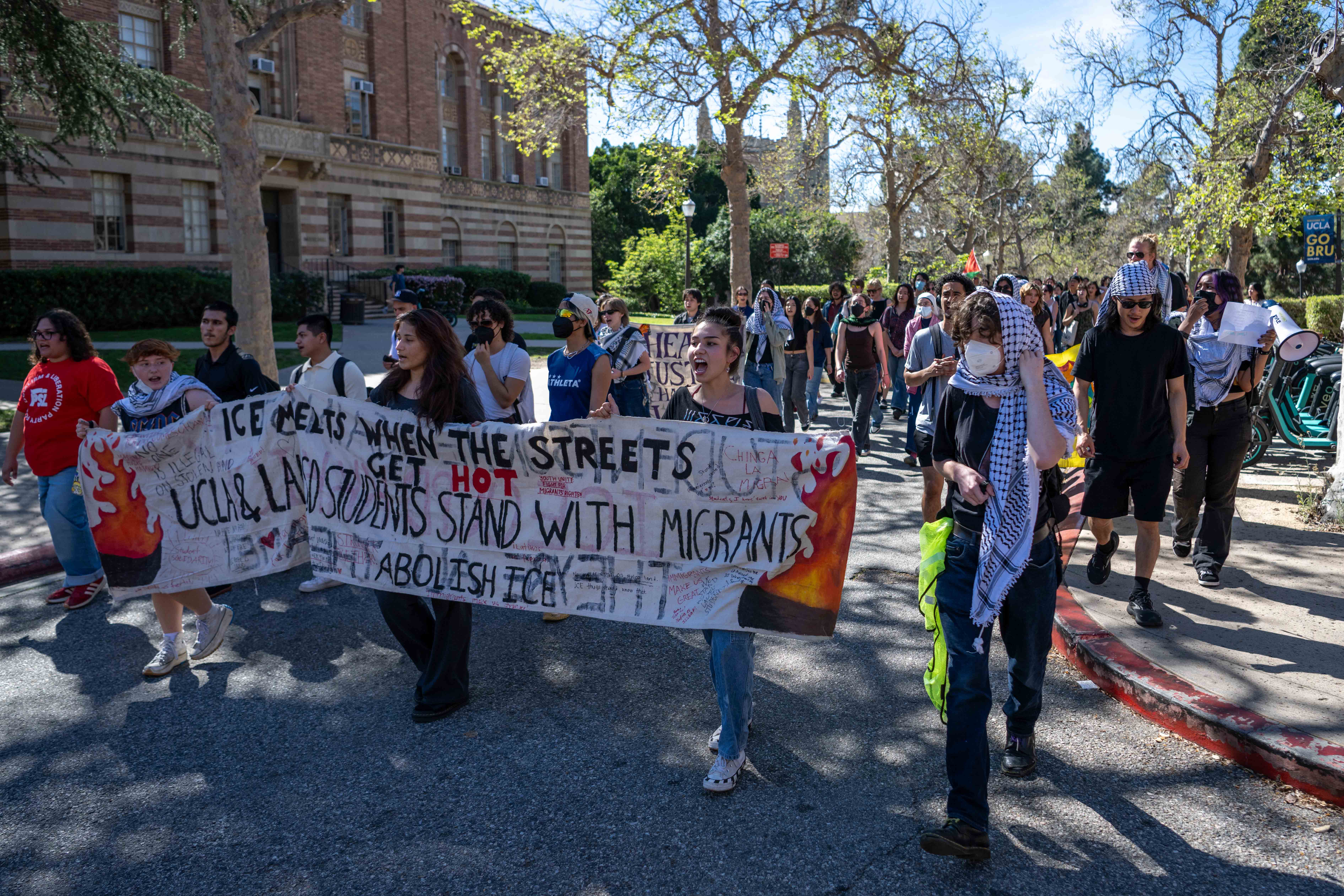
Demonstrators protest outside Moore Hall. President Donald Trump’s immigration enforcement strategies have drawn criticism nationwide. (Andrew Ramiro Diaz/Photo editor)

By Nicholas Mouchawar
April 17, 2026 10:30 p.m.
Amid a partial government shutdown, the United States Department of Homeland Security observed its 23rd anniversary in March.
DHS oversees Immigration and Customs Enforcement, U.S. Customs and Border Protection and the Federal Emergency Management Agency. Together, these agencies work to address security, immigration and disaster management concerns at the federal level. President Donald Trump’s second administration has faced intense scrutiny over its expanded use of ICE to carry out stricter immigration enforcement, particularly after ICE agents shot and killed two Americans earlier this year.
[Related: UCLA faculty discuss new California laws restricting immigration enforcement]
The federal government created the DHS after 9/11. The department was designed to address domestic concern over national security, said Talia Inlender, the deputy director at the Center for Immigration Law and Policy at the School of Law.
“It’s, in some ways, a relatively new phenomenon and grew out of a time when there was a concern about how well law enforcement agencies were working together to combat terrorist threats,” Inlender said.
ICE is the largest investigative arm of the DHS and is tasked with enforcing federal immigration and customs laws, including investigating criminal and terrorist networks and addressing the movement of people, goods and contraband into, within and out of the U.S.
Inlender said ICE has traditionally handled interior enforcement, including detention facilities and removals, while Border Patrol Agents within Customs and Border Protection have focused on enforcement near land and maritime borders.
“One thing that has changed dramatically during the second Trump administration is that they have not only substantially increased ICE enforcement in the interior,” Inlender said. “But they have also taken Border Patrol … and deployed those across the United States well into the interior in ways that have never been done before.”
Since returning to office, Trump has said his administration intends to dramatically expand immigration enforcement and carry out what he has described as the largest deportation operation in U.S. history.
His January 2025 Executive Order 14159 prioritized interior enforcement and expanded the administration’s ability to carry out expedited removals. Since then, ICE arrests have increased sharply, with Reuters reporting that the agency averaged 746 arrests per day in 2025 – a rate over twice as high as it was from 2015.
Trump administration officials said enforcement efforts are focused on people with criminal histories, but the lack of enforcement guidelines has expanded the range of undocumented people that are subject to detention and removal to noncriminals. According to Reuters, only a third of the 177,000 detainees from late 2024 to the end of May 2025 had criminal convictions.
The White House did not respond in time to a request for comment on the administration’s approach to immigration enforcement.
[Related: ‘Is it selfish for me to go?’: UCLA applicants worry over immigration crackdowns]
While Trump’s first term also oversaw the forced removal of approximately 2 million undocumented immigrants, his second administration has broadened its enforcement applications in unprecedented ways.
That expansion has coincided with a surge in federal court challenges. As of March 3, Reuters reported a sharp increase of 434% in lawsuits filed in 2025 compared to the prior year by detainees contesting the legality of their detention.
Inlender said part of the administration’s legal framing has relied on characterizing immigration as an invasion.
“To use that characterization, to rely on laws that, in my view, were not meant to be used outside cases of foreign invasion of war,” Inlender said. “He’s trying to use them in really unprecedented ways.”
In Minnesota, federal officials used this rationale to deploy additional immigration agents under Operation Metro Surge, the largest immigration enforcement operation in U.S. history, bringing additional ICE and USBP officers to execute arrests, according to the Minnesota Reformer.
Immigration attorneys, including the ones working for UC’s immigration services, have seen the effects of increased ICE presence in their daily work.
“There has been this uptake in consultations for immigration court or for family members that have been or are in removal proceedings or that have been detained,” said Gina Pech-Sanchez, a UC Immigrant Legal Services Center attorney.
Since starting her position in 2023, Pech-Sanchez said she has seen a significant increase in removal defense cases, along with a rise in inquiries related to immigration court detention and ICE check-ins compared to the Biden administration.
Pech-Sanchez added that detention and removal defense attorneys have faced a substantial shift in legal strategy, as changes to immigration case law have restricted the ability for judges to grant bond hearings – hearings that determine if the detained pose a threat to public safety or national security, or can be released.
As a result, some attorneys have moved away from immigration court bond hearings and are turning to challenge the legality of the detentions.
Beyond courtrooms, enforcement tactics themselves have changed.
Pech-Sanchez said she has observed more of these operations happening, previously hearing of enforcement stops and presence infrequently but now hearing of them nearly every day.
“We’re still seeing the unmarked cars,” she said. “We’re still seeing some plainclothes officers.”
Pech-Sanchez said the increase in operation frequency coincides with increased federal recruitment efforts.
In February, CBS reported that an ICE whistleblower who was a former instructor at the agency testified before Congress, alleging that the agency had shortened training for new recruits from 72 days to 42 days.
The whistleblower said new officers were graduating without sufficient instruction in constitutional law and use-of-force standards. DHS officials have since contested claims that training has been significantly expedited.
[Related: Students call for UCLA to adopt sanctuary campus title amid immigration crackdown]
ICE’s expanded operations have not been limited to recruitment and training, as the agency has also expanded its reach with 287(g) partnerships – agreements enabling local law enforcement’s assistance in enforcing immigration laws with ICE.
“For example, if you’re pulled over for speeding, that local law enforcement officer can just give you a ticket for speeding,” Pech-Sanchez said. “But under these partnerships, they can also ask about immigration-related or conduct immigration-related enforcement if they think that or have a reason to believe that you are also not a certain immigration status.”
Pech-Sanchez added that while LAPD and UCPD do not currently participate in those types of partnerships, other states – including Minnesota and Florida – have entered into 287(g) agreements with ICE, with participation determined by local and state policy decisions.
In Minneapolis, federal immigration agents were responsible for the two fatal shootings of Renée Good and Alex Pretti during Operation Metro Surge, intensifying national scrutiny and protests.
Emil Chu, a University of Minnesota alumnus and organizer for Students for a Democratic Society, said the university’s local law enforcement has also been involved in arresting demonstrators protesting ICE activity.
“We’ve had upwards of 70 people arrested by the University of Minnesota Police Department for protesting ICE,” Chu said. “It’s just another way that the university has shown that they are not willing to put any resources into protecting their students from ICE, and instead, they are using these resources to do the opposite.”
Advocates and attorneys said while federal enforcement authority has broadened, constitutional protections remain in place.
“As far as right now, the laws, the Constitution is still the same,” Pech-Sanchez said. “We still have our constitutional rights right now.”
At the same time, Pech-Sanchez said she acknowledges that attorneys are increasingly preparing for what she described as worst-case scenario outcomes in light of the events that transpired in Minnesota.
“What if those rights are not being respected?” Pech-Sanchez said. “That’s been a very significant change in how we are talking about scenarios … when we’re doing consultation, that’s something we have to bring up unfortunately.”
She added that the UCIMM has been working to reflect this changing emphasis on constitutional protections by hosting know-your-rights workshops.
Pech-Sanchez said students – regardless of immigration status – can prepare by understanding their rights if approached by immigration agents and by connecting with legal service providers before a crisis occurs.
Inlender said she has been inspired by the range of civic engagement that has emerged in response to expanded enforcement, from mutual aid networks to large-scale protests in cities like Minneapolis and Los Angeles.
She added that while public demonstrations have played an important role in drawing attention to immigration policy, the courts have also stepped up when challenging executive action and that courts across the country have already begun reviewing enforcement decisions.
[Related: Student groups host walkout at UCLA to protest ICE, support migrant workers]
Chu said he hopes ICE’s aggressive enforcement in Minneapolis will galvanize community members to take action.
“We have a responsibility not just to fight for our present but to be forward thinking and push for a better future,” Chu said. “Fighting looks different for different people, but it’s important that we all get mobilized.”
Contributing reports from Anna Gu, Quad editor.