How ‘Heated Rivalry’ builds on progress of LGBTQ+ representation in cinema

(Polina van Hulsen/Daily Bruin)

By Brooke Herstein
April 8, 2026 11:36 p.m.
This past winter, it felt like everyone was hooked on “Heated Rivalry.”
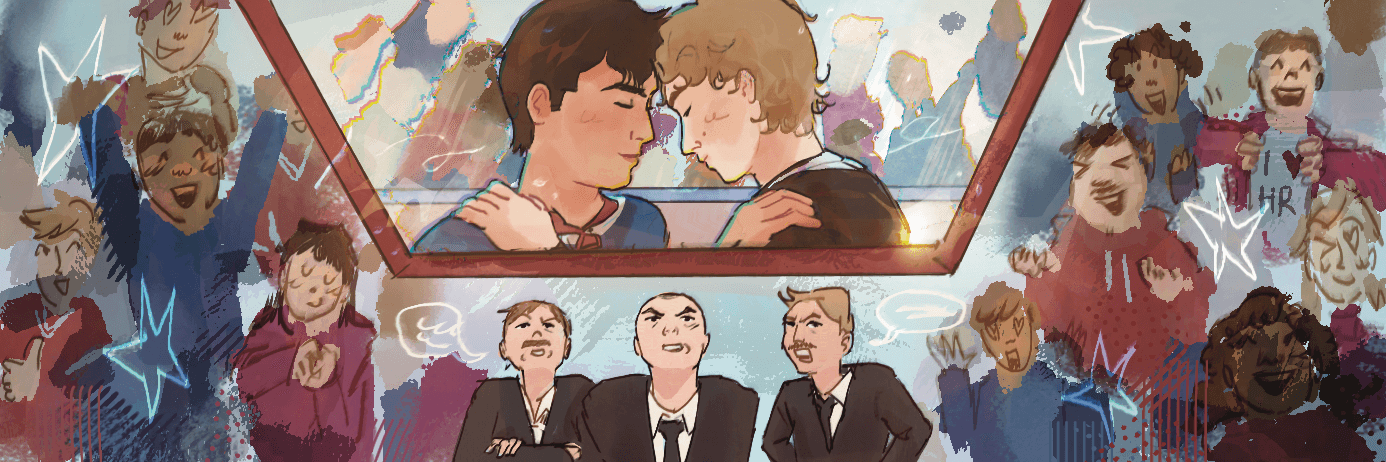
The Canadian show, adapted from Rachel Reid’s 2019 novel, centers around closeted LGBTQ+ professional hockey stars Shane Hollander and Ilya Rozanov in an NHL-style rivalry. The show’s portrayal of queerness, sex and love touched the hearts of millions of viewers.
Some students said they enjoyed the romantic storyline between the two central characters.
“It’s a queer love story in such a hypermasculine world like professional hockey,” said Abby Strawn, a first-year education and social transformation student. “It’s not something that’s represented pretty much anywhere else.”
The success of “Heated Rivalry” is not simply a miracle story – it is the product of decades of progress in LGBTQ+ cinema and media by queer activists and critics, according to the GLAAD, the largest global organization advocating for LGBTQ+ media.
From the 1930s to 1968, the Motion Picture Producers and Distributors Association implemented the Motion Picture Production Code – more commonly known as the Hays Code – which restricted queer representation in media.
This code regulated what could or could not be featured in motion pictures, notably outlawing visuals of queer relationships in cinema by labeling these relationships as “sex perversion.” Scholars have argued the enforcement of this censorship code increased cookie-cutter representations of race, religion, women and sexuality, according to the UCLA Film & Television Archive.
“One of the most obvious barriers we can see is the censorship regimes that, in both film and television, explicitly worked to block queer representation – at least especially explicit queer representation,” said Sam Hunter, a doctoral candidate in cinema and media studies.
This barrier resulted in a lack of LGBTQ+ representation in film and television throughout the mid-20th century until the Hays Code was abolished in 1968. Any queer-coded characters – or characters that were implied to be non-heteronormative or gender-nonconforming – at the time were cast as villains with tragic endings to promote traditionalist notions of heterosexual conformity, a move known as the “bury your gays” trope.
Even after the eradication of the Hays Code, queerness continued to be treated as immoral in filmmaking.
In place of the Hays Code, the Motion Picture Association Classification and Ratings Administration – a parental advisory board – established a rating system to help parents determine the suitability of films for their children. This system uses a five-tier rating scale – G, PG, PG-13, R, NC-17 – based on content factors such as violence, language and sexual content.
Sam Hunter said despite the implementation of this new classification system, LGBTQ+ censorship in cinema continued as other restrictions arose. He added that the motion picture rating system, although more tolerant than its predecessor, still censors queer representation in more subtle ways.
Throughout most of the 20th century, queer characters continued to be portrayed in isolated and lonely narratives, often in doomed relationships met with heartbreak and unrequited love, said Michael Hunter, the academic program manager in LGBTQ+ studies.
For example, in the 1999 movie “But I’m a Cheerleader” – a romantic comedy featuring a young lesbian who is sent to conversion therapy camp – Sam Hunter said director Jamie Babbit felt pressured to cut a scene depicting a female orgasm to prevent the film from receiving an adult rating, which would have restricted its screening accessibility in many theaters.
However, films and shows can bypass this restrictive classification system by pushing content out on platforms where such regulations are less stringent, such as through streaming services rather than movie theaters.
This trend also coincides with the growing popularity of streaming services among consumers in recent years.
According to a 2025 Pew Research study, the majority of Americans use streaming platforms, with 83% of United States adults and 88% of Americans between the ages of 18-29 years old watching programming on streaming services.
Sam Hunter said these streaming services create spaces for more inclusive films and shows with authentic LGBTQ+ representation to reach audiences.
The media analytics company Nielsen found that LGBTQ+ audiences have seven times more inclusive content to choose from on streaming platforms compared to traditional television. Michael Hunter said the representation of queer joy in these streaming shows has become increasingly common, and he said he expects the success of these shows to continue to inspire similar narratives.
“The representations of queer people, especially gay men and lesbian women … who are happy and are not troubled and are not encountering homophobia and discrimination everywhere they turn is a new threshold that we’ve crossed in the media,” Michael Hunter said.
Some notable examples of shows that highlight queer characters through a lens of joy rather than tragedy include “Heartstopper” on Netflix and “Red, White & Royal Blue” on Prime Video.
The plot of “Heated Rivalry” centers around hockey players in Major League Hockey – the fictionalized equivalent of the NHL – taking viewers into a space where queer individuals are often not accepted for their identities and exist in a culture that silences them.
[Related: Second take: NHL still has a long way to go on inclusivity amid success of ‘Heated Rivalry’]
Men’s elite ice hockey is one of the most patriarchal and hypermasculine sports in the global North, according to a 2023 research study by the Men and Masculinities journal. In fact, as of this year, there are currently no active National Hockey League players who are openly gay.
In February during the 2026 Winter Olympic games, President Donald Trump’s remarks criticizing the U.S. women’s Olympic hockey team after the men’s victory over Canada sparked renewed national attention surrounding the toxic masculine culture in the sport.
Strawn said the current social and political climate underscores the significance of “Heated Rivalry” in challenging prejudiced notions surrounding sexuality and identity.
Sam Hunter said the success of “Heated Rivalry” was possible due to the independent filmmakers of the 1980s and 1990s, whose work helped pave the way by placing queer relationships at the center of their films.
“We often take a lot for granted about the past, and we think that we understand it because we’re so new and modern,” Sam Hunter said. “Especially when it comes to queerness or when it comes to other sorts of marginalized identities, I think we can gain a lot by looking to the past and by trying to fit what we see now in historical context.”