Second take: NHL still has a long way to go on inclusivity amid success of ‘Heated Rivalry’
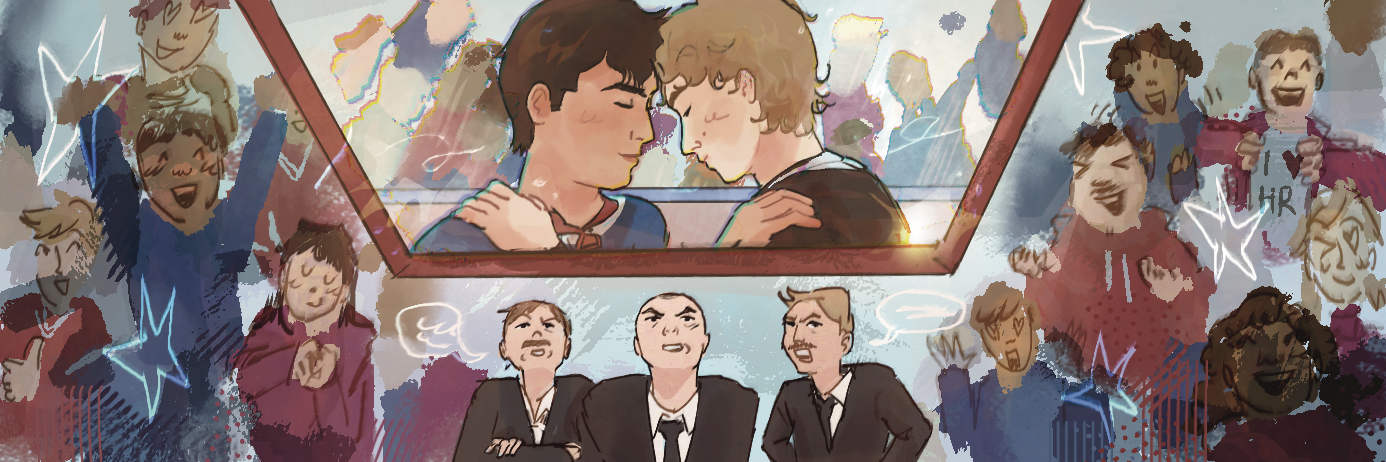
(Brooke Oasis/Daily Bruin)

By Felicia Keller
Feb. 5, 2026 11:24 p.m.
This post was updated Feb. 6 at 12:09 a.m.
“Heated Rivalry” and Taylor Swift have more in common than you might think.
The Crave original series, which aired on HBO Max in the United States, has become mainstream internet culture’s latest obsession. Everyone seems to be talking about it – from celebrities to students who watched it over winter break.
The fictional show, initially released Nov. 28, follows two of the best hockey players in the world – Canadian Shane Hollander (Hudson Williams) and Russian Ilya Rozanov (Connor Storrie) – as they meet in their rookie season, begin a sexual relationship and eventually fall in love years later, all while keeping their connection a secret from the world. Written, directed and produced by Jacob Tierney, the show is adapted from the 2018 book series by Canadian hockey fan Rachel Reid.
The show’s popularity has ballooned into a true cultural moment. Williams and Storrie have been thrown into the spotlight: Paparazzi obsess over them, their Instagram accounts have amassed over three million followers each and they were officially named as torchbearers during the 2026 Winter Olympics Torch Relay. Furthermore, the show itself has seen over 600 million minutes watched in the U.S., with the fifth episode performing historically well on IMDb ratings.
Yet while romance fanatics, members of the LGBTQ+ community and “Heated Rivalry” book lovers have mostly welcomed hockey fans with open arms, it is not entirely clear if the NHL is prepared to do the same. If it is, this embrace could usher in a new wave of fans passionate about young players and the game itself – something that could only be good for the league.
StubHub claims it saw an increase in visits to its website and tickets purchased in the weeks following the show’s release, plus a 35% increase in interest for the Montreal Canadiens vs. Boston Bruins game – the equivalents of Hollander and Rozanov’s teams, respectively.
So, while romance readers’ response to the show has been to flock to watch NHL games – going to the “boy aquarium,” as TikTok calls live hockey inside the glass boards – the NHL has been anything but open toward fans who are female, LGBTQ+ or people of color in the last few years.
Until 2022, the league seemed to be taking steps to welcome different communities to the NHL community. Then, over the summer of 2023, it banned any cause from having a specialty warmup jersey and players could no longer wear Pride jerseys – often designed by local queer artists – on the ice. Other honorary warmup jerseys, such as Military Appreciation and Hockey Fights Cancer, were eliminated with the ban as well, seemingly because NHL owners did not want the headache caused by a handful of players refusing to wear jerseys in support of queer people. That same summer, there was yet another controversy regarding the NHL’s banning of Pride tape on players’ sticks, but it was short-lived due to player Travis Dermott’s refusal in October 2023 to abide by the rule.
Recently, Commissioner Gary Bettman admitted to media at a Washington Capitals game that he binged “Heated Rivalry” in one night, calling it a compelling story. But it is difficult for those words to come across as sincere to queer hockey fans, considering Bettman spent the earlier part of that same day at the White House visiting the Trump administration, whose policies and rhetoric are widely criticized by the LGBTQ+ community. Bettman has also called Pride jerseys a “distraction,” according to ESPN in 2023, and as commissioner he led the charge to eliminate them from pregame warmups.
So, it is not exactly shocking that in the “Heated Rivalry” world of Major League Hockey – modeled after the NHL – players Scott Hunter, Rozanov and Hollander are all terrified of being outed.
Potentially the least realistic part of the show comes when Hunter kisses his boyfriend, Kip Grady, on live television after winning the championship in episode five. There are certainly real players in the NHL sneaking in and out of hotels with loved ones, just as characters do in the show – and there are definitely real players living their lives in secret just to ensure they can keep playing the game they love.
With that being said, there has never been an out NHL player. “Heated Rivalry” character Hunter is the first one in his league to hit mainstream media. Historically speaking, the NHL does not seem ready for this to happen, no matter how much it is willing to lean into the mass popularity surrounding the show – and they certainly have, with the Ottawa Senators selling actual Rozanov and Hollander jerseys and the Boston Bruins selling Tuna Melts.
François Arnaud, who plays Hunter, has called out the league’s behavior during his press tour.
“I hope that the league that is now using the show for tweets and Instagram posts and selling tickets actually follows through and supports (the queer community and players),” Arnaud said on the Kelly Clarkson Show this past January.
However, some teams’ reactions feel more genuine than others. A couple teams host Hockey Is For Everyone nights – as opposed to Pride nights – which feel more like a catch-all for inclusion than an actual commitment to communities. The Los Angeles Kings – one of the few teams to not host a Pride Night of any kind – as well as the Montreal Canadiens and the Vancouver Canucks – on their Pride Night – have invited Tierney, Arnaud and Robbie G.K., who plays Grady, respectively, to their games. Additionally, players on the Washington Capitals and Boston Bruins commented on the show ahead of their Pride game, and the Seattle Kraken’s DJ played songs from “Heated Rivalry” at its Pride celebration. Plus, multiple teams have played music from the soundtrack composed by Quebecois artist Peter Peter.
There are certainly instances of allyship and love for the queer community in the sport. Women’s hockey consistently centers queer people – headlined by Canadian star Marie-Philip Poulin and her wife Laura Stacey, who play for the Montreal Victoire. A few notable players in the NHL have also been staunch supporters in their time in the league.
Yet there is still a segment of the NHL’s response to “Heated Rivalry” that feels performative and profiteering. The show itself acknowledges this, from the language Shane hears in his own locker room to Scott’s unwillingness to come out when he first meets Kip. “Heated Rivalry” is perfectly aware that the real world would be unwelcoming of the very characters the story celebrates.
Until the NHL environment changes, it’s “Actually Romantic” – as Swift would put it – and “honestly wild” that the NHL is so obsessed with “Heated Rivalry” yet continues to be unwelcoming toward the queer community.