Some UC language programs are getting moved online. These professors aren’t happy.
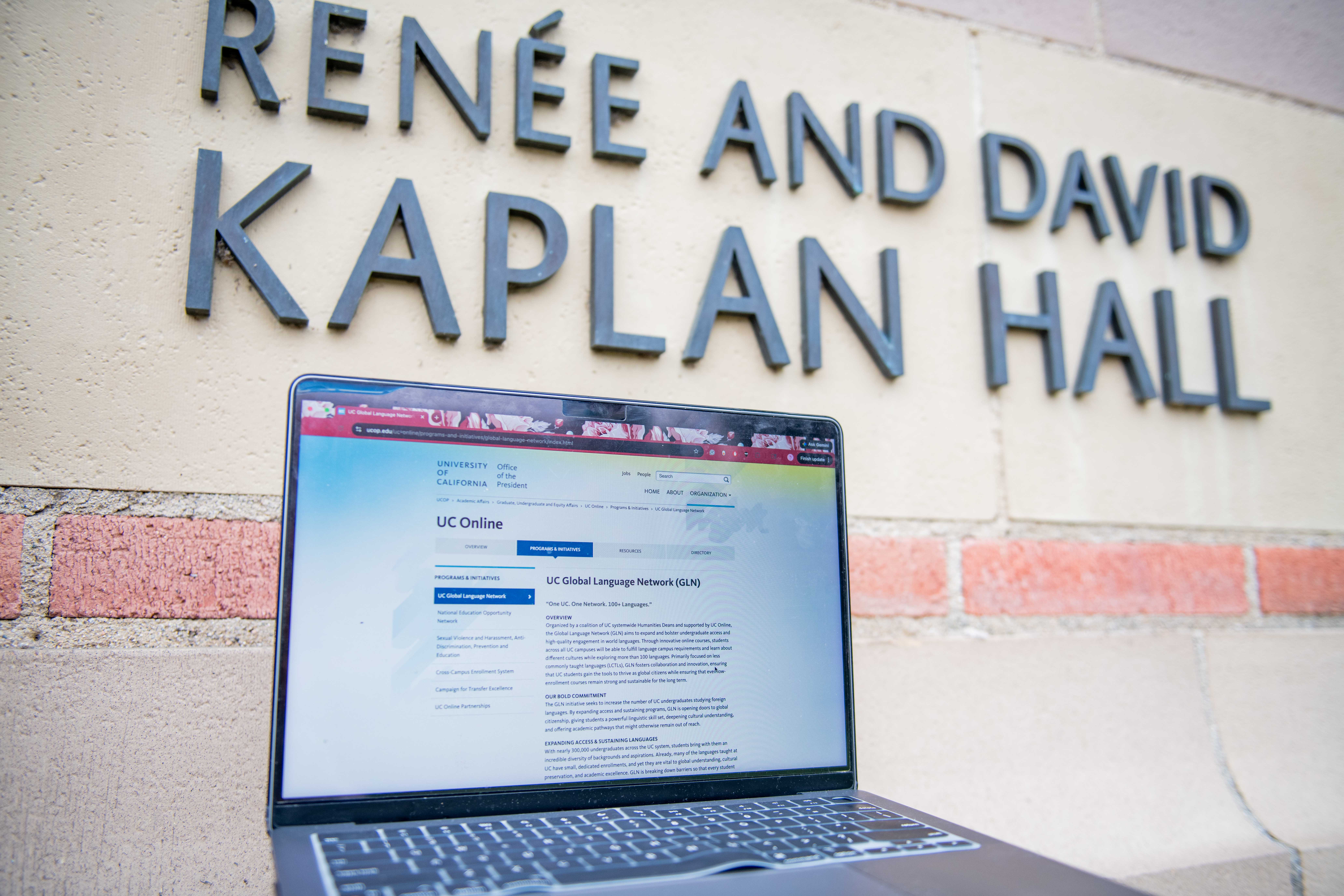
The website for the Global Language Network is displayed on a laptop. The virtual language education initiative has sparked concern among UC instructors. (Joice Ngo/Daily Bruin staff)

By Phoebe Huss
April 2, 2026 9:44 p.m.
This post was updated April 10 at 1:00 a.m.
The UC implemented a virtual language education initiative in January, sparking pushback from instructors amid language program cuts.
The Global Language Network, which was designed by UC humanities deans, allows faculty from different UC campuses to provide digital foreign language instruction to all University students.
The program was first designed in May 2023 to address a major decline in language class enrollment since 2019, said Alexandra Minna Stern, the dean of UCLA’s division of humanities and the network’s leader.
The network will adapt a subset of UC language courses – focusing on less commonly taught languages – students can enroll in over UC Online, a virtual cross-campus platform, Stern said. However, the program is intended to eventually include all languages taught across the UC, totaling more than 100, according to the GLN website.
UC language instructors and department leaders alleged that they were not consulted during GLN’s development, adding that they only found out about it years after its initiation, through word of mouth or by randomly accessing its website. Others said they only discovered its existence when they were asked to fill out a questionnaire on it in 2025, after the network proposal was submitted to UC Provost Katherine Newman.
“We just feel completely blindsided by the administration,” said Carine Rohmer, a continuing lecturer in French at UC Santa Cruz.
The nine network courses that launched in January are synchronous, but Stern said future courses may be taught asynchronously. The courses currently contribute general unit credit, but not necessarily credit for students’ foreign language requirements, said Kiril Tomoff, the associate dean of arts and humanities at UC Riverside.
The GLN aims for each course to count eventually toward students’ foreign language requirements, Tomoff said. However, the network will probably not allow students to major in languages that their home campuses do not provide, he added.
Julia Simon, the French program coordinator and interim chair of German and Russian programs at UC Davis, said the UC humanities deans lack knowledge and understanding about language instruction since not all of them teach languages. She added that she was not involved with the development of the network despite the fact that she oversees three language programs.
“The faculty really have been kept out of it for the most part,” Simon, who is also a distinguished professor of French, said. “You’d think I would have had an inkling that this was going on, but I had no idea.”
Language faculty said their programs are already underresourced and that moving classes online could hurt them further.
In recent years, UCLA has cut language programs because of budget constraints. Though the university purports to offer more than 40 languages, nobody teaches several of these courses anymore, and instructors said others are at risk of severe downsizing. When lecturer Abraham Adhanom attempted to reinstate Tigrinya by volunteering to teach it for free, Stern refused, according to emails reviewed by The Bruin.
[Related: UCLA foreign language faculty, students criticize language program cuts]
Claudio Fogu, a professor and director of Italian studies at UC Santa Barbara, said deans considered administrative – and not instructional – concerns while developing GLN.
“It is a dean’s initiative,” Fogu said. “That tells you immediately the nature of the initiative. It is an initiative that is completely administrative.”
Stern said she has involved language faculty by collaborating with other humanities deans and by surveying instructors who participated in Phase I, the name for the January launch. Phase II will begin in Spring 2026 with an expanded list of language offerings that – unlike the initial rollout – were not previously available on UC Online, Tomoff said.
Tomoff also said he asked UCR language department heads and chairs for feedback on GLN, and in response, the leaders brought him a list of concerns. He added that he had previously not considered some of their concerns, such as which campus’ placement exam to use for the classes.
Tomoff said there are lurking fears among faculty that GLN will pit campuses against each other but added that the campuses involved are determined to make it work for everyone.
“It’s a really complicated process to make sure that we get it right,” Tomoff said.
However, faculty said there are widespread concerns that GLN will shrink programs to become exclusively online. Faculty from different campuses said another widespread fear is that the network will result in limiting programs to one campus per language.
Funding for the GLN courses comes out of each campus’ language program budget, with some supplemental funding from the UC Office of the President, Tomoff said. Stern said UC Online is partially paying for the program as well.
Fogu added that he doubts GLN will stay limited to less commonly taught languages, since the initiative includes Arabic, which is already taught at most UCs.
Michael Cooperson, UCLA’s Near Eastern Languages and Cultures department chair, said a humanities dean told him that language classes with fewer than 15 students enrolled would eventually be cut and some would be moved online. However, these languages will only be taught by one campus each, as a result of GLN. He clarified in an email statement that Reem Hanna-Harwell, a senior associate dean in the division of humanities who is now UCLA’s interim CFO, said this to him at a meeting.
Hanna-Harwell, who became UCLA’s interim chief financial officer in February, did not respond to a request for comment on the alleged statement.
A UCLA humanities spokesperson said in an emailed statement that while the idea of an enrollment minimum was discussed at the meeting, it is not the deans’ guiding principle when making decisions about language course offerings.
“Although the concept of a minimum enrollment was mentioned, it was as one of numerous possible ways to frame the discussion around the topic during the meeting,” the spokesperson said in the statement. “This concept was never intended to be the primary metric that determines whether, how or when courses are offered in person or online.”
The deans said GLN has different advantages for different schools. Noah Guynn, the associate dean of faculty for humanities and a professor of comparative literature and French at UC Davis, said it will provide his students with far more learning opportunities than their own campus allows.
“From UC Davis’s perspective, we’re really jealous of the ability of a UCLA or a Berkeley to continue to offer languages that we just can’t afford to,” Guynn said.
Some students at campuses with language programs reduced because of budgetary constraints might only be able to access the ends of their language sequences online, Guynn said. He added that at UC Davis, the network could help language classes break even, as they are taught at a financial loss unless they can enroll 35 students.
Yong Chen, the associate dean of curriculum and student services at UC Irvine, said students have asked him for more language classes, as the university only provides about a dozen. Chen added that he tried to grant their wishes, but not enough students took the new classes to keep them.
GLN and its UC-wide courses could help increase enrollment, Chen said.
For a campus like UCLA, which has had to trim its language offerings because of budget cuts, Stern said the network could save language programs from elimination and will grant students wider access to other languages in the UC inventory.
“It is not meant to take over – it is meant to complement,” Stern said.
In 2024, a task force of UCLA humanities personnel submitted a report to Stern outlining its frustrations with the degradation of its language programs, including various problems with UC Online.
The Global Languages and Intercultural Education Task Force said in its report, obtained by the Daily Bruin, that UC Online enrollment takes several weeks and most students do not know about its classes anyway because campus-specific class registration websites like MyUCLA do not mention them.
UC Online has existed since 2013 but never worked well, said Torquil Duthie, the task force’s co-chair and Asian Languages and Cultures department chair. Students enrolled in UCLA’s courses from other campuses do not appear on the instructor’s roster until the quarter is nearly over, Duthie added.
“It’s just catastrophically bad,” Duthie said.
A UCOP spokesperson said in an emailed statement that UC Online enrollments must be approved by an academic advisor from a student’s home campus before they appear on the course roster, potentially leading to delays.
“While a brief administrative lag may occur before students appear on the official roster, the process is designed to meet all enrollment deadlines,” the spokesperson said in the statement.
Tomoff said since its launch, the GLN has experienced major challenges. UC Online listed inaccurate enrollment data at first until the software was manually fixed, he added.
Simon said she has noticed deficits in listening and speaking skills among community college transfers who took languages entirely online, and she fears that problem would be repeated through GLN.
Language courses require nonstop talking, so instructors get to know students well, Simon said. Online, she worries students will lose one of few opportunities to bond with instructors in small settings.
“Nobody gets to know them, and nobody gets to interact with them, and the feedback they receive is kind of at a distance,” Simon said.
Rohmer said virtual curricula lack cultural teaching vital for study abroad.
“Languages are about, sure, the language, but also the people, the culture,” she said. “When they think that you can just learn a language with a video online and then a couple of quizzes on a module, I’m like, ‘Have you ever interacted with another human being?’ … They’re leading them to disaster.”
Rohmer and her colleagues polled their students and found that 85% prefer in-person courses to online, she said. The students reasoned that they pay tuition for in-person classes, Rohmer added.
However, UCSC canceled a large chunk of language classes last year and heavily reduced the teaching budget this term, Rohmer said. UCSC made the difficult decision to reduce language offerings, the university said in an emailed statement.
“When I see on the website that UC is trying to create academic pathways to let their students be able to take languages, I find that kind of rich, knowing that they are cancelling our courses that we offer in person,” Rohmer said. “They are actually the ones making it harder for students to take languages.”
David Moak, a UCSB lecturer in comparative literature and French, said there is a problem with decreased student interest in languages, but he is trying to combat it by building courses combining French with subjects like computer science and marine biology instead of moving lessons online. Moak added that he is applying for outside grant funding and collaborating with other departments at UCSB to develop these courses.
Several students are interested in virtual language learning, but told the Daily Bruin they want the UC to prioritize interaction in their classes.
Chanel Zong, a fourth-year French and international development student at UCLA, said language students in small classes engage with professors more deeply, form a tight-knit community with their peers and are more likely to participate in language-based extracurriculars.
Zong said her favorite French course was on New Wave cinema, but students participated significantly less when the class met on Zoom, which she thought was because students are self-conscious talking to a screen.
“If it makes people’s lives easier, … that’s a good thing,” Zong said. “But if you’re there because you enjoy conversing with others in French and you enjoy eye contact with the professor and having a fully immersed experience watching a film in class all together, I definitely think that’s something that online courses can never do.”
When Griffin Galimi enrolled in an asynchronous Italian class at UCLA, he said he found out on the first day that it had multiple assignments due that night and would not require much interaction. He quickly dropped the course, adding that he could better pursue languages independently and in the Italian and Bruin Spanish clubs.
However, Galimi, a second-year computer science student, said while he prefers his own methods to the language courses at UCLA, he thinks asynchronous learning can make learning more accessible for some people.
“It’s good to be able to learn these languages that are much lower resourced, or harder to find resources on, asynchronously on your own time, without having to pay someone to teach you or to find a lesson that only happens on Mondays at 11 a.m.,” he said.
Cooperson, an Arabic professor, said he prefers the GLN strategy over removing programs altogether but added that if the UC limits to one campus per language, faculty at the other campuses could be laid off, which is not ideal.
“If they want to do it also on Zoom for other campuses, that’s fine, but I want UCLA students to be able to have their languages in person and not cut anything,” Cooperson said.
Stern said she is passionate about protecting less commonly taught languages, as they are currently under immense threat and have already disappeared from other institutions.
“Less commonly taught languages are really at risk of being lost because of low enrollments. How can we maintain them? Is it better to offer something online than to not have it at all?”
“Less commonly taught languages are really at risk of being lost because of low enrollments,” she said. “How can we maintain them? Is it better to offer something online than to not have it at all?”
Tomoff said his campus’ GLN course, which was Korean, was more popular this winter than the equivalent in-person lectures taught at the same time. In fact, only the online class filled up completely. As a result, he wants to keep teaching both modalities, he said.
Lily Hu, a second-year education and social transformation and public affairs student, said she wants to take French at UCLA and would rather study it online than in person – as long as the course is synchronous.
“It’s really important to speak the language among people,” she said. “If you are inside the environment and immersed in it, it just feels natural.”