Trump administration’s anti-trans actions spark advocacy across UC community
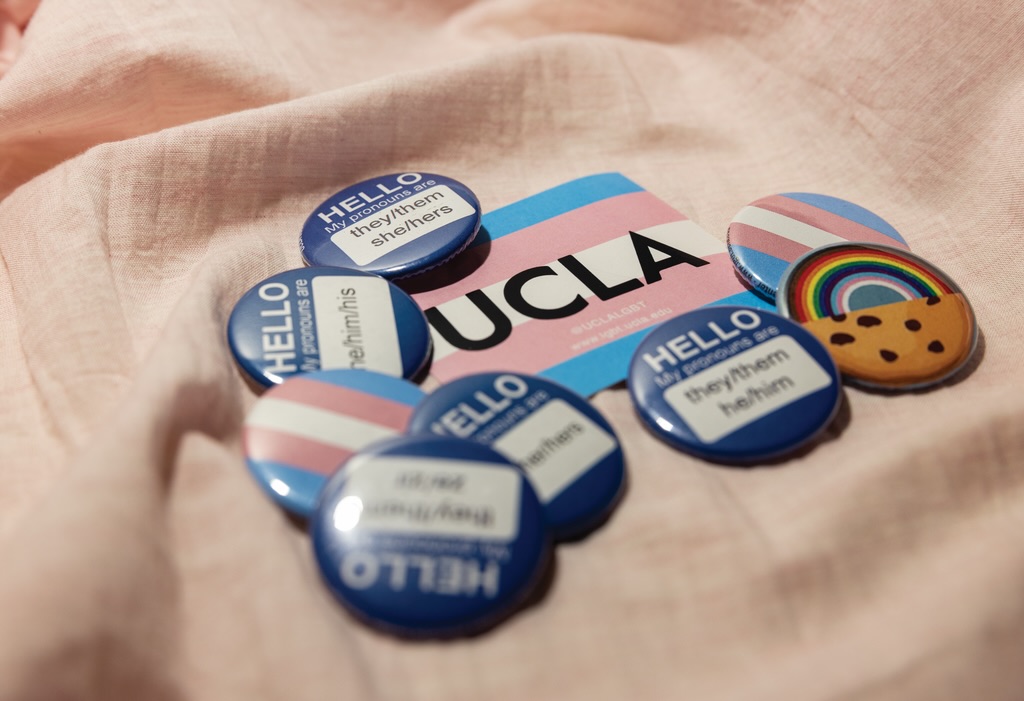
A sticker with the transgender flag and several pins with the trans flag and sets of pronouns are pictured. The Trump administration’s rollback of rights for transgender people has incited pushback among advocates across the UC. (Daily Bruin file photo)

By Lilly Leonhardt
Oct. 14, 2025 11:14 p.m.
This post was updated Oct. 14 at 11:51 p.m.
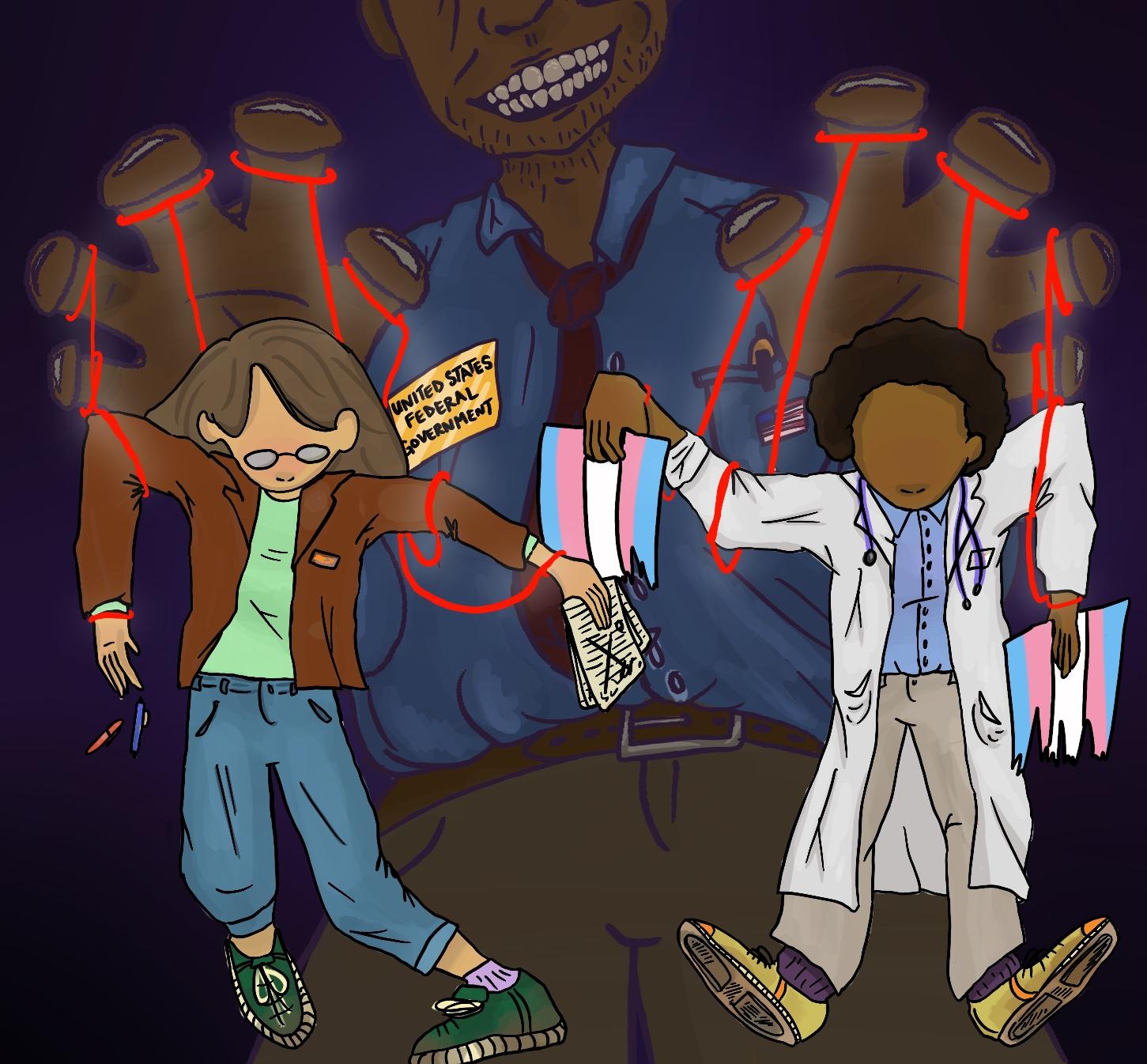
The Trump administration’s rollback of rights for transgender people has resulted in pushback among advocates across the UC.
President Donald Trump signed several executive orders limiting the rights of transgender people in his early days in office – defunding gender-affirming care for transgender individuals under 19 years old – and has threatened to withhold federal funding from institutions that fail to comply. Most recently, the Trump administration proposed a $1 billion settlement for UCLA to regain its federal research funding – and also demanded that its hospital stop offering gender-affirming care for minors.
Hundreds of UC staff, students and community members signed an August letter to Gov. Gavin Newsom, California Attorney General Rob Bonta and the UC Board of Regents, urging the Regents not to acquiesce to anti-trans demands – especially with regard to restricting gender-affirming care within the UC system.
The Trump administration suspended $584 million in federal research grants to UCLA in late July, alleging that the university has allowed antisemitism, affirmative action and “men to participate in women’s sports.” A federal judge temporarily reinstated the vast majority of UCLA’s frozen grants, but the ruling will only last while the case – brought by UC researchers – plays out in the courts.
[Related: Federal judge orders Trump administration to restore $500M of UCLA research grants]
The Trump administration demanded that UCLA mandate single-sex housing for its female students and “ensure athletic recognition for female athletes in women’s sports,” according to an Aug. 6 draft copy of the proposal acquired by CNN.
The university was also asked to issue a public statement saying it does not recognize transgender people’s identities and stop providing gender-affirming care to minors at its medical facilities, according to the Los Angeles Times. Children’s Hospital LA – once a leading provider in transgender health care – closed its gender-affirming care clinic July 22, following pressure from the Trump administration.
[Related: Trump administration makes demands for UCLA policy changes in exchange for funding]
Nicolette D’Angelo, a doctoral student in Classics, said in an emailed statement that she signed the letter to urge the UC to support trans students and employees.
“Trump’s proposed assaults on trans healthcare are not abstract policy debates: they strike directly at the rights and dignity of myself and my friends, colleagues, and community here in Los Angeles,” D’Angelo said in an emailed statement. “We signed the Save UC Trans Healthcare letter to urge the UC administration to back its words with real action and stand firmly with its trans students and workers.”
Tammy Ofek, a doctoral student in physics and the advocacy coordinator of Trans UCLA Pride – or TransUP – said she initially felt panic, and later numbness, after Trump was elected.
On his first day in office, Trump issued an executive order saying the federal government would recognize only two genders. The administration has also demanded that 40 states remove mentions of gender identity or transgender people from some federally funded sexual education programs.
“After a two-week period, I guess the shock wore off,” Ofek said. “I became very angry, very upset and emotional.”
States that have not complied with Trump’s order have faced retaliation from the administration, including California, which had a $12 million federal education grant for sexual education cut in August.
Nicky Cutler, a co-founder of the Yes Ma’am Club, which organizes events centered around trans people, said he was nervous for the trans community upon hearing the news of Trump’s reelection, especially with regard to Project 2025 – a conservative policy agenda contributed to by some of Trump’s close advisors that detailed several anti-trans provisions.
Ofek said transgender students have been quiet at UCLA, as many were prepping for a “doomsday scenario” prior to Trump’s presidency.
“Now that we’re well into the Trump administration, the community has been quiet. It’s been quieter than it has been in a long time,” she said. “People just felt less safe, less excited, less happy to be out in public about their identity.”
While advocacy is a part of TransUP, Ofek said she believes transgender students currently do not feel safe, making advocacy secondary to providing them with resources and support.
“Unfortunately, it’s still very much survival,” she said.
Yes Ma’am focuses primarily on advocacy through events, Cutler said, adding that he is driven by a sense of urgency to combat rising anti-trans rhetoric since Trump assumed office.
One of those recent events was a wrestling match, in which the Yes Ma’am Club invited people of all gender orientations to compete against each other. Cutler said it was “beautiful” to watch trans people compete against each other without worries over gender norms.
“These events are so important because you have to have spaces that people feel safe, that people feel seen, that people feel heard and supported,” he said. “We’re not getting that from the outside world, and I guarantee that those that are spitting the most harm have never even met a trans person.”
D’Angelo said she believes events that disrupt the status quo are necessary to make change.
“We can organize teach-ins, petitions, phone-banking campaigns and protests like the ones that have been going on for months outside the Children’s Hospital of Los Angeles,” D’Angelo said in the emailed statement.
Ofek said she is grateful, though, to live in California and attend a university that defends basic protections for transgender people.
The California State Legislature recently passed the Transgender Privacy Act, which makes all court records pertaining to gender transition completely confidential, something Cutler said was important for the trans community amid federal policies limiting their rights.
“I’m very glad that we are all UCLA students,” Ofek said. “We are honestly so very fortunate to be living in, honestly, one of the greatest states in the union, providing some of the greatest gender-affirming care anywhere in this country.”
D’Angelo said the fragility of transgender people’s support network was shown when Newsom vetoed a bill meant to improve health care for intersex individuals.
While Cutler said he is grateful to live in a state that does not overtly challenge trans people’s rights, he added that the proposed UCLA settlement and CHLA’s move to close its gender-affirming care unit show that transgender rights are still being threatened close to home.
“I take a lot of pride in living and teaching in LA,” D’Angelo said in the statement. “But it would be dangerously naive to assume that California’s progressive reputation insulates us from the transphobia that shapes every facet of public life.”