The Black Film and Theatre Initiative at UCLA creates both community, art
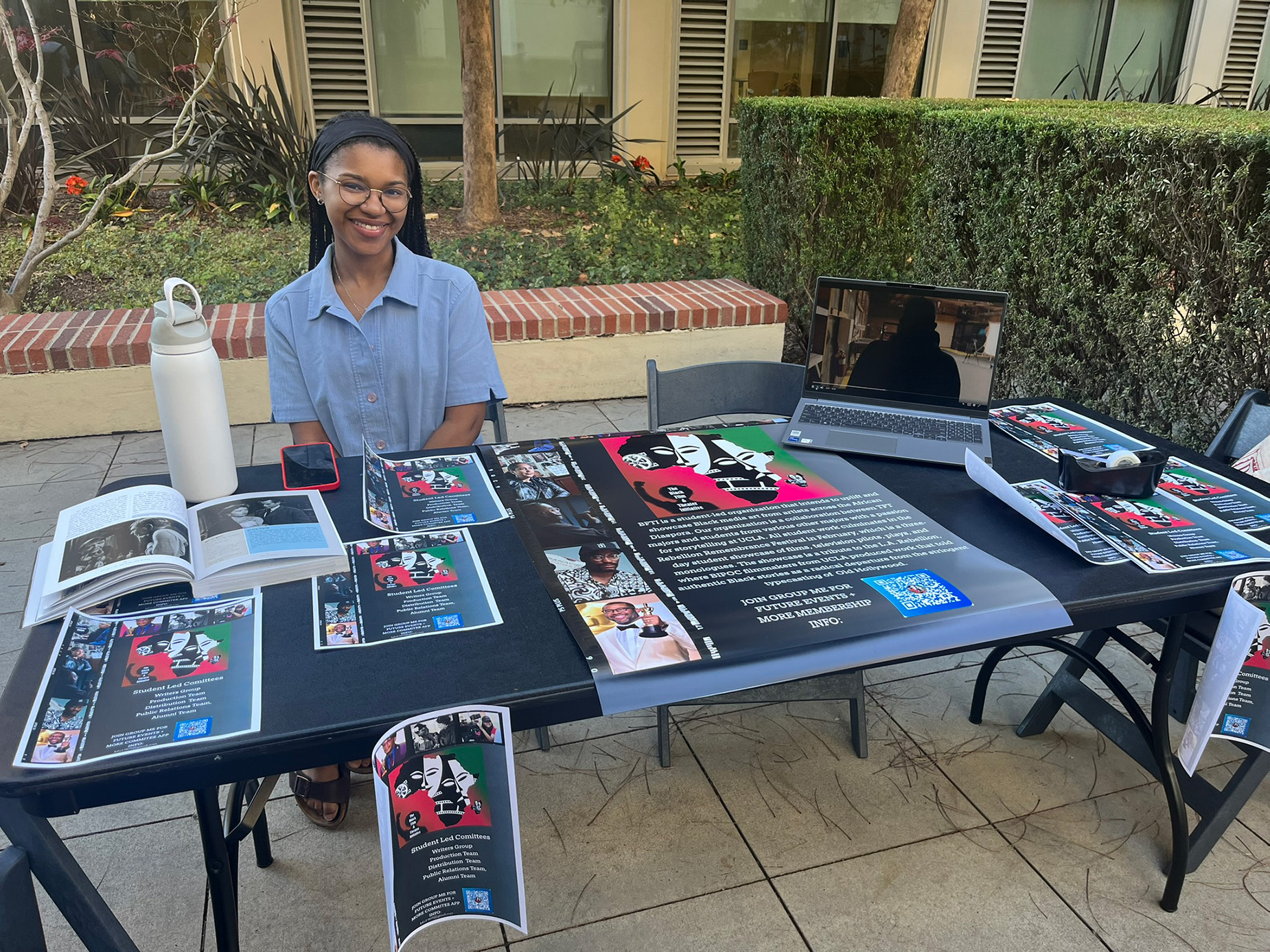
Vice president of the Black Film and Theatre Initiative Maiyah LaMar poses at a table with flyers and posters highlighting different aspects of the organization. At a school where Black students only make up around 7% of the student body, clubs like BFTI are vital in ensuring each voice is heard, said club president Amber Payne. (Courtesy of Amber Payne)

By Angelina Alkhouri
Sept. 18, 2025 9:43 p.m.
Capturing the Black Film and Theatre Initiative means showcasing its mission to redefine the boundaries of community and art at UCLA.
Amber Payne, a fourth-year film and television student and president of BFTI, was inspired to start the initiative in the spring because she felt as though UCLA lacked a space for Black filmmakers. Maiyah LaMar, a fourth-year film and television student acting as the organization’s vice president for the 2025-26 school year, and Joshua Odiase, a third-year physics and statistics and data science student who is creative writing chair of BFTI, worked alongside Payne to bring their vision to life.
“Originally, the club was to bring us (black filmmakers) together, but then I started meeting non-film students who were also looking for community,” LaMar said. “(BFTI) is a way to not only bridge all Black-identifying TFT students but also students across all majors at UCLA.”
The club welcomes all Black-identifying students to come together. At a school where Black students only make up around 7% of the student body, clubs are vital in ensuring each voice is heard and meant to strengthen the confidence of all ideas, Payne said.
“If you’re a dancer, a painter, photographer or anything across that spectrum, we welcome you. Film is a community-based effort, so we embrace Black creatives across all fields,” Payne said.
Odiase said creating a healthy space for community allows for appreciation of historically marginalized voices and designs.
“The creative purpose of BFTI is to implement a space of acceptance for these different stories and perspectives instead of trying to narrow them down or try to shrink them to a strict paradigm that’s so used to the Hollywood standard, or what we’ve come to know as film and art,” Odiase said.
Odiase added that breaking these traditional barriers changes the narrative and revitalizes film as a personal art. Students are granted exposure to diverse themes and styles and can grow without limits when supported by an identity group like BFTI, he said.
Payne said the success of the short film she directed in high school – which was recognized for two Laurel Awards – was directly related to the shared community of the filmmaking process. She said she wanted to replicate that atmosphere for others in BFTI.
“The biggest thing about BFTI – but also film and art as a whole – is the importance of community,” Payne said.
The club’s meetings allow specific sections to handle the different aspects of the initiative through the creative writing, film production, theater production and distribution teams, Payne added. This past summer, BFTI has hosted meetings every Saturday to discuss upcoming events and community-building activities, Payne said.
Students can look forward to two screenings this school year, one in which students can watch an independent Black film, LaMar said. The other is Hollywood-esque and will include a panel afterward for students to engage with the people who created it, she added.
BFTI plans to collaborate with other clubs such as the Cultural Affairs Commission to host poetry slams, Odiase added. He said the initiative is also planning their annual tradition “Rebellion Remembrance,” which is a student showcase film festival for films, monologues or first act plays during Black History Month.
This club offers students the opportunity to be pushed to create, share ideas and sharpen their craft, Payne said. Working on another students’ project is inspiring and fun because you get to meet new people and collaborate on all the aspects of cinematography, LaMar added. Being a contributor to other projects may even be as fruitful as constructing one’s own.
“Everyone has a vision, and we’re here to cultivate your vision so you can do it at the highest execution,” Odiase said.