UAW Local 4811 pushes for immigrant protections, pay equity in UC negotiations
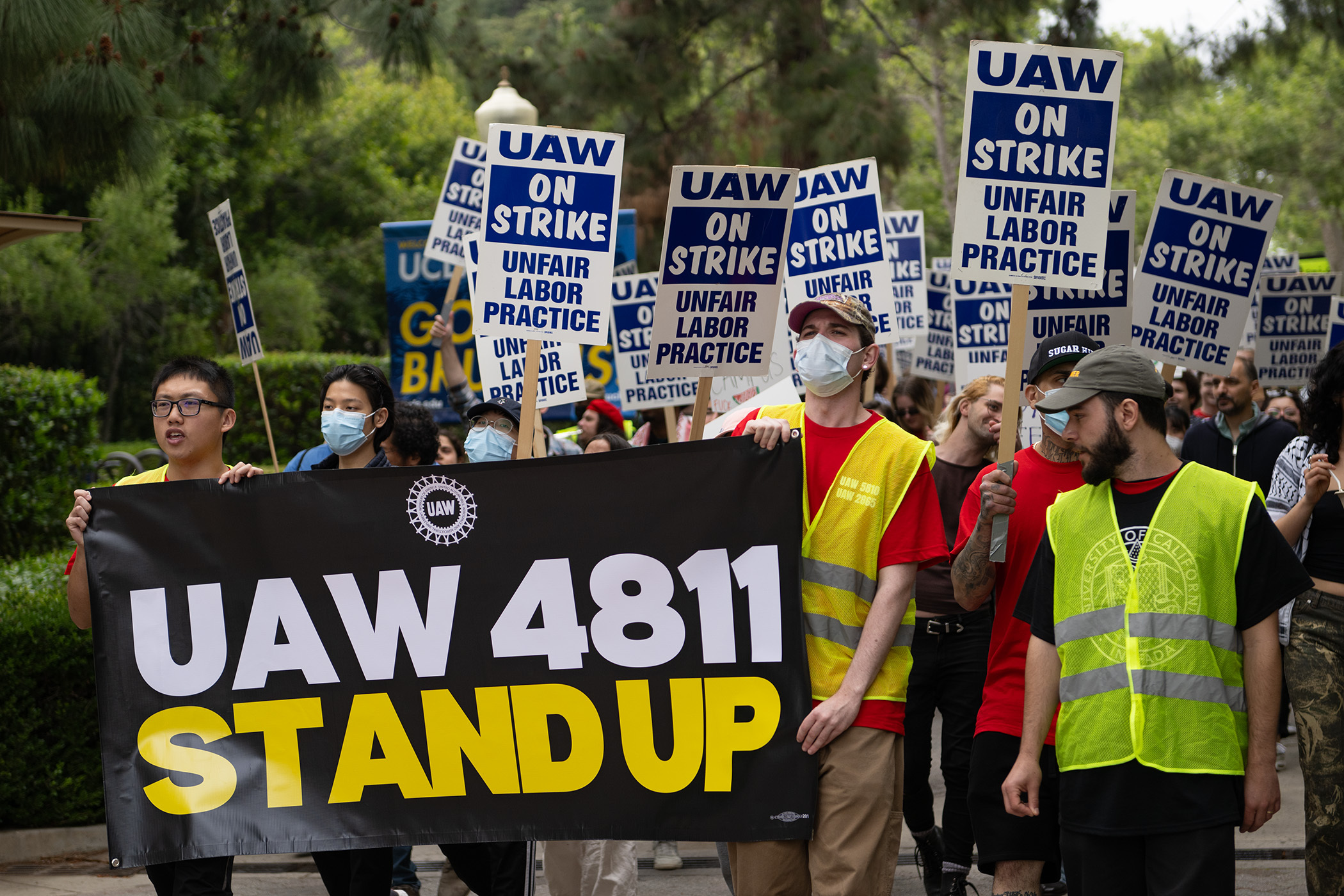
A United Auto Workers Local 4811 protest is pictured. UAW Local 4811 demanded protections for immigrant workers, pay equity and pushback against federal funding cuts during negotiations with the UC beginning July 8. (Daily Bruin file photo)
By Josephine Murphy
Aug. 23, 2025 11:40 p.m.
United Auto Workers Local 4811 demanded protections for immigrant workers, pay equity and pushback against federal funding cuts during negotiations with the UC beginning July 8.
About 33,000 of the over 57,000 employees under UAW Local 4811, including academic student employees and graduate student researchers, are being represented in the ongoing negotiations. UAW Local 4811 is also representing nearly 5,000 student services and advising professionals in the determination of another bargaining unit contract – the first contract for the new group, which was recognized by the University in April.
There are five bargaining units under UAW Local 4811 – academic student employees, graduate student researchers, student services and advising professionals, postdoctoral scholars and academic researchers – three of which are being represented in the current negotiations. Once a new contract is determined, ASEs and GSRs will merge to simplify bargaining and implementation, according to a press release from the UC Office of the President.
UAW Local 4811’s existing contract with the University will expire Jan. 1, with negotiations expected to run through the end of 2025.
UAW 4811 – the largest union within the UC – was formed through the merger of United Autoworkers Local 2865, which represented academic student employees, and United Autoworkers Local 5810, which represented postdoctoral scholars and academic researchers, in 2024. UAW Local 2865 and Student Researchers United-UAW – which was later absorbed by UAW Local 2865 – went on strike for nearly six weeks in 2022 until the current contract was ratified in late December.
UAW Local 5810 also went on strike for nearly a month and ratified their contract in early December 2022. The strike, led by the three unions – the “UAW Fair UC Now Campaign” – brought together over 48,000 workers across the UC and was the largest strike in the history of U.S. higher education.
[Related: UAW ratifies contracts for graduate student workers, ends historic UC-wide strike]
Aya Konishi, a bargaining team member and doctoral student in sociology, said this decision will make it so that the two parties can negotiate together and that the final contract will represent TAs, tutors, readers and GSRs.
“Oftentimes, workers will switch between job titles every academic quarter,” she said. “Sometimes you might be a researcher, sometimes you might be a teaching assistant. And so we’re hoping that folks can have more stability across their job titles.”
The union’s initial demands included fair pay and job security, including experience-based raises and cost-of-living adjustments, legal and financial support for international workers and protections on free speech, according to the UAW Local 4811 website.
Konishi also said she hopes the proposed contract protects researchers and their ability to continue doing “life-saving research.” She added that she believes the UC’s decisions in these negotiations will be telling of how it will respond to the federal government, should it threaten the UC.
“We just really want to encourage the university to see these negotiations as an opportunity to pick a side amidst the threats to higher education,” she said. “They could choose to go along with Trump, or they could side with workers to build a better UC.”
[Related: UCLA student researchers face uncertainty amid federal cuts, budget proposals]
Samantha Lannan, a philosophy teaching assistant, said UAW Local 4811 has been strategizing to prepare for federal funding cuts for months.
The United States Department of Education has threatened to pull millions of dollars in funding from several universities – including Columbia University and Harvard University – for failing to meet the administration’s demands, such as allegedly allowing antisemitism on their campuses.
[Related: UCLA students react to Trump’s attacks on higher education, federal funding cuts]
“As soon as Trump was elected and made it clear through his rhetoric that he was going to be funding this war against higher education, it’s something that we have realized is a very important part of an issue that we really do need to face head on in order to organize effectively, and, again, to recognize and fulfill our interests,” Lannan said.
Hundreds of members of UAW Local 4811 protested in April as part of a national day of action against research cuts by the Trump administration, including a 15% cap on indirect funding from the National Institutes of Health. The cap is currently being fought in court, with the NIH appealing a federal judge’s April 4 block on the cuts.
[Related: UAW Local 4811 protests against federal funding cuts for research, education]
The NIH and the National Science Foundation have also promised to deny grants to organizations with anti-Israel boycotts and diversity, equity and inclusion initiatives.
UCOP said in a press release that the University hopes to negotiate a fair contract in the face of current federal funding uncertainties.
“As we begin bargaining today, we recognize both the vital contributions of our graduate student employees and the unique challenges we are facing in light of continued uncertainties related to federal funding,” said Missy Matella, the associate vice president of Employee and Labor Relations for UCOP, in the press release.
Garret May, a doctoral student in materials science and engineering, said the union’s proposed contract’s emphasis on protecting international students is especially important at UCLA because of immigration raids happening across Los Angeles. He added that he believes that the goals of UAW Local 4811 chapters are consistent across the University’s campuses.
As a contract action team member and past bargaining representative for UAW Local 4811, May said the union has provided him with a unique outlet for activism as a STEM student.
“I’ve just kind of grown closer and closer into the Union and absolutely love it and the community that it provides, as well as a thread of activism through graduate school,” he said. “As an engineering Ph.D. student, I can say that a lot of people in STEM like to think of science as this apolitical island when it’s very much not.”
Lannan said she is feeling hopeful about the negotiations, as UAW Local 4811 has conducted a significant amount of outreach among its members regarding how they can become involved in bargaining – both by helping decide demands and physically attending bargaining proceedings. She added that despite there being two distinct units in the current negotiations, shared issues are at stake.
“We all really do have a shared interest in these main issues that we are prioritizing in our bargaining process,” she said.
Lannan added that the state legislature’s rejection of Gov. Gavin Newsom’s proposed budget cuts to the University – which would have reduced funding to the UC by $129.7 million – was a “big step forward” for UAW Local 4811.
May said the union’s last contract, which included a 16.7% wage increase for salaried ASEs and a $1 per hour increase for hourly ASEs for the 2024-25 academic year, was “strong.” He added that he hopes this will indicate that the University will agree to another strong contract between UAW Local 4811 and the UC.
“I’m feeling pretty hopeful,” he said. “Having a contract negotiation right now, … we have the ability to help set the tone for how the UC system is going to be interfacing or not interfacing with the Trump administration, moving forward with the systemic attacks on education.”