Students urge transparency during UC’s efforts to restore federal funding
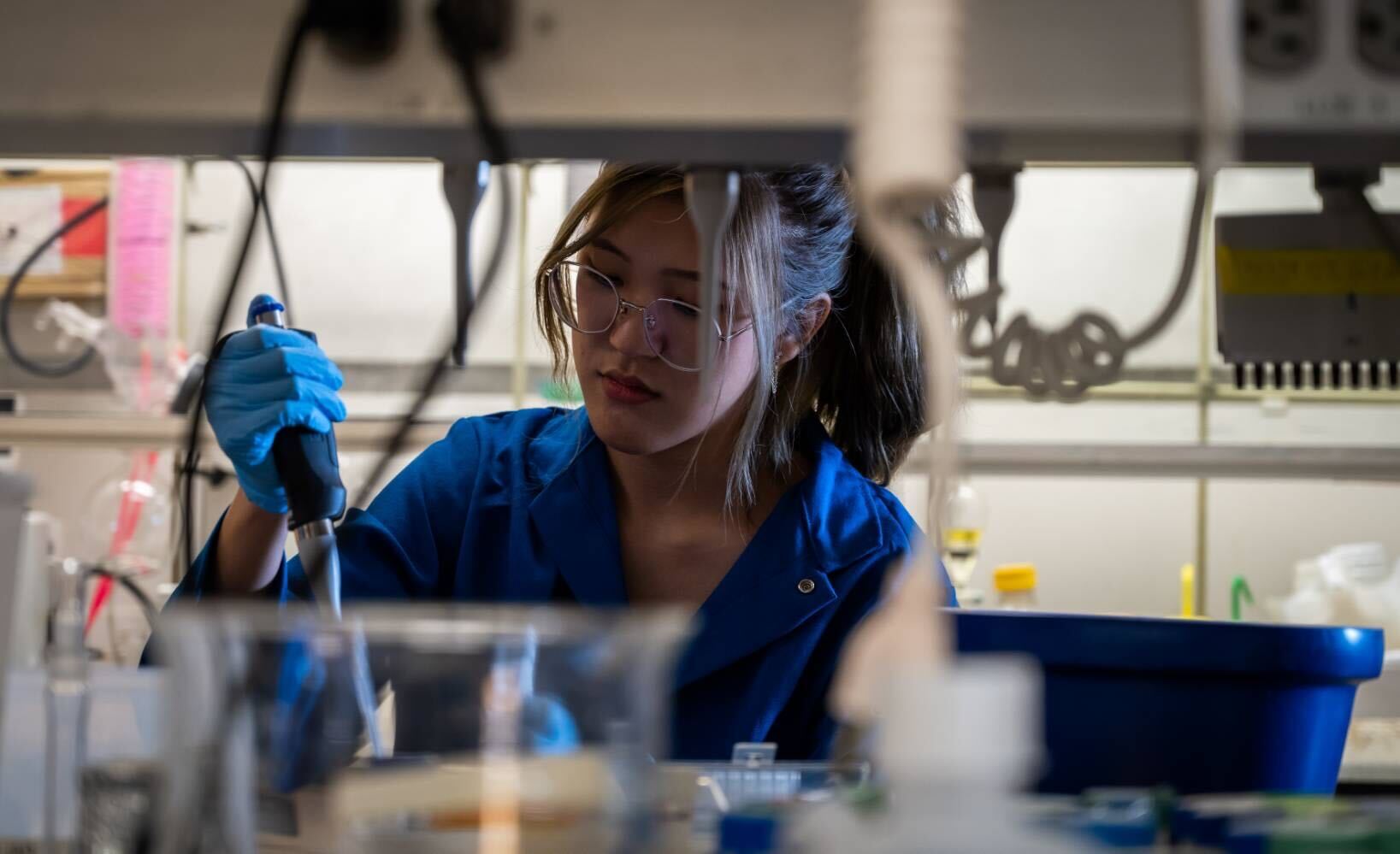
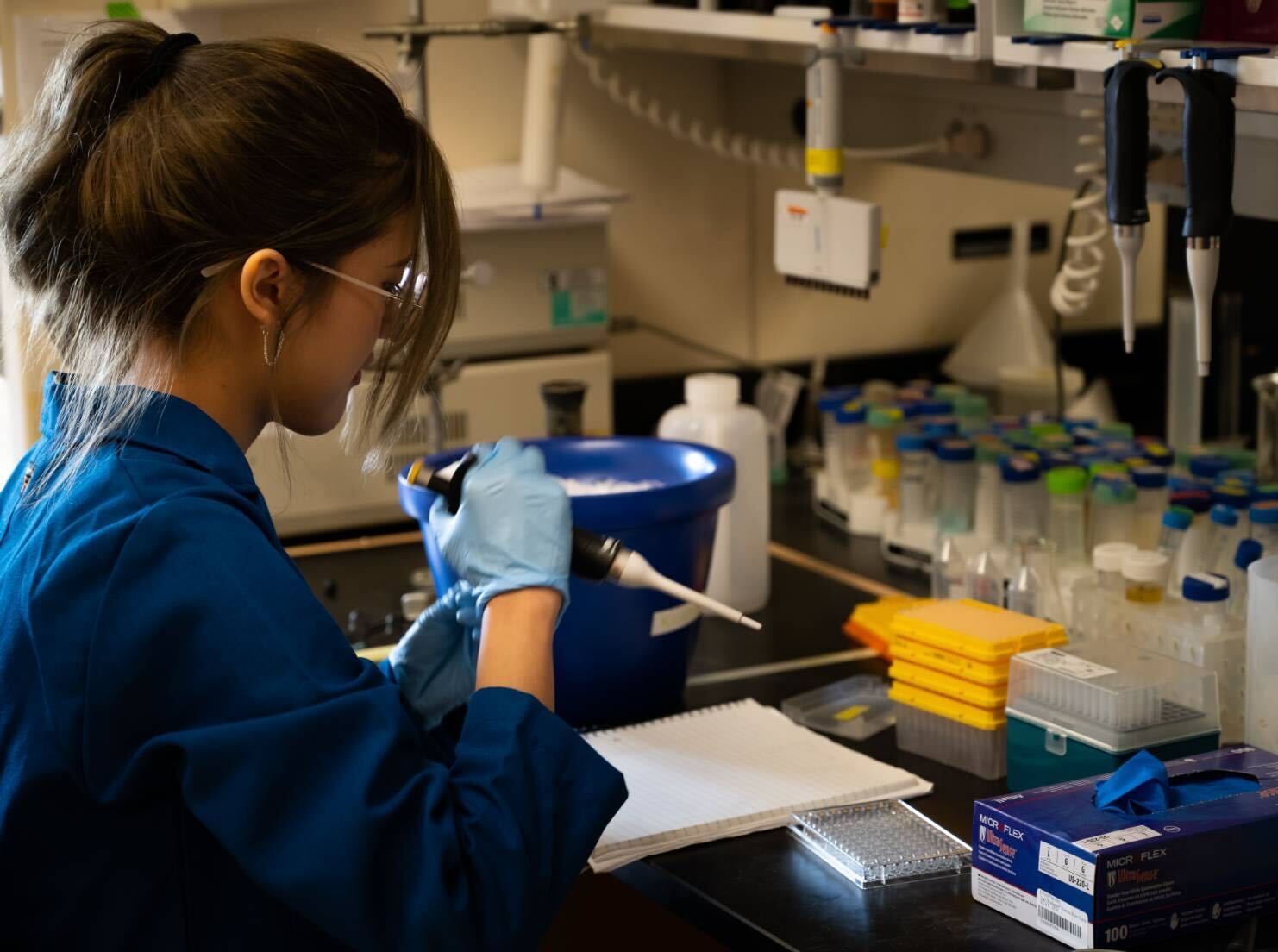
Kendy Chen, a fifth-year biochemistry student, works at a lab. Students urged the UC to remain transparent as the federal government seeks a $1 billion settlement from UCLA to restore its research funding. (Courtesy of Arjun Pamidi)

By Elizabeth Yang
Aug. 19, 2025 5:56 p.m.
Students urged the UC to protect its researchers and increase transparency amid federal negotiations to restore UCLA’s frozen research grants.
The Trump administration suspended about 800 of UCLA’s research grants from the National Institutes of Health, the National Science Foundation and the United States Department of Energy in late July. The agencies cited that UCLA has allowed antisemitism, affirmative action and “men to participate in women’s sports” as reasoning for the funding suspension – which totaled about $584 million.
[Related: FEDERAL FUNDING CUTS TO UCLA]
A federal judge ordered Tuesday that the federal government must restore the suspended NSF grants to UCLA. However, the NIH and DOE grants remain suspended.
[Related: Judge orders Trump administration to restore some of UCLA’s frozen research grants]
The funding freeze requires researchers to cease all spending on the targeted projects and submit a financial report detailing all expenses within 30 days, said Roger Wakimoto, the vice chancellor for research and creative activities, in an Aug. 1 email to principal investigators.
The funding suspension has caused labs across campus to adjust budgets, delay research and scale down their workforce, said Kendy Chen, a fifth-year biochemistry student. As negotiations between the UC and the federal administration continue, Chen said she believes the outcome will have an impact on students’ academic futures.
“It’s really not the best choice to go into grad school or even do anything that’s science-related,” Chen said.
[Related: ‘An attack on knowledge’: UCLA researchers say lifesaving research is in jeopardy]
The federal government is seeking a $1 billion settlement from UCLA to restore its research funding, according to CNN. The settlement would also mandate that UCLA hire a resolution monitor and a new senior administrator to oversee the university’s compliance with anti-discrimination laws, revise its policies surrounding protests, end race- and ethnicity-based scholarships and stop offering gender-affirming care at its hospital and medical school.
[Related: Proposed UCLA settlement from federal government seeks $1 billion, policy changes]
Chen said UCLA’s first public statements about the funding suspension were vague, adding that she feels they did not include concrete steps toward a resolution where UCLA could restore its funding.
Chancellor Julio Frenk has sent out four campus-wide emails regarding the freeze, in what he called an effort to be in “constant communication” with the UCLA community as it navigates funding challenges. Frenk’s initial July 31 email announced the suspension of research funding, while following emails clarified the dollar amount of grants suspended, disclosed the federal government’s proposed $1 billion settlement and gave students ways to advocate for UCLA.
However, Chen added that the UC has faltered in providing clear updates on its planned course of action, which has made researchers uncertain about the future of their projects and positions, as well as the potential duration of the negotiation process and the funding freeze.
The UC Board of Regents held an emergency meeting – which was not open to the public – to “discuss a path forward” regarding the funding suspension and the administration’s proposed settlement. The UC has “spent recent days evaluating the demand, updating the UC community and engaging with stakeholders,” said Meredith Turner, the UC’s senior vice president of external relations and communications, in a statement following the closed meeting.
Chen, who is conducting research on biosynthesis, the process of producing molecules in cells, said she is unsure if she can continue her research because she can no longer purchase synthetic DNA – artificially created DNA molecules – to make proteins for her project.
“I just hope it (the UC) can be more transparent,” she said. “I’m still not sure what the status is right now.”
Some labs, such as that of electrical and computer engineering doctoral student Samuel Wang, have not been impacted by the cuts to the same degree due to diversified funding sources. Wang said the semiconductor manufacturing lab he is working in has not faced major disruptions as of Aug. 10.
However, he added that he believes the UC should still improve financial transparency for those currently unaffected by the funding freeze – such as by providing details regarding where funds that the school collects from all research groups are going.
“Every dollar that we bring in through our proposals, the UC takes about half of it,” Wang said. “My group mates and I would love to at least have an idea of how the UC is also spending the funding that we’re bringing in through our proposals.”
Vyas Koduvayur, a rising third-year computational and systems biology student, said he wants the UC to be more clear about which positions will be impacted by the funding freeze and the resources available to them. The suspension could make graduate school admissions more competitive due to uncertainty surrounding budget cuts, he added.
Graduate students in Chen’s lab were told by their professor that the funding suspension could mean leaving projects unfinished or exiting their doctoral programs with a master’s degree instead of completing the doctorate, she said. The students were warned they may have to graduate early because of budget constraints, Chen added.
Chen said she is reconsidering if she will apply to UC graduate programs at all, fearing that other UC campuses could be targeted by the federal administration next.
The U.S. Department of Justice launched an investigation into the UC in March to determine if the University has allowed an “Antisemitic hostile work environment to exist on its campuses,” according to a DOJ press release. It also announced in June that it would investigate the UC’s hiring practices, citing concerns that the University has engaged in race- and sex-based employment discrimination.
Some universities – such as Northwestern University, Massachusetts Institute of Technology and Washington State University – have reduced doctoral degree offers in response to federal funding cuts. UC San Diego’s Biological Sciences program scaled back its admissions by over 30%, according to Forbes.
The funding freeze could have profound impacts on international students, Koduvayur said, following an already tumultuous spring in which at least 19 UCLA international students – and over 1,800 nationwide – had their visas revoked by the Trump administration. The federal government later restored the students’ visas in April while it develops a consistent “framework for status record termination.”
Koduvayur said he believes that “careers are now in jeopardy” – and while he personally would prefer the UC to fight back against the federal government’s demands, he believes a quick settlement would be a more just option for international student researchers whose visa statuses depend on grant funding.
J1 visas allow international scholars to stay in the United States to participate in research, and H1-B visas support researchers who come to the country to perform full-time professional positions, according to the UCLA Dashew Center for International Students and Scholars’ website.
When the programs of researchers on J1 visas and the employment of those on H1-B visas end – including through the suspension of their research grants – they receive a 30- and 60-day grace period to leave the country, according to the U.S. Citizenship and Immigration Services website.
These cutbacks could impact the livelihoods of international students, Chen said. Her lab mentor, an international student, is worried about his visa status if the funding freeze jeopardizes his research position, she added.
As negotiations continue, Wang said he wants the university to work toward a quick resolution because a prolonged funding suspension could mean a loss of valuable time on impactful research.
Wang said he saw some of the settlement terms as manageable, such as the hiring of new compliance administrators. But he added that the other terms – including ending race- and ethnicity-based scholarships and gender-affirming care – undermine academic freedom and scientific independence, making a quick resolution more complicated.
“I don’t think the government should be determining what scientific consensus is,” Wang said.