‘An attack on knowledge’: UCLA researchers say lifesaving research is in jeopardy
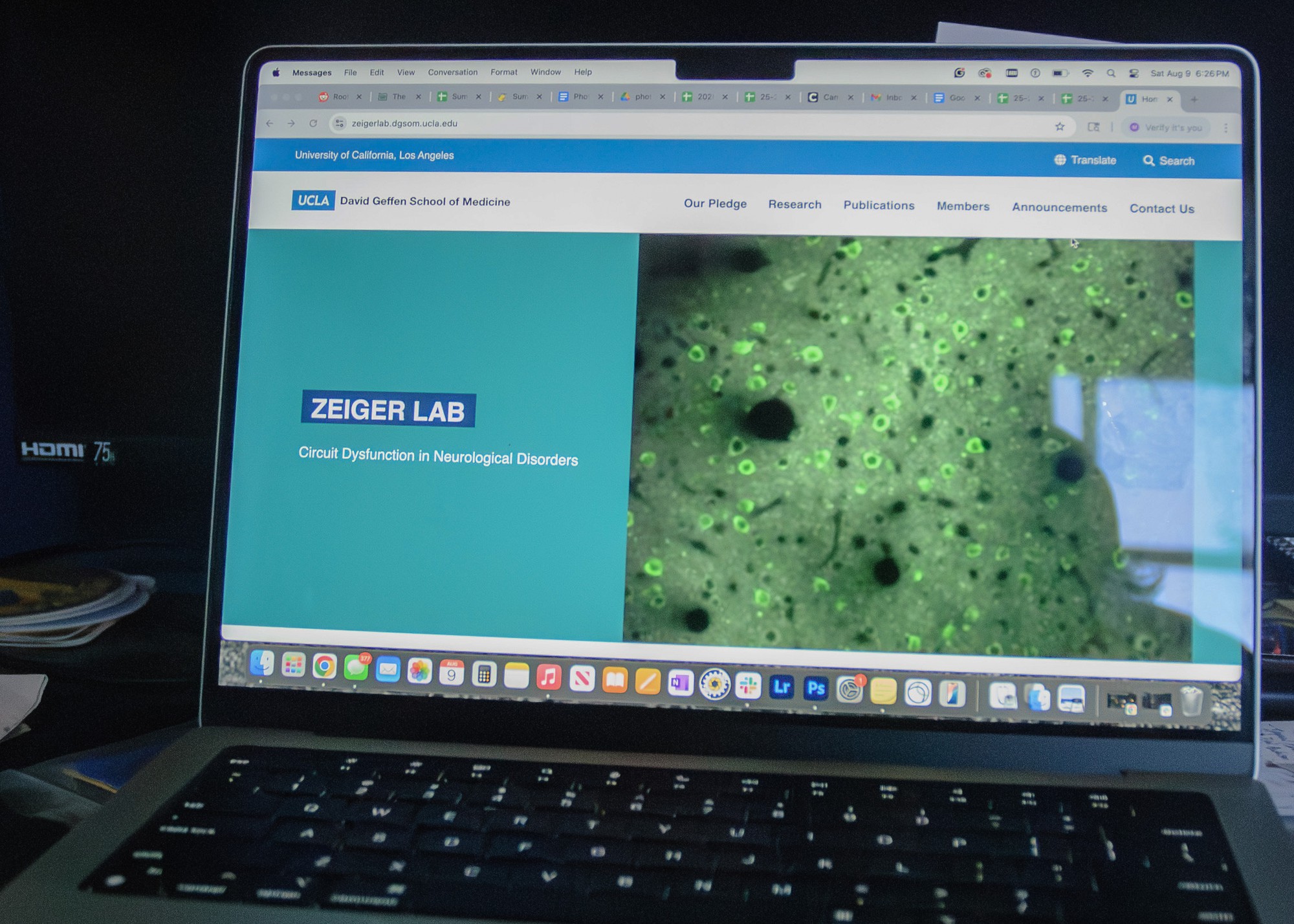
Dr. William Zeiger’s lab website is pictured. UCLA researchers said the federal government’s suspension of about 800 research grants has caused uncertainty among students and faculty. (Michael Gallagher/Assistant Photo editor)

By Alisha Hassanali
Aug. 9, 2025 6:59 p.m.
Dr. Jerzy Kupiec-Weglinski has led organ transplant research at UCLA for nearly three decades.
Kupiec-Weglinski, the vice chairman of basic science research in the David Geffen School of Medicine’s surgery department, said his research centers on improving organ transplant surgery outcomes amid the growing demand for transplants as the population ages.
His team was also on track to formally establish the Transplant Institute at UCLA under the Department of Surgery, which would focus on improving clinical outcomes and getting more donor organs, he said.
However, these lifesaving efforts are in jeopardy, he said.
Kupiec-Weglinski’s two grants from the National Institutes of Health – which funded researcher salaries and animal care – were suspended July 31, he said.
“We are just scrambling what to do,” Kupiec-Weglinski said. “We have people to feed and we have animals to feed … and we are told that we need to cut down on everything – and it’s very, very, very uncertain times.”
Kupiec-Weglinski said in an emailed statement that he is unsure about the future of the Transplant Institute and his research, adding that he was “told to be prepared for short-term lay-offs and identify indispensable personnel” to continue research efforts.
The federal government suspended about 800 of UCLA’s research grants from the NIH, the National Science Foundation and the United States Department of Energy on July 30 and July 31 – alleging in letters announcing the suspensions that the university had allowed “antisemitism and bias,” illegal affirmative action practices and “men to participate in women’s sports.”
[Related: About 800 NIH, NSF research grants suspended following UCLA federal funding cuts]
The funding suspension halts all spending and requires an interim financial report detailing all project expenses within 30 days, according to an Aug. 1 email from Vice Chancellor for Research and Creative Activities Roger Wakimoto.
The federal government is seeking a $1 billion settlement from UCLA, which, if agreed to, would be the largest payout by a university to the Trump administration since it began withholding funding from some universities in March. It would require the university to hire a resolution monitor and a new senior administrator to oversee the school’s compliance with nondiscrimination laws, ban overnight protests and discontinue race- and ethnicity-based scholarships, according to CNN.
[Related: Proposed UCLA settlement from federal government seeks $1 billion, policy changes]
Dr. William Zeiger, an assistant professor in residence of neurology whose two NIH grants were suspended, said his research focused on examining how the dysfunction of networks of neurons within the cerebral cortex – the outermost layer of the brain responsible for consciousness and functions related to the senses – leads to symptoms of neurological conditions such as stroke and Parkinson’s disease.
His lab used various clinical techniques to analyze neural circuit dysfunction in mouse models of those diseases, according to the Zeiger Lab website. Zeiger, a physician-scientist, added that he hoped to develop therapies to improve patients’ quality of life and find cures for neurodegenerative disorders, which are chronic conditions damaging to a person’s nervous system.
But the funding freeze comes with consequences that will extend well beyond the suspension period itself, he said. Zeiger said his suspended grants covered the salaries of three postdoctoral students and a lab technician as well as lab equipment, supplies and animals that were studied for the research.
He added that a challenge his lab has encountered is ensuring the animals – including worms, flies and mice – are ethically housed and receive veterinary care on a continual basis despite the grant suspension.
“Although the grant has been suspended, those animals are still very much alive,” Zeiger said. “It’s not as if we can just stop taking care of them.”
Carrie Bearden, the director of the UCLA Center for the Assessment and Prevention of Prodromal States, also had two training grants suspended. Her research focuses on risk factors in developing psychotic disorders and young people with particular developmental neurogenetic disorders, she said.
The suspension of Bearden’s NIH training grant on neurogenetics, which served as a source of income for 10 graduate student and postdoctoral trainees, disrupted her projects, she said.
“Everyone is scrambling to figure out how we can pay people that are no longer able to be supported by the grants they’re being paid on,” said Bearden, a professor of biobehavioral sciences, psychiatry and psychology and a faculty member in the UCLA Brain Research Institute.
The suspension of grants exposes the vital relationship between clinical and research enterprises in ensuring healthy patient outcomes, Kupiec-Weglinski said. He added that the medical practices at Ronald Reagan UCLA Medical Center rely on advances made by researchers.
“It will make Americans sicker. It’ll make us less knowledgeable,” Bearden said. “It really is an attack on knowledge.”
Bearden said she sees the suspension of research funding as an attempt to “destroy” universities. She added that she is concerned for students who are beginning their careers in science and academia, as well as international students, who may be vulnerable because of instability surrounding immigration processes.
“It’s just so obvious what a loss it is to take away grants that are going to change the future of treatments for brain diseases and treatments for cancer,” Bearden said. “It’s a tragedy for this country that this is happening.”