Mani Bhaumik funds new postdoctoral fellowship, increases intellection freedom
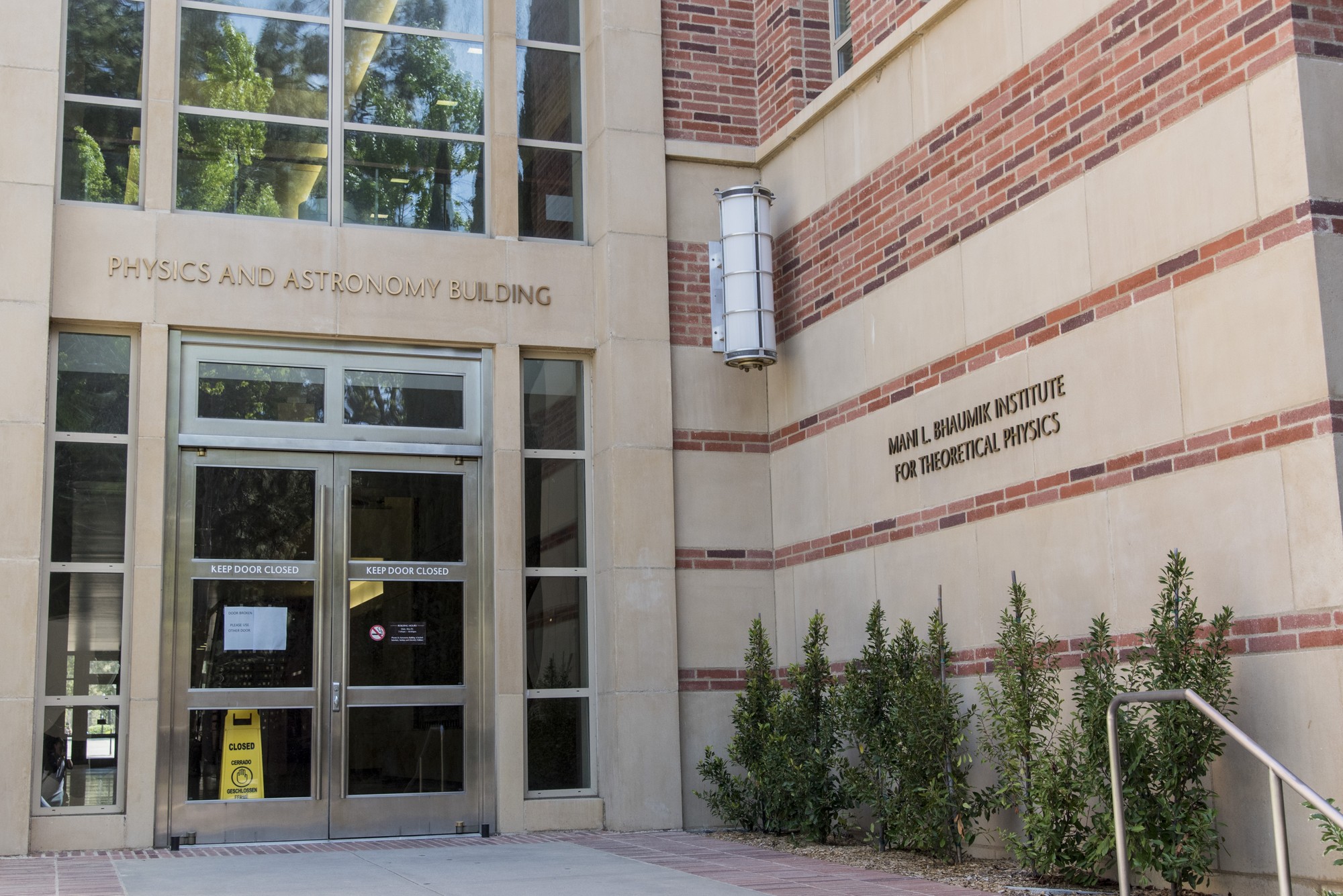
The Mani L. Bhaumik Institute for Theoretical Physics is pictured. (Daily Bruin file photo)

By Charlie Hamilton
Aug. 12, 2025 8:28 p.m.
This post was updated Aug. 12 at 9:23 p.m.
Amid the federal government’s freeze of over $500 million of UCLA’s research funding, Mani Bhaumik hopes to support postdoctoral candidates who want to continue researching at UCLA with a new fellowship.
Miguel García-Garibay, the dean of the UCLA Division of Physical Sciences, said the program, funded by a $3 million donation from Bhaumik, a famous physicist and philanthropist, will offer postdoctoral fellows both intellectual freedom and financial compensation for two to three years. Postdoctoral candidates are scholars who have recently received their doctoral degree and are transitioning to become independent researchers by continuing research and typically training with a faculty member.
Before the cuts, UCLA relied upon federal funding to hire most of its postdoctoral scholars, García-Garibay said. He added that although an increase in private donations – such as this most recent gift from Bhaumik – has allowed the university to expand its hiring power for these positions, he still hopes federal funding will be restored soon.
He said he anticipates the program will begin around November or December.
“Very talented postdocs of many different disciplines will have an opportunity to interact scientifically and socially so that they can influence each other in terms of their ideas, their thoughts, their futures, their careers,” Garcia-Garibay said.
Stuart Brown, a professor in the UCLA’s physics and astronomy department, said the program will enhance the reputation of his department, adding that he believes postdocs are the future leaders of science.
The program will also allow UCLA to recruit talented researchers and create top prospects for faculty positions across the globe, said Alex Spokoyny, chair of the UCLA chemistry and biochemistry department.
Federal and state funding is limited – especially for the physical sciences – leaving Spokoyny’s department to often rely on the generosity of UCLA alumni like Bhaumik, he added.
“This really will bring us to a next level of competitiveness in physics and chemistry and biochemistry to compete with some of those top programs … for the best talent,” he said.
Zvi Bern, the director of the Mani L. Bhaumik Institute for Theoretical Physics, said young postdoctoral scholars help advance science.
“Many times the great advances are directly due to young postdocs. It’s the lifeblood of science. It’s the way science gets done,” Bern said.
This donation is not the first that Bhaumik has made, Bern added. His institute has an income of over $700,000 per year from their $11 million endowment, which Bhaumik provided, Bern said.
“To run a proper lab, that may not sound like much … but I can tell you in theoretical physics, it’s a big deal,” he said.
Bhaumik, who could not be reached for comment, moved from West Bengal, India to the United States on a Sloan Foundation postdoctoral fellowship to study and continue his research at UCLA in 1959, Bern said. His research and discoveries in laser technology were instrumental for the development of lasik eye surgery, according to the Bhaumik Institute.
This personal connection with the university – along with extensive resources and a deep interest in helping science – has prompted Baumik to give these donations, Bern added.
Enrico Herrmann, a postdoctoral researcher at the Bhaumik Institute, said the lab’s funding was one of the main reasons he chose UCLA over other offers he had.
“The number of postdocs here, the travel funding and all sorts of resources that you can (use to) invite visitors,” he added. “That was very attractive.”
Herrman said while many federal grants that funded postdoctoral research are now under jeopardy, Bhuamik’s funding has given him the extra stability and independence to do fundamental science and research at UCLA in theoretical high energy physics.
Bern added that private funding from donors like Bhaumik is absolutely essential for research.
“Any university which does not have private funding or an endowment from the past is basically going to be screwed,” Bern said. “And it’s not just the Trump administration.”
García-Garibay said that the federal government has been divesting from higher education, which makes monetary support from the public, foundations and individuals like Bhaumik much more important.
“The cost of higher education and the cost of research is very high,” said García-Garibay. “But the benefits that we receive from that are also extremely high.”
Bern added that donations from larger private groups can bias the direction of science according to a personal agenda, as they have no standardized, peer-reviewed process for bestowing money like the federal government.
Similarly, Spokoyny said that while private donations can support areas often unprioritized by the federal government, they cannot replace federal funding.
“We’re in dangerous territory if we have to rely on just private donations to run the science in the United States,” Spokoyny said.