Scouting Report: UCLA football vs. Illinois


This post was updated Nov. 12 at 9:13 p.m.
No. 4 UCLA football (9-0, 6-0 Big Ten) returns to the Rose Bowl for a Friday night showdown against Illinois (6-3, 4-2). The Bruins are now projected to receive a bye in the College Football Playoff, according to the second iteration of the rankings. Here is this week’s scouting report from Sports editor Jacob Nguyen, who wants to see which students win free tuition, and Sports reporter Jack Clarke, who is curious to see if free Chick-fil-A is enough to incentivize students to sit in Los Angeles rush hour traffic for Friday’s game.
Illinois’ offense:
Offensive scheme: Spread
Run-pass percentage: 50% run, 50% pass
Strength: Consistency
Weakness: Depth
X-factors: Katin Houser and Collin Dixon
If there’s one word many college football fans would associate with the 2026 season, it would be “unpredictability.” And few teams have embraced this narrative as much as the two slated to meet in the Rose Bowl under the Friday night lights.
In an ESPN preseason prediction, Illinois was slated to finish ninth in the Big Ten with seven projected wins. However, after uninspired offensive outputs against Ohio State and Purdue in consecutive contests, many pundits were quick to write off the Fighting Illini’s 2026 squad and its ability to become bowl eligible.
But, in alignment with this season’s theme, Illinois coach Bret Bielema’s team has been quietly rebuilding its season with four consecutive conference wins, including a victory over now-No. 16 Oregon by two scores.
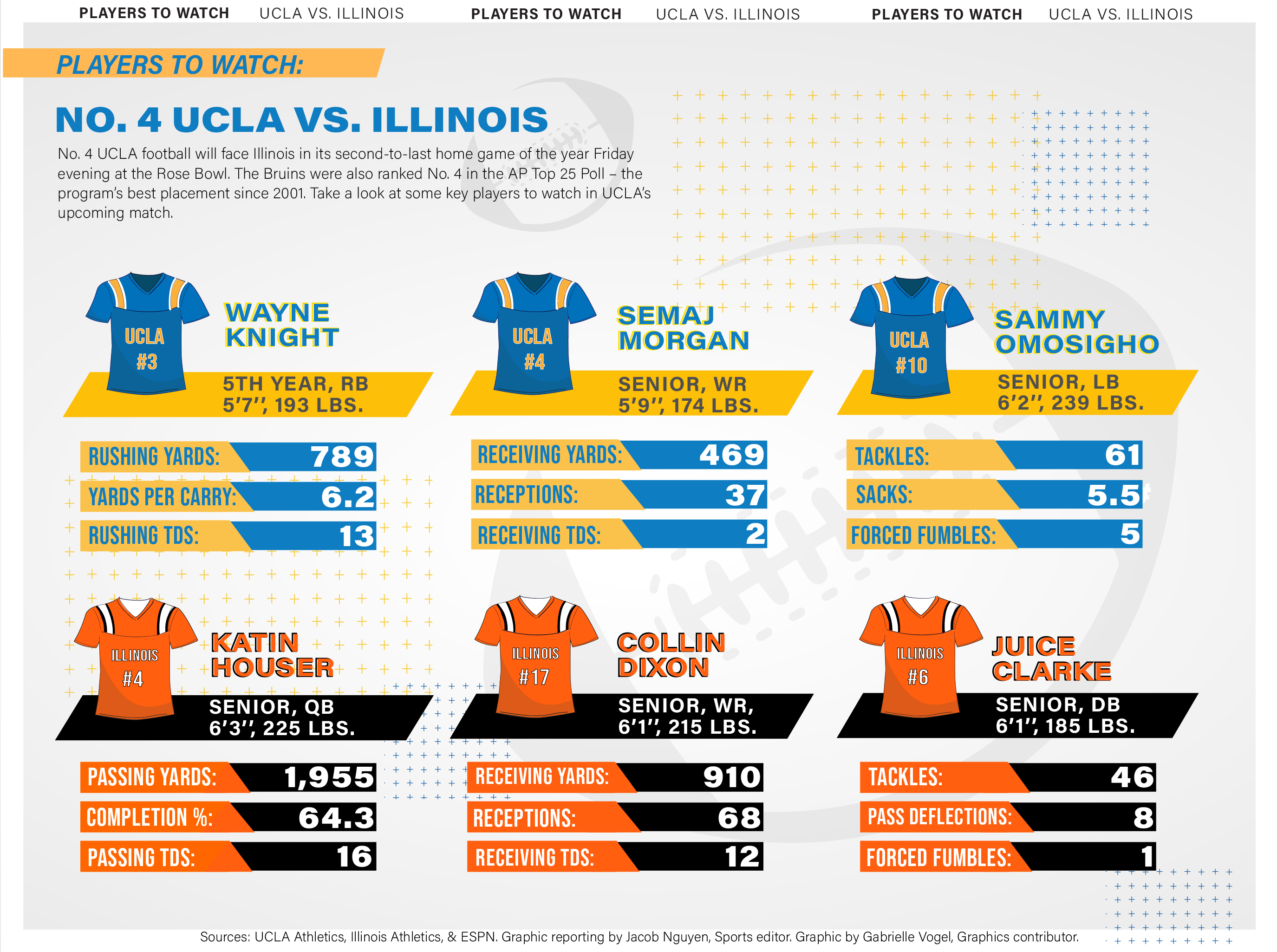
Propelling this growing confidence in Urbana-Champaign has been the consistency of Fighting Illini quarterback Katin Houser. Despite missing his team’s triumph over the Ducks on Oct. 24, Houser has begun to play his best football in November, including his most recent performance against Nebraska.
In the Fighting Illini’s 24-13 victory over the Cornhuskers, Houser threw for three scores with 292 passing yards and no turnovers against the Nebraska defense – one of the Big Ten’s stauncher units in 2026.
Houser’s game is dependent on smart decisions with the football to limit turnovers and keep third downs manageable, demonstrated by the Fighting Illini’s 46% conversion rate on third down – the third-highest mark in the conference.
On the topic of smart football, getting the ball to one of the country’s most productive receivers is usually an intelligent offensive strategy.
Wide receiver Collin Dixon – whose season has been largely overshadowed by a historic campaign from fellow Big Ten receiver, Ohio State’s Jeremiah Smith – has quietly put together an All-American-level season as Houser’s top target. The pass-catcher is currently tied for third in the country in receiving touchdowns with 12, fifth in receptions with 68 and eighth in receiving yards with 910 through nine games.
While Dixon’s two-touchdown, 129-receiving-yard performance against the Cornhuskers is likely something UCLA’s defense will have to consider, it is also important to note the Illinois offense’s true balance.
Offensive coordinator Barry Lunney Jr. calls an offense that puts Houser in high-win situations as a passer while balancing the aerial attack with a bruising rushing game. Throughout the season, the Fighting Illini have used simple concepts, targeting the middle of the field to secure completions and stay in front of the sticks.
For a UCLA defense that has achieved success by limiting opponents on the ground and forcing turnovers, Friday’s clash will be an interesting test for the now-No. 4 Bruins. Illinois has only surrendered six turnovers in 2026, meaning UCLA will have to get off the field by limiting the opposing offense on early downs to make third downs more difficult to convert.
Another key to victory will be winning battles at the line of scrimmage. Despite its consistency, the Illinois offensive line has sustained multiple setbacks throughout the season, including a season-ending injury. Challenging this group through line movement and blitzes will be crucial for preventing the Fighting Illini from gaining momentum on offense.
While Houser’s efficiency through the air and weapons across the field will be a challenge for defensive coordinator Colin Hitschler’s unit, an aggressive and sustained defensive game plan will be crucial for propelling UCLA to a 10-0 record.
Illinois’ defense:
Defensive scheme: 3-3-5
Strength: Midseason improvement
Weakness: Quarterback pressure
X-factor: Roger Cooper
After a 2-2 start that ended with a 23-point loss to then-No. 7 Ohio State – in which the Buckeyes scored six touchdowns, including four in the air – defensive coordinator Bobby Hauck’s departure seemed to indicate a culture shift in Champaign County, with inside linebackers coach Roger Cooper usurping the vacant position.
Hauck’s 3-3-5 scheme was met with optimism ahead of the 2026 season, but its excessive presnap motion and overcomplicated communication – Hauck would speak to a coach on the sideline, who would then relay the message to a player on the field – undermined the defense’s ability to execute.
When Cooper took over, his simplification of the defense and streamlining of play-calling allowed the Fighting Illini to focus on playing more quickly. While some schematic issues are still present, it’s hard to argue against a four-game win streak, with Illinois allowing under 20 points in each of its past three matches.
In its most recent game against Nebraska, Illinois gave up just 13 points – albeit scoring only 24 itself – and maintained control with timely stops on third and fourth downs, while also forcing two missed field goals and a failed two-point conversion to prevent a late-game resurgence.
Nevertheless, the victory wasn’t without some shortcomings. The Cornhuskers had a statistically good performance, with quarterback Anthony Colandrea leading a line that logged over 400 yards of total offense. Colandrea himself had 43 passing attempts, converting on 32 of them for a 6.6-yard average.
Against a defensive line that usually deploys just three rushers, Illinois has struggled to consistently pressure opposing signal-callers, instead preferring to overload coverage up the field. Consequently, this lighter front necessitates elite interior tackles the Fighting Illini simply don’t have, giving opposing offensive lines crucial one-on-one victories.
Senior quarterback Ty Dieffenbach could enjoy even more time in the pocket to dice up Cooper’s squad – one that has earned just 11 total sacks – with ample checkdowns, as Colandrea did Nov. 6.
Illinois likes to send interior linebackers on blitzes to attack gaps typical linemen would exploit, with most of the pocket pressure coming from players such as Ismael Kante and James Kreutz – two of the squad’s three leading tacklers. The two have contributed to a decent rushing defense, but the Fighting Illini still remain in the bottom half of the Big Ten in rushing yards allowed per game.
Unless absolutely perfect, Cooper’s defense leaves seams that are easier to break. As a result, Illinois technically has the conference’s worst passing defense, but how much of that comes down to poor pressure at the line of scrimmage versus an actually bad secondary is a question in and of itself.
Helmed by defensive back Juice Clarke’s eight passing deflections – tied for third in the Big Ten – Illinois’ pass coverage has been improving since the start of the year. However, with just three interceptions over halfway through the season, the Fighting Illini have struggled in the open field, as an inability to get to the quarterback means the team’s last line of defense is consistently being tasked with making big stops.
If Cooper is unable to get every level of his defense to click Friday, Dieffenbach may be in for yet another career game.