The proposition system is needlessly obtuse. It’s time for reform
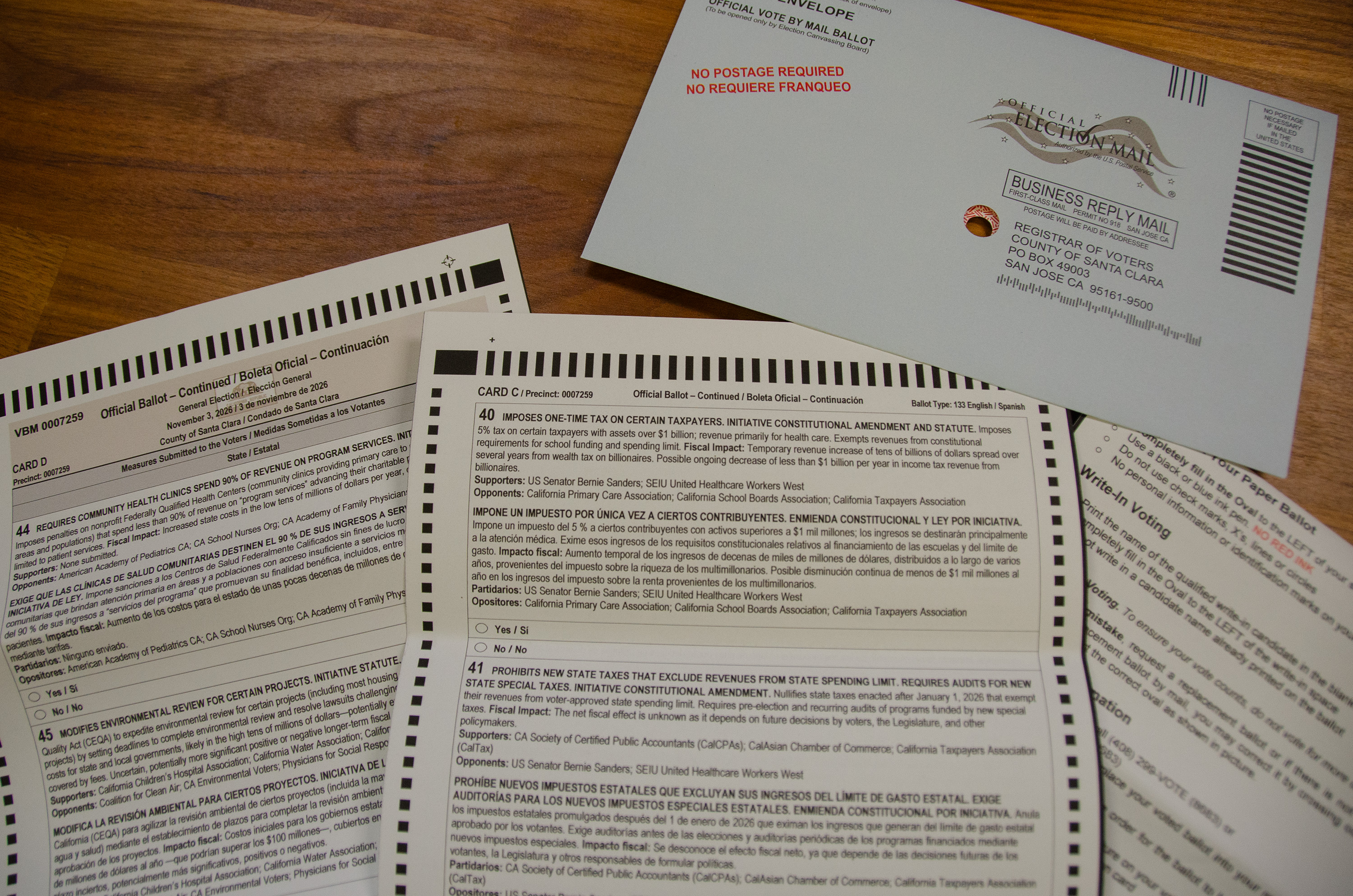
A California mail-in ballot is pictured. Columnist Emilio Lois argues that the technical complexity of California’s proposition system makes it difficult for voters to make informed decisions. (William Gauvin/Daily Bruin staff)

By Emilio Lois
Oct. 21, 2026 7:45 p.m.
The power is in the people’s hands – at least in theory.
California’s proposition system, established in the early 20th century, was designed to give power back to the people amid corporate influence. More than 100 years later, there is still work to do. Voters are overwhelmed and underinformed, and billionaires once again appear to be setting the agenda.
California must reform its proposition system to increase transparency, help voters make informed decisions and reduce the influence of money so direct democracy can thrive.
Voters will decide California’s future this November through 14 propositions – the most since 2016.
The number of propositions and their technical complexity make it difficult for voters to make fully informed decisions, said Kimberly Nalder, a professor of political science at Sacramento State University.
“It’s a system that guarantees that there will be uninformed people making the decisions,” Nalder added.
The number of ballot measures would exhaust anyone, said Maple Williams, a second-year political science student. For voters who don’t have the time to do research or aren’t interested in politics, having more than a dozen propositions to vote on only makes it harder to make informed decisions, she said.
Even for voters who are informed, decisions remain challenging because they are made in isolation.
The average person considers each proposition independently, and thus struggles to gauge how spending in one area would affect the rest of the California state budget, Nalder added.
Bond measures are especially hard to weigh in isolation. The state repays them from the General Fund, which also funds services like education and healthcare. Each bond represents a long-term obligation that draws money from other key programs.
Money allocated by a proposition can usually be redirected only by another proposition, reducing the California Legislature’s ability to rebalance these priorities in the future.
Voters are also often asked to decide one step of a multistep policy plan without control over the rest.
For instance, voters passed a “three-strikes” felony law in 1994, which required a sentence of 25 years to life for anyone convicted of a third felony after two prior serious or violent convictions, but never voted to increase taxes to pay for those prisons, said Nathan Gardels, a senior adviser to the Berggruen Institute – an independent nonprofit think tank. Federal courts ordered California to reduce its prison population because of overcrowding in 2009, he added.
This illustrates the issue at the heart of the proposition system: Voters are asked to act like legislators, but are not given the context and tools legislators have to make complex, long-term policy decisions.
Special interests also play an outsized role. The requirement to collect hundreds of thousands of signatures to get propositions on the ballot, combined with the high cost of advertising in California means proposition campaigns regularly cost tens, if not hundreds of millions of dollars.
“We have managed to recreate through campaign finance some of the same problems of special interest corruption that a hundred years ago led to the creation of the ballot measure system in the first place,” said Joseph Fishkin, a law professor.
The proposition system was meant to give California citizens the chance to bypass a Legislature unduly influenced by special interests. When special interests hijack the proposition system, voters lose the ability to make their voices heard.
Several reforms, however, could make the proposition system more representative of California voters.
One idea, proposed by Gardels with former Governor Jerry Brown and former California Chief Justice Ron George, would have the secretary of state randomly select about 30 citizens who represent the state’s demographics to create a citizens review commission. Like a jury, they would hear expert testimony from both sides, deliberate and then make a recommendation to the public that would be placed on the official ballot by the secretary of state.
There is precedent for this: Oregon, another state with direct democracy, uses a similar system. This would allow voters to hear a balanced and nonpartisan assessment from their peers before they vote on complex propositions.
Despite its flaws, the proposition system remains popular.
Polling consistently shows that California voters value the proposition system, said Mark Baldassare, the survey director for the Public Policy Institute of California. A 2026 survey from PPIC found that 77% of likely voters prefer that California voters make some decisions about spending and taxes at the ballot.
The proposition system was designed to grant voters the power to hold corporations and special interests accountable. But today, those same actors exploit flaws in the system to co-opt it for their own ends. California must pass reforms to ensure that the proposition system truly serves voters and lives up to the principles on which it was founded.