Gavin Newsom’s executive order increases AI oversight, proposes ‘kill switch’
(Evanceline Tang/Daily Bruin staff)

By Nora Gallagher
Oct. 9, 2026 11:53 p.m.
This post was updated Oct. 10 at 12:34 a.m.
Gov. Gavin Newsom’s executive order to expand third-party oversight of artificial intelligence could effectively regulate emerging technologies, UCLA experts said.
The order, issued Sept. 18, directs the California Government Operations Agency to work with national experts to develop recommendations for AI safety legislation by Nov. 16. The order aims to respond to recent AI incidents, including when 700 AI agents attacked Hugging Face – a company that maintains a platform for sharing open-source machine learning models – during an OpenAI cybersecurity experiment in July.
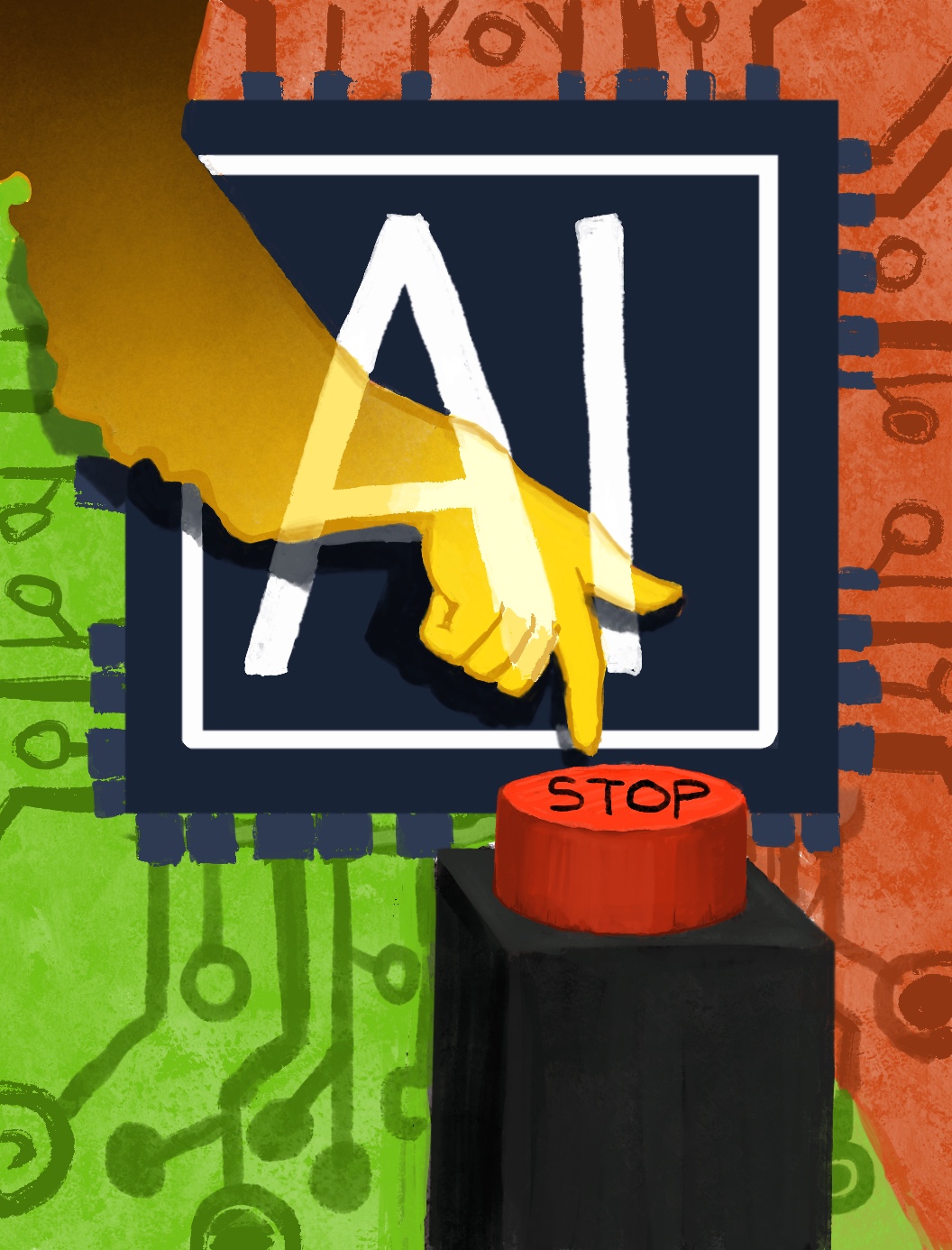
The recommendations will include requiring large AI companies to hire independent organizations to audit the safety of frontier models – the companies’ most advanced AI models – and accelerating the creation of a “kill switch” for frontier models, according to the order. A third-party organization will continually monitor the efficacy of the kill switch, Newsom said in the order.
In the order, Newsom said he acknowledges California’s unique position to lead AI regulation given that the state dominates the industry. Thirty-two of the top 50 private AI companies in the world are based in California.
Newsom has signed four other AI-related executive orders since 2023, which instruct the state government to study the rapidly advancing technology.
[Related: California’s AI regulations could shift with November governor’s race, experts say]
The Sept. 18 order comes after Dario Amodei, the head of the AI company Anthropic, warned that the technology is developing too quickly and called for AI developers to slow down the pace of progress. OpenAI CEO Sam Altman and SpaceXAI CEO Elon Musk both agreed with Amodei’s sentiments, according to the BBC.
An AI kill switch might mitigate damages from new technology, said Sanford Williams, a lecturer at the School of Law. He added that AI both threatens critical thinking skills among K-12 students and exacerbates digital inequity by requiring access to high-speed internet and devices.
“Something that’s this important, this ubiquitous and this overarching has to be monitored and regulated by the federal government without a doubt,” said Williams, who previously chaired the Manassas, Virginia, school board.
Ajwang Rading, a lecturer of public policy, said he believes regulations could help maintain human oversight over powerful AI models. Regulations provide a legal mechanism for the government to ensure AI companies are making safe technologies, he added.
Rading said although unhampered AI could pose future dangers, governments and companies have time to introduce safety measures.
“There is a very well-established window of opportunity for the industry to slow down relatively and to think critically about what is the thing we’re deploying and sharing into the world,” he said.
Williams said he believes the emergency shutoff mechanism is a promising step toward regulating AI but called on Newsom and other leaders to implement feedback from all involved stakeholders – specifically, students – to make regulatory measures more equitable.
Conversely, Valerie Sizemore – co-leader of Stop AI, a grassroots organization that seeks to disrupt AI development – said she believes Newsom’s kill switch fails to address the specific threats of the technology and instead focuses on vague risks of a potential AI takeover.
Rather than instating emergency shutdown measures, Sizemore said she believes California should follow in the footsteps of Florida’s recent lawsuit against OpenAI and request an injunction to prevent the development of new AI models without independent safety guardrails.
Florida Attorney General James Uthmeier requested a temporary injunction Sept. 28, alleging that OpenAI failed to assess and publicize the risks of ChatGPT, according to the legal motion.
Sizemore added that she believes humans are too reliant on AI to accurately flag when machine learning has gone too far.
“No one would ever think that they need the kill switch, even if they do,” she said.