Scouting Report: UCLA football vs. California


This post was updated Aug. 30 at 11:52 p.m.
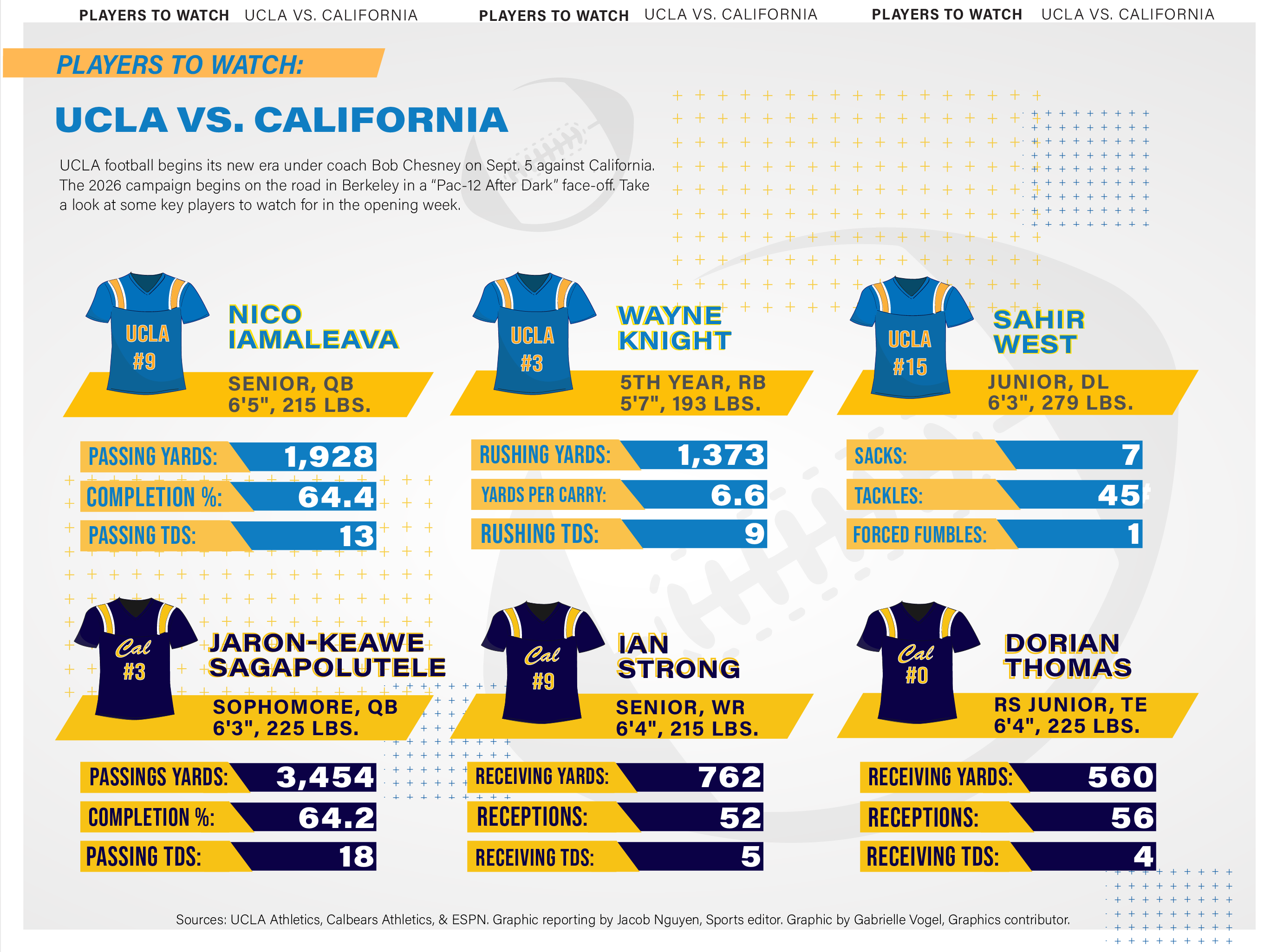
UCLA football begins its 2026 season Sept. 5 against California away at California Memorial Stadium. After a discouraging 3-9 campaign last year, the Bruins begin a new era under coach Bob Chesney, with both former conference rivals seeing major roster turnover and staff changes during the offseason. Here is this week’s scouting report from Sports editor Jacob Nguyen – who is excited to see the momentary revival of Pac-12 After Dark – and Sports contributor Zach King – who can’t wait to see two returning quarterbacks show some West Coast flair.
California’s offense
Offensive scheme: Pro style
Run-pass percentage: 46% pass, 54% run
Strength: Playmaking
Weakness: Running game
X-factor: Dorian Thomas
Only one word could describe my thoughts when I first saw now-sophomore quarterback Jaron-Keawe Sagapolutele’s 19-yard back-shoulder touchdown pass to tight end Mason Mini in his first-ever drive last year against Oregon State.
It was the same thought when the Golden Bears ran in a nine-yard touchdown to go up 35-10 against then-No. 8 Miami after hosting College Gameday – a lead they would blow after the Canes stormed back on a 29-3 run.
It was the same thought when former head coach Justin Wilcox decided to line up Fernando Mendoza for what would be a game-winning two-point conversion against Caleb Williams’ USC squad, which was completely stuffed.
And it was the same thought when Sagapolutele led his team to a dominating 21-0 lead in his native state’s bowl game – before the Golden Bears went nearly scoreless the rest of the way and got walked off by a 22-yard dot from Hawai‘i’s backup quarterback.
“Whoa.”
For better or for worse, that may be the defining word of California football.
And as Cal’s “Caloha” era enters its second year, one question hangs over the Golden Bears’ offense: Can they finally control the wave of inconsistencies?
Sagapolutele had the most passing yards by a true freshman across Power Four conferences last year – while the Bears had one of the worst rushing attacks in the FBS. The passing attack looked unstoppable in top-25 upset wins against Louisville and SMU – and couldn’t be found in blowout losses to San Diego State and a 3-7 Stanford team.
But new faces and an arsenal of new weapons look to change that.
After coaching under Kenny Dillingham at Oregon and Liam Coen in Tampa Bay, first-year offensive coordinator Jordan Somerville will look to implement a similar style to those teams: a dynamic run game setting up creative play-action pass plays at a fast pace.
In the trenches, the Golden Bears return guards Tyson Ruffins and Sioape Vatikani alongside center Bastian Swinney. They also add Jimothy Lewis from Mississippi State and Jacob Arop from South Dakota to compete with returner Frederick Williams at the tackle positions. Finding consistent tackle play will be critical for the Bears to not repeat last year’s struggles on the ground.
Equally important is finding depth within the running back room. Even after losing running back Kendrick Raphael to the Mustangs, Somerville has reason to be excited about Washington transfer Adam Mohammed following a 523-yard, five-touchdown season as the Huskies’ third-down option.
Joining Mohammed is Carter Vargas, whose 445-yard, five-touchdown freshman campaign was crucial for a UC Davis squad that made a notable FCS playoff push.
Consistent from last year’s Golden Bear coaching staff is associate head coach and quarterbacks coach Nick Rolovich – who took the helm for the last two games of the season, including the victory over SMU.
Rolovich and former head coach Justin Wilcox often utilized multiple tight end sets, a luxury that Somerville will inherit with even more pass-catching talent at the position.
Mini is the returner with the most receptions on the team from last year, while New Mexico transfer tight end Dorian Thomas enters as possibly the most formidable receiving threat on the team. Not only did Thomas dominate the Mountain West last year, but he did it against Power Four competition as well, including a 71-yard, two-touchdown performance at then-No. 14 Michigan and three catches for 41 yards against the Bruins at the Rose Bowl.
The Golden Bears will not only have more options in tighter formations, but when stretching the field as well. Cal’s limited receiving core forced much of last season’s passing attack to barrel exclusively through a small collection of targets. Alternatively, Somerville enters this year with an influx of size, strength and speed. Rutgers transfer Ian Strong and Ohio transfer Chase Hendricks arrive after combining for 123 receptions last year, and can both be utilized as the No. 1 or in the slot.
Former four-star Cooper Perry offers immense upside as well after following new head coach Tosh Lupoi down from Oregon, and can stretch the field with his speed.
Sagapolutele’s ability to stretch defenses vertically and fit throws into tight windows will only continue to improve, and with an abundance of reliable options, the versatility of the Bruin linebackers and secondary will need to show out.
UCLA will need to generate pressure without leaving Cal’s new weapons isolated downfield, remain stout against Golden Bear attempts at establishing their rebuilt backfield, and force their opposition into third-and-long situations that force JKS out of the pocket.
In short, the Bruins’ job is simple: keep knocking the Golden Bears off their new board before they can catch their party wave.
Otherwise, it may be UCLA wiping out.
California’s defense
Defensive scheme: 2-4-5
Strength: Pass coverage
Weakness: Inexperience
X-factor: Jericho Johnson
It is a new era of defense in Berkeley.
After a middling 2025 campaign in which the Golden Bears allowed 30-plus points seven times – including two 40-plus outings – first-year defensive coordinator Michael Hutchings makes the trip to the Bay after spending three years coaching the safeties for the Minnesota Vikings.
During his time in the NFL, Hutchings helped develop names such as six-time Pro-Bowler Harrison Smith and Camryn Bynum – the leading tackler among defensive backs in 2023.
And Hutchings’ success in defending the passing game will carry over to a Berkeley squad that already has the foundations for strong air coverage.
Despite a middle-of-the-pack overall defense, the Golden Bears ranked fourth in the ACC in passing yards allowed per game and led the conference with the fewest passing touchdowns allowed. Individually, Cal’s secondary was spearheaded by Brent Austin and Hezekiah Masses, who combined for 25 pass deflections and the latter of whom posted five interceptions throughout 2025.
But with both leaders departing for the NFL this past offseason, Hutchings sees a revamped cornerback and safety room looking to emulate the high-zone coverage he employed in Minnesota, with a handful of new transfers and returners assuming larger roles.
Cal projects to start returning safeties Aiden Manutai and Isaiah Crosby, who should both line up in regular two-high safety shells for a team that seems to live and die by quelling wideouts.
Last year, Manutai made 11 starts, during which he garnered 44 tackles, two pass breakups and an interception, quickly earning trust among his coaches early on as a true freshman.
Meanwhile, Crosby has been selected for the College Football Comeback Player of the Year Watch List after playing in just four games last season before being sidelined with injury, making him a name Bruin fans should watch out for come kickoff. Crosby is an agile and fast free safety who will likely be seen roaming around in deep coverage.
Rounding out the secondary is a pair of transfer cornerbacks, with Ricky Fletcher coming from Ole Miss and Daniel Harris out of Georgia, as well as returning nickelback Jasiah Wagoner. While both corners bring notable SEC experience to the West Coast, both players saw limited action last season at their respective schools.
Additionally, Wagoner played in all 13 games but started just four times. Expect the likely week-one starter to take most of the one-on-one assignments against UCLA’s slot runners.
But while there may be opportune moments to exploit in the air, the Bruins should expect to find their best answer on the ground.
In 2025, Cal’s defense allowed the fourth-most rushing yards per game in the ACC with 161.9. Recording just 21 sacks on the season, the Golden Bears’ front seven was particularly light and struggled to put pressure on opposing quarterbacks, while also falling short in containing heavier teams.
Cal is likely to employ just three defensive linemen alongside a deeper rotation of linebackers who can be plugged into various lineups depending on the situation. However, considering UCLA’s strong ground game with a deep running back room, Cal may be inclined to deploy an extra rusher to counter power run schemes.
Coming on the edges are returners Nate Burrell and Derek Wilkins. The former missed all of his senior campaign in 2025 due to injury, but appeared in every game across the previous three seasons, most recently logging 29 tackles and 2.5 sacks in 2024. The latter started just two games last season, but recorded a program record for defensive linemen with eight pass breakups.
Considering Cal’s recent struggles stopping the run game, plugging the middle of the line of scrimmage will be key. The Golden Bears will rely heavily on Jericho Johnson as the starting nose tackle after spending two seasons with Oregon, where he saw limited game time.
While the roster features several viable options in the middle of the field – where the Golden Bears can expect success in covering short passes – no clear names have run away from the pack as the long-term starters.
Names like Jayden Wayne, Solomon Williams, Aaron Hampton and Tristan Jernigan project to be early contributors, but Cal also brought in new transfer linebackers that remain in the competition for valuable snaps. The question as to who steps up as the trusted No. 1 leader among the position group may not be answered until a few weeks into the 2026 campaign.
Between those returning from injury, new teammates, young underclassmen and first-time starters, the Golden Bears may suffer from inexperience both individually and as a group.
But with NFL experience now helming the defense, 2026 could still begin with considerable challenge for UCLA’s offense.