UCLA announces $125 million Semiconductor Hub with industry partners
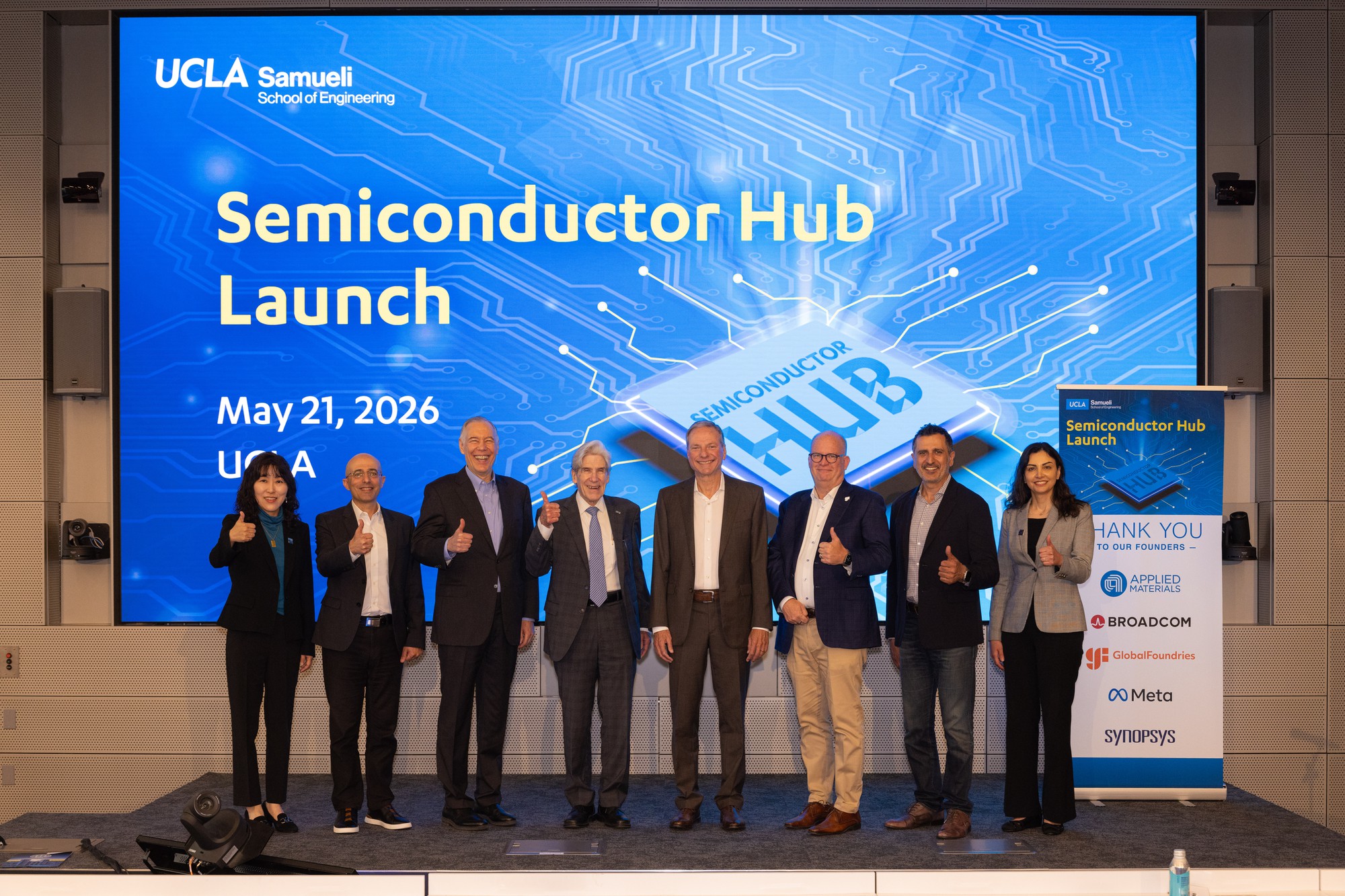
From left to right: Alissa Park, Charlie Kawwas, Gary Dickerson, Julio Frenk, Henry Samueli, Michael Hogan, Sassine Ghazi and Mona Jarrahi at the Semiconductor Hub launch in the Mong Auditorium. The faculty, administrative and corporate leaders will spur innovation and student learning at the new hub. (Courtesy from UCLA Samueli School of Engineering)

By Owen Mazzola
June 2, 2026 2:00 p.m.
The Henry Samueli School of Engineering’s new $125 million Semiconductor Hub will push technological boundaries, faculty and administrators said at a conference May 21.
The hub will accelerate research on semiconductors, which are materials used in computer chips to regulate electrical current, faculty speakers said. The project will advance autonomous vehicles, robotics, environmental engineering and space systems, the School of Engineering said in a statement.
Alissa Park, the Ronald and Valerie Sugar Dean of the School of Engineering, announced the hub and its corporate partners – Applied Materials, GlobalFoundries, Meta, Synopsys and Broadcom – at the Mong Auditorium. Engineering faculty, students and more than 250 industry executives attended the half-day event.
The Semiconductor Hub will assist the School of Engineering and empower every industry that relies on nanoprocessors, Park said.
“We launched (the Semiconductor Hub) as an engineering school effort, but this will impact so much across the entire campus,” Park said.
Chancellor Julio Frenk, who attended the event, said in a speech that the hub will reduce institutions’ reliance on federal funding and establish a collaborative space for students and industry leaders.
The Trump administration withheld $584 million in scientific research funding from UCLA in late July, alleging that the university allowed antisemitism, affirmative action and “men to participate in women’s sports.” While a series of court orders restored the vast majority of the frozen grants, the UC has pushed for alternative funding, including state funding and a bill that would allow California voters to decide on a $12 billion bond for scientific research.
The Semiconductor Hub will also change the structure of UCLA’s engineering doctoral program, Park said.
Instead of engaging in four years of research, doctoral candidates will work in a lab for three years before pursuing an internship at one of the semiconductor hub’s partner companies in their fourth year, she added.
“They can do more applied research working at the companies,” Park said. “That combination, we’ve never seen before.”
The School of Engineering will soon put out a call for researchers to begin forming specialized teams for the hub, said Mona Jarrahi, a professor of electrical and computer engineering.
“The hub is founded with five founding member companies; we are actually opening up to other industrial members,” Jarrahi said.
Park said in a statement that Henry Samueli – chairman of the board of semiconductor and software company Broadcom – helped create the vision for the hub.
“Henry cofounded Broadcom while teaching at UCLA, underscoring the school’s strong position to help drive semiconductor innovation for a new era of AI,” Park said in the statement.
Jason Cong, a computer science and electrical engineering professor who will serve as the hub’s AI research lead, said the hub will help improve the AI industry.
“The new kind of semiconductor chips will enable this AI model to run more efficiently,” he said. “This can benefit not only one company, but the whole industry.”
Charlie Kawwas, president of the Semiconductor Solutions Group at Broadcom, said in a written statement that the growing software industry needs chip innovation. He added that the hub will solve issues in electronics design and keep up with the current rate of innovation.
The hub aims to spark communication between industry leaders and researchers, Cong said. He added that it will allow students to pitch their ideas to faculty and company executives through annual project proposals.
“Interaction is also very healthy, because these companies are really leading-edge companies worldwide,” Cong said. “They have a lot of value to add in the innovation process.”
Tim Breen, CEO of semiconductor manufacturer GlobalFoundries, said in a statement that developments around AI and an increase in data centers have created a need for faster chips. Research conducted in the hub will ensure this demand is met, he added.
With a bigger push for faster and more efficient chips, the hub will establish the Samueli School of Engineering as a leader in engineering education and innovation, Park said.
“UCLA education in undergrad, masters and PhD really empower the United States,” Park said. “The United States really needs academia industries to work together, and we are doing that here, so this is really critical, and it will be fun.”