Woody Brown depicts diversity in communication through bestselling novel “Upward Bound”
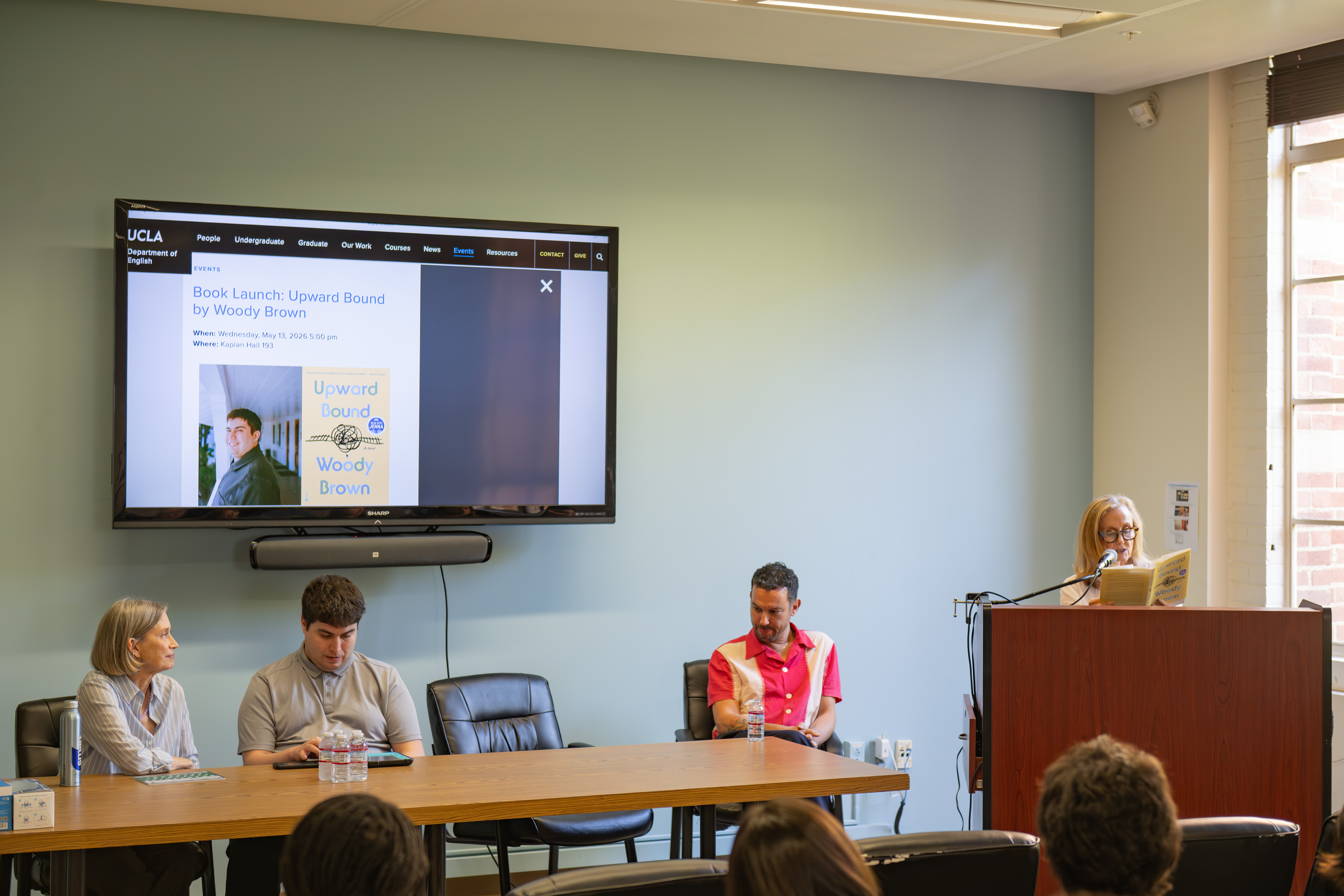
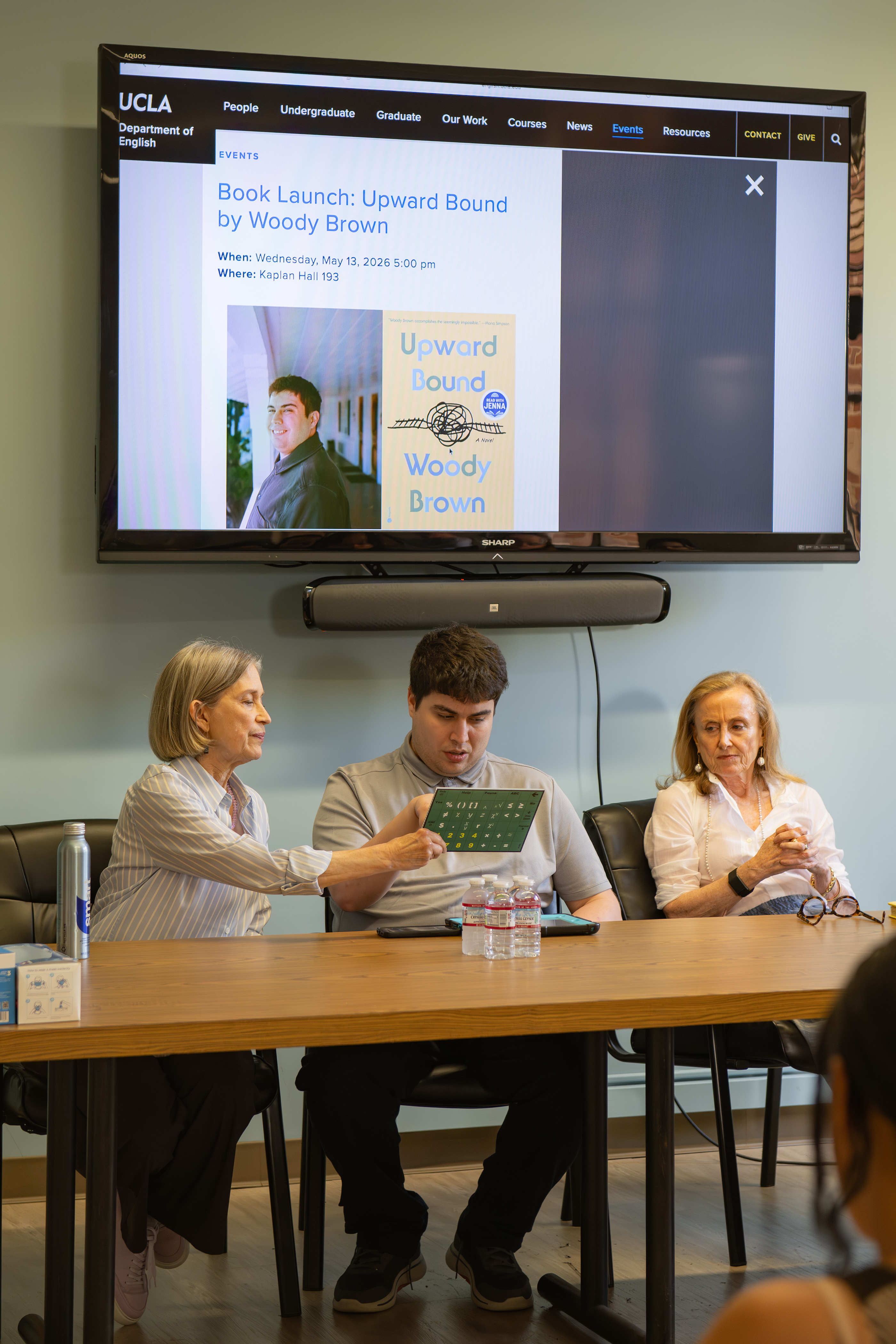
Woody and Mary Brown sit in front of an audience in Kaplan Hall to discuss “Upward Bound,” Woody Brown’s new book. Mary Brown has been both Woody Brown’s companion and translator along every step of his academic journey. (Gabby Yang/Daily Bruin)

By Mya Ward
May 29, 2026 11:21 p.m.
This post was updated June 3 at 8:44 p.m.
Following the success of his debut novel “Upward Bound,” Woody Brown returned to his alma mater to promote his book and discuss disability and communication.
Brown graduated with a degree in English from UCLA in 2022 and went on to obtain a master’s degree from Columbia University. His mother, Mary Brown, said she has been both his companion and his translator along every step of his academic journey. Woody Brown, who was diagnosed with a form of autism characterized by echolalia, has limited spontaneous speech and has often relied on repeated verbal scripts. His mother accompanied him to classes and provided a laminated alphabet card to support his communication, she said. She interpreted his comments and questions using rapid prompting method, which uses rapid sensory prompts and letter boards to encourage communication. Through this method, Brown answered questions about his book, his writing and creative process as someone with limited speech capabilities at the May 13 reading and Q&A.
“I didn’t expect to be successful here,” Brown spelled out to the audience of students, faculty and staff. “I had no confidence that my work was worthy, and I feared being a disappointment to myself for not being as bright as you all are.”
“Upward Bound” is told through the perspectives of patients, staff and visitors at a disabled adult daycare center in Los Angeles preparing for a Christmas pageant. The book explores the intersection of communication, disability and friendship – which Brown’s mother said he has direct experience with.
[Related: Leanne Betasamosake Simpson unpacks Nishnaabe stories, decolonization in new book]
During the Q&A session, Brown used a laminated alphabet card held by his mother to communicate and spell words for his mom to speak on behalf of him. Two screens were positioned in front of him, one of which displayed Angry Birds. Mary Brown said these screens help neutralize the activity within his head, and he also used a similar setup throughout his college career. Brown has a similar setup on his desk at their home in LA, his mother said, where a bank of screens play different games, movies and shows.
Excerpts from the novel were read aloud by Professor Justin Torres and Professor Mona Simpson, the latter of whom taught Brown and later became his mentor.
“It was Mona who saw something I had not seen, and she plucked me from obscurity,” Brown spelled. “We worked together one-on-one throughout lockdown, and by the end of that year I started to feel like a writer. I don’t know if I would be sitting here with an actual book without Mona and UCLA.”
Brown’s mother said despite the activity surrounding his setup, the writer’s day begins with morning meditation. She added that his writing sessions are usually 20 to 30 minutes long before he takes a break – often to read. Haruki Murakami is his favorite author, his mother said. When asked by an audience member whether he encountered a character in his reading who appeared to exhibit neurodivergent traits, he said he was reminded of many characters from Murakami’s books.
[Related: Kiran Desai expands on new book’s theme of loneliness at Hammer Museum talk]
“The exchange of intellectual energy is not something you can get from an audiobook,” Brown spelled.
The excerpts read from “Upward Bound” had a similar effect of intellectual exchange, said Leila Farhi, a fourth-year anthropology student. Farhi said they came to the talk to earn extra credit in their disability studies class taught by Fred Ariel Hernandez. Farhi added that they were engaged by Brown’s writing style and hoped to see more neurodivergent writers emerge in the mainstream. Olivia Aerin Lee, a third-year English student who attended the event on her professor’s recommendation, said she felt inspired by the excerpts read at the event.
“It is so important to read a diverse wealth of books and to support local artists and authors,” Lee said.
Brown’s mother said the writer is in the process of working on his next book. His next work “Alfie” is a bildungsroman – a type of novel that follows the protagonist from youth to adulthood – that follows the difficulties of friendship and camaraderie for someone who does not communicate in a conventional way. She added that, as an autistic person, Brown often felt alienated at both Pasadena City College and UCLA but was able to find the connection and warmth of friendship at Columbia. As Brown continues to write his next novel, he said his efficacy as a writer has precipitated, and he prefers to ignore all the noise surrounding his debut – both the praise and the skepticism.
“It’s so outrageous that I don’t even like to think about it,” Brown spelled. “I won’t listen to the reviews and would rather dwell in anonymity. I don’t like running across the naysayers either, so ignoring all hoopla is my preference.”