Opinion: Grabbing coffee is more than an act of caffeination. It’s about connecting.
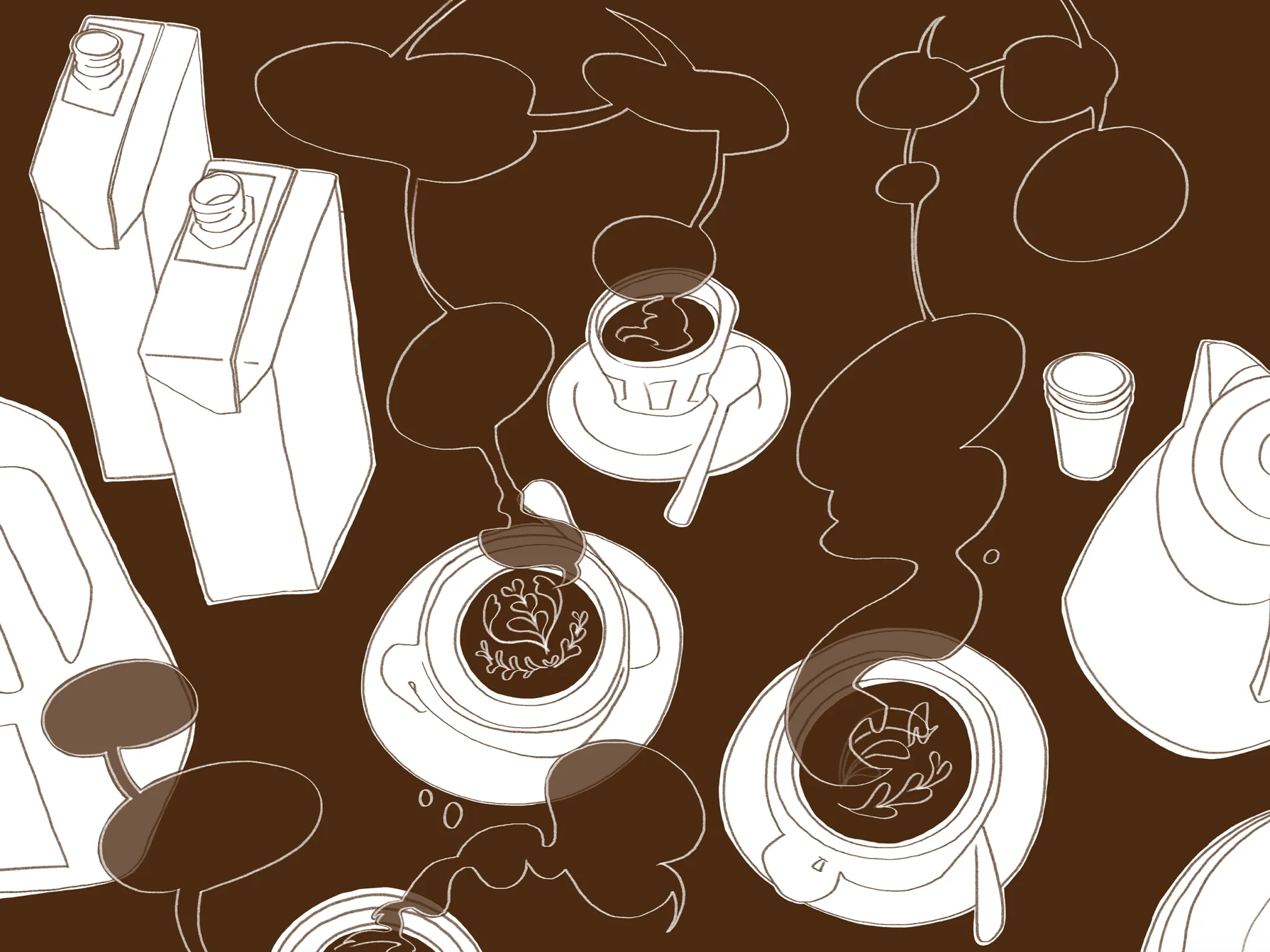
(Yejee Kim/Cartoons director)

By Sierra Benayon-Abraham
May 18, 2026 1:44 p.m.
This post was updated May 25 at 8:51 p.m.
I walk into Westwood with one thought on my mind: I need a cup of coffee.
What used to be an action with one goal – getting caffeine into my body – has manifested into so much more. Beyond the creamy, frothy milk, the two pumps of simple syrup I crave in my hot vanilla latte and the comfort that comes with wrapping my hands around a warm mug, coffee means more nowadays.
Coffee means connection.
People should welcome the act of getting a cup of coffee with a friend, peer, colleague or stranger. The conversations and human connection that a cup of coffee can inspire reinforce positive social interactions and strengthen relationships.
Coffee shops allow people to connect with friends and explore new places, said Hannah Jimenez, a third-year public affairs student.
It is estimated that 2.5 billion cups of coffee are consumed every day across the globe and that coffee is the second-most consumed beverage behind water.
But what does drinking a cup of coffee with someone really mean?
For starters, it can mean networking. Aspiring professionals’ classic, “Can I have a coffee chat with you?” has been asked for years. Coffee chats can be immensely valuable for those trying to enter a new career, inquire about an application process for graduate school or simply learn something new about someone they find interesting.
Coffee chatting with someone you want to learn from can foster genuine professional relationships, open up unadvertised opportunities and allow people to ask and answer honest questions in a low-pressure environment.
I met my mentor from the Los Angeles Times over a cup of coffee. While the purpose of our conversation was initially to ask questions about the journalism industry, our routine coffee chats evolved into an unparalleled friendship.
Robin Sunada, a third-year psychology and religion student, said grabbing a cup of coffee can be an opportunity to simply hang out with someone.
“It’s a great excuse,” Sunada said.
Coffee can also help form and sustain friendships. With the hustle and bustle of our daily lives, coffee can provide an intimate setting for face-to-face conversations.
“Grabbing coffee is a good way to catch up and hang out, especially since we’re all super busy,” said Kaetlene de Guzman, a second-year cognitive science and political science student.
There is no doubt that having the ability to pick up a phone to call or text a friend is valuable. But meeting in person for a cup of coffee allows people to engage with social cues, such as eye contact and active listening – which everyone could benefit from practicing more in today’s digital age.
“Sharing food with people, eating, drinking in the first place – it’s an act of communion,” said Marissa Nishi, a first-year international development studies and mathematics student. “It’s a good way to bond with people.”
Coffee shops offer many economic and social benefits as well. Recent data has found that an increasing portion of coffee sales are going toward smaller, entrepreneurial coffee shops, with consumers inclined to support local business owners.
The social connection that coffee provides is thus not just between coffee drinkers but also baristas and their customers.
“We have a relatively positive atmosphere here, and it just bleeds onto the customers,” said de Guzman, who is also a barista at the on-campus coffee shop Bruin Buzz. “There’s some regulars that I know by name, and I already know their order. I can just form casual conversations with them, and I probably would have never met them if I didn’t work here, which is really cool.”
Additionally, people can utilize cafes as a third space – somewhere that is separate from home, school and work.
“I like the cozy atmosphere, especially at Kerckhoff (Coffeehouse),” Nishi said. “It’s really unique inside, and it’s a little more intimate, better to get to know people.”
For some people, a coffee shop may be a socially productive space, but, for others, it might be an environment that encourages academic productivity and learning.
“I can’t study in libraries. It’s too quiet,” said Luca Mirza, a second-year neuroscience student. “Kerckhoff provides the perfect study environment for me because I can focus on my school work but also take breaks and socialize among the others walking through the coffee shop.”
Coffee shops and cafes may be productive, social or self-care spaces. Nonetheless, they are a retreat from routine, which is proven to have positive mental health effects including relieving stress, preventing burnout and increasing cognitive function.
While it is true that coffee prices have increased dramatically in recent years and certain coffee shops are becoming increasingly unaffordable – especially for students – we can still reap the rewards of coffee without spending $8 per cup.
Make a cup of coffee at home and invite over a friend, colleague, peer or mentor. If you are sick of your home and want to get outside, bring two cups of coffee in to-go tumblers to a nearby park and enjoy a coffee date in nature.
And, if you don’t like the taste of coffee, substitute it with tea or another beverage – the same effects still apply.
After all, coffee matters so much more than we think.