UC investment assets dip, regents discuss at bimonthly meeting
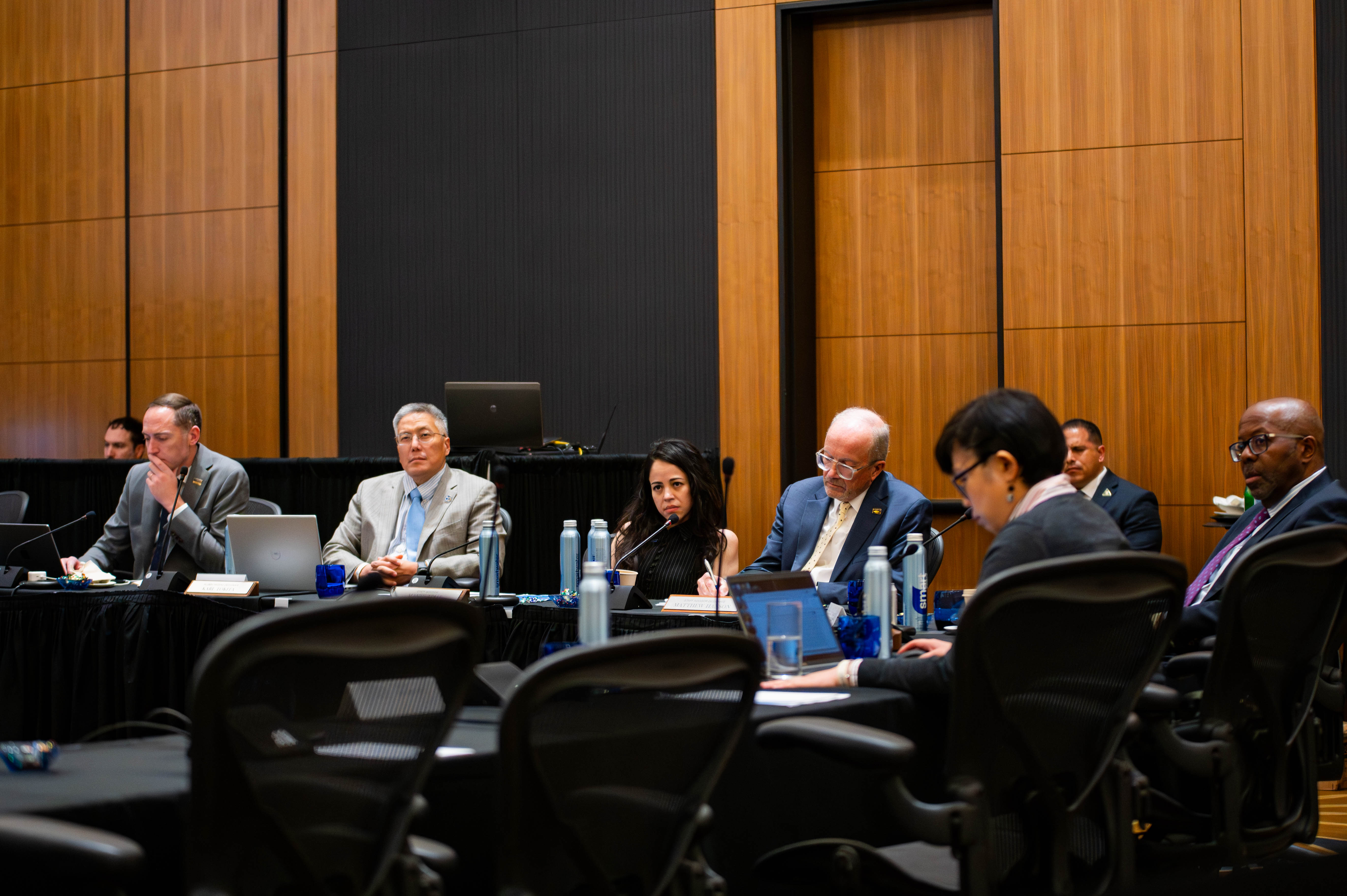
UC Board of Regents members sit during its May meeting. The UC’s investments portfolio dipped last quarter, according to a report discussed at a UC Board of Regents meeting which protesters disrupted Tuesday. (Elle Smith/Daily Bruin staff)

By Saya Mueller
May 7, 2026 10:05 p.m.
The UC’s investments portfolio dipped last quarter, according to a report discussed at a UC Board of Regents meeting which protesters disrupted Tuesday.
The board met at the Meyer and Renee Luskin Conference Center on Tuesday and Wednesday for its bimonthly meeting. The investments committee reviewed the University’s third quarter fiscal year performance, and the finance and capital strategies committee voted to approve bond issuances for the 2026-27 year and expenditure rate increases for the UC General Endowment Pool on Wednesday.
Student protesters interrupted the meeting about two minutes after it began to demand that the UC divest from companies associated with the Israeli military. The meeting briefly adjourned and relocated to another room in the building.
Net returns from UC investments have increased over the past three fiscal quarters, despite a tumultuous past few months for the market, said Jagdeep Singh Bachher, the UC’s chief investment officer.
The UC endowment – which is composed of the Blue and Gold Endowment Pool and the General Endowment Pool – increased about 19% and 15%, respectively, over the past year, Bachher said. He added that the UC Pension, which is part of the UC Retirement program, increased by about 15% in the same period.
Although the yearlong overview shows a steady increase, the UC investment assets dipped overall from last quarter, according to the report.
The University’s investment portfolio declined modestly from December 2025 to May in most major investment categories, with total UC Investments assets falling from $213.5 billion to $209.7 billion, according to the report.
“That shows you that the very first quarter of this last 12 months was very strong, that lifted all the results for one year,” Bachher said.
Bachher said he is not concerned about short-term fluctuations, adding that bumps and dips can happen regularly.
“In there lies the importance of staying invested, staying focused on the long term, not blinking an eye through tumultuous time periods,” Bachher said.
Bachher said he believes the key to long-term growth over the past 12 years was altering the allocation of UC assets. He added that, rather than having a 50% to 31% allocation between equities and fixed income, the portfolio is now divided as 64% to 16%, which is preferable because equities have seen continued growth over the past decade.
“Almost those two things unanimously define the range of how the performance has grown in the last 12 or 10 or five or seven years,” Bachher said.
Bachher said during the board’s March meeting that he was concerned about the impacts of war, private credit and artificial intelligence on the UC’s investments. However, he said during the May meeting that he is no longer concerned about private credit, but rather about how inflation brought by the ongoing war in Iran could alter consumer spending.
Iran took control of the Strait of Hormuz – which about 20% of the world’s oil travels through – after the United States and Israel attacked the country in late February, according to the Associated Press. The waterway’s closure has resulted in rising inflation because of heightened global energy prices, according to Reuters.
“Energy prices will stay high in the foreseeable future – that has driven inflation higher than where we were a few months ago, and we see that in gas prices,” Bachher said. “The reality is that could have impact on consumer behavior.”
[Related: UC investment officer discusses assets, what constitutes war-related investments]
The finance and capital strategies committee unanimously approved approximately $4 billion of bond issuances – used to finance and refund existing bonds – for the 2026-27 fiscal year, according to the report.
The committee plans to increase the expenditure rate of the General Endowment Pool from 5% to 5.15%, or a total payout of $825.6 million, to keep up with inflation, according to the report.
The change would coincide with another increase in the endowment administration recovery rate from 0.55% to 1%, according to the report. The portion from the endowment administration recovery rate is allocated toward operational expenses, and is used by University campuses and the UC Office of the President to support fundraising activities.
“Keeping the fees at 0.5%, or any lower than 1%, doesn’t allow the University to compete against other universities who have a fee at 1%,” said Charles Melton, the alumni regent-designate.
Regent Mark Robinson said he believes keeping raises incremental could be easier to implement as an amendment to the proposal. He added that raising the administration recovery rate from 0.55% to 0.8% is less imposing than doubling the current rate, particularly as the University’s large endowment pool would entail significant change, even with a small increase.
Robinson added that donation administration fees may vary depending on the UC campus because of donor culture. UC San Francisco Chancellor Sam Hawgood said the university itself typically covers most donor fees.
“Donors do not want to feel as if they are paying for the fundraising activities themselves,” Hawgood said. “I would just ask that we allow for a certain amount of campus nuance in how we talk about this.”