UC investment officer discusses assets, what constitutes war-related investments
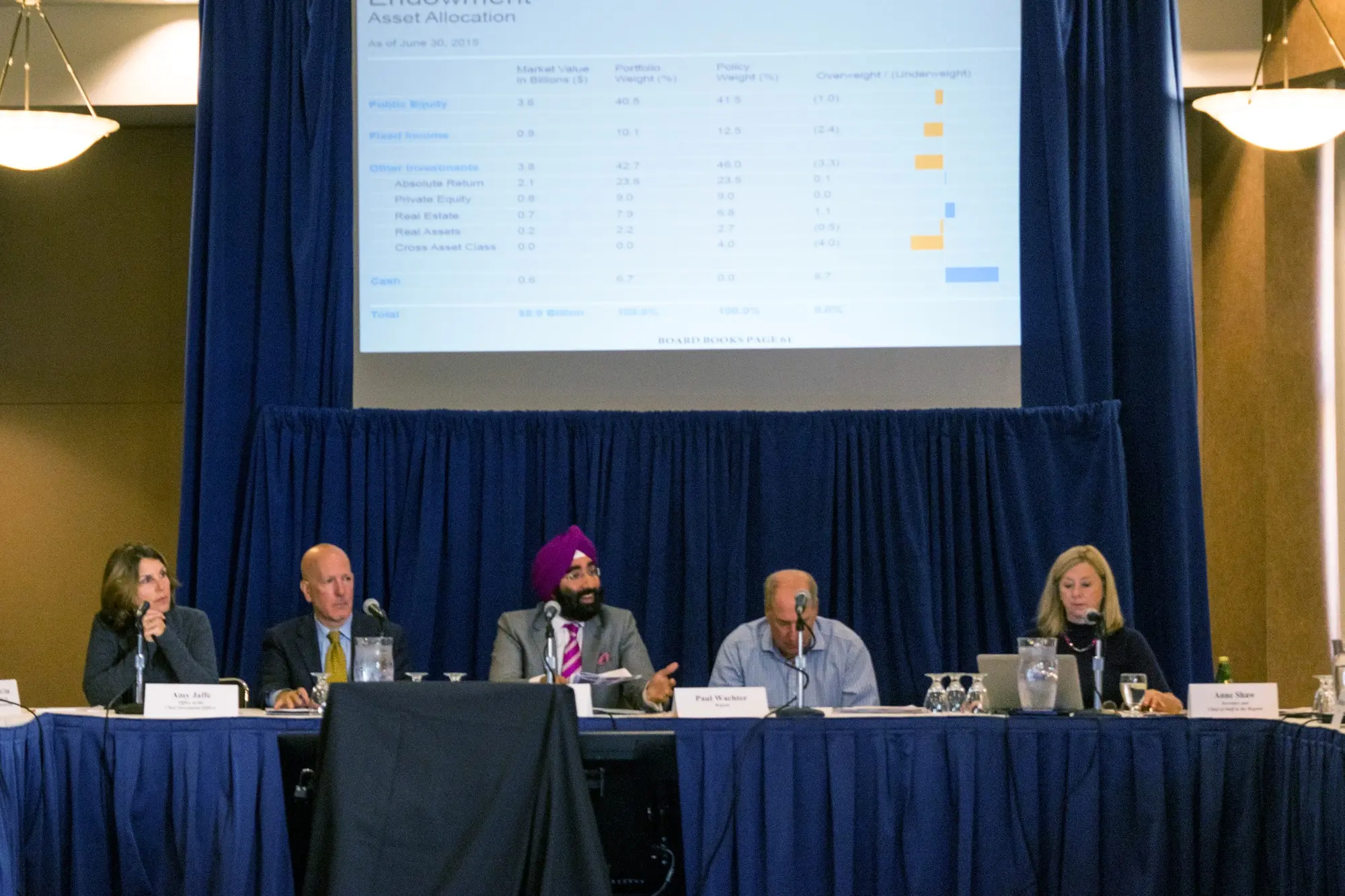
Jagdeep Singh Bachher (center), the UC’s chief investment officer, is pictured. Bachher said he believes it is difficult to consider what constitutes supporting war – whether directly or tangentially – when it comes to the University’s investments, especially with regard to U.S. companies. (Daily Bruin file photo)

By Josephine Murphy
March 19, 2026 12:42 p.m.
Pro-Palestine students and advocates have called on the UC to disclose and divest from companies allegedly associated with the Israeli military.
But at a Tuesday UC Board of Regents meeting, the UC’s Chief Investment Officer said he believes it is difficult to consider what constitutes supporting war – whether directly or tangentially – when it comes to the University’s investments, especially with regard to U.S. companies. CIO Jagdeep Singh Bachher said at the regents’ May 2024 meeting that if the University were to divest from these companies, it would amount to about $32 billion of their then-$175 billion portfolio.
“I could make the argument to you that we should sell everything we own in the United States,” Bachher said. “Because, of course, we (the United States) are initiating wars around the world.”
Bachher and the UC Board of Regents discussed the University’s investments at the bimonthly Regents meeting Tuesday and Wednesday at UC San Francisco. UC Investment assets – commonly split up into the UC Endowment, UC Retirement and UC Working Capital – stood at $217 billion as of Jan. 31, according to the discussion item.
He added that insurance will be added as a fourth category – made up of $2.4 billion currently listed under UC Investment’s working capital – in future meetings.
Bachher said he is not worried about over-investing in AI. He compared the rise of AI to the early days of Amazon, adding that it is important to predict long-term gains and not exit before the University can reap the benefits from its investments.
“Artificial intelligence is here, and our faculty and our researchers are going to help us build out this future. And so are our students,” he said.
The UC’s investment assets increased by $27 billion in the last year, and have more than doubled since 2014, according to the discussion item.
The UC Endowment – which is made up of the UC General Endowment and Blue and Gold Endowment – increased in value by $3 billion between 2024 and 2025, according to the agenda item.
The UC General Endowment Pool, which is 94 years old, stood at $25.4 billion as of Dec. 31, with a one-year net return rate of 14.7%, according to the agenda item. About $6 billion from the pool has been spent on faculty and students, as well as academic programs, according to the discussion item.
The Blue and Gold Endowment – which was launched in March 2019 – stood at $7.8 billion in December, a figure 31 times larger than its original $250 million sum, according to the discussion item. Bachher described the endowment fund at the November Regents meeting as the University’s strongest-performing asset over the past five years.
UC Retirement, composed of UC Pension and the Retirement Savings Program, increased in value by $23 billion from $144.3 billion between 2024 and 2025.
UC Working Capital – the smallest of the assets – increased from $12.5 to 13 billion between the 2024 to 2025 fiscal years, according to the discussion item.
Bachher said at the meeting that the UC’s investments and its allocations of assets as of Dec. 31 were identical to their state at the time of the November regents meeting – when he last updated the board on his work. Bachher said there have been several economic surprises since the end of the calendar year – which many of the updates came from – potentially changing the investment outlook.
“If I could basically summarize what keeps us up at night – there’s war, artificial intelligence and private credit,” Bachher said.
Marco Merz, the managing director of defined contributions products at the UC, said at the meeting that while it seems prudent for the University to invest conservatively, it would have seen about nine percent less in returns over the past decade had it followed that approach. He added that UC Investments manages assets amounting to more than $48 billion for about 380,000 current and former employees.
“This is the cheapest retirement savings plan in the United States of America,” Bachher said.
The UC has added about 50,000 employees in the last decade, Bachher said, and that many new employees are both younger and support growth-oriented products.
“We stay the course, we stick to our strategic asset allocation – and ultimately that’s the only reason why Jagdeep can show you those very healthy returns,” Merz said.