This UCLA Russian and Czech lecturer is fighting to keep teaching her languages
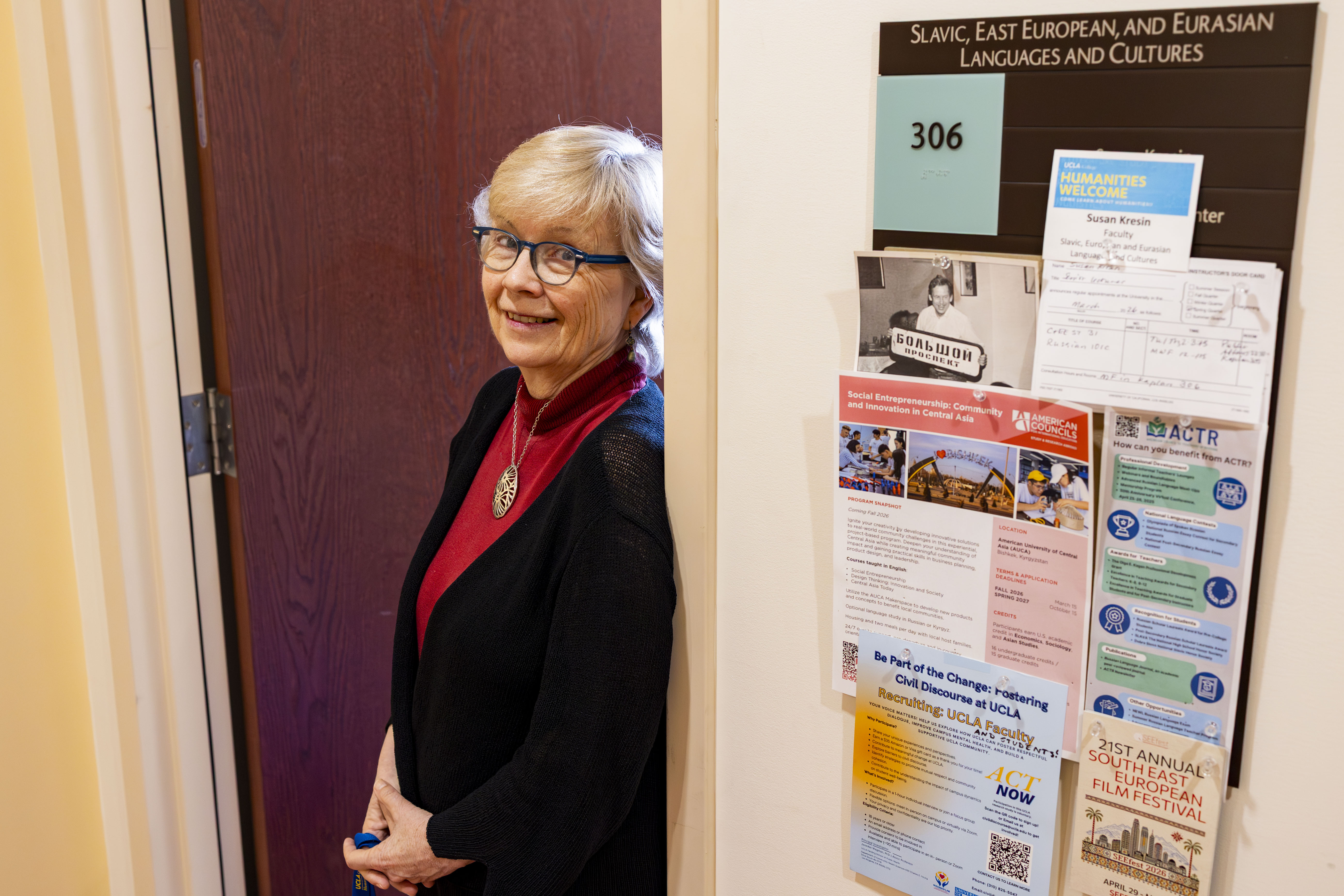
Susan Kresin, a senior lecturer in Russian and Czech, stands by a doorway. Kresin, who joined UCLA faculty in 1996, received a national award for expanding Russian and Slavic language education. (Chenrui Zhang/Daily Bruin staff)

By Nury Salazar-Ibanez
April 23, 2026 10:40 p.m.
A senior lecturer of Russian and Czech received an excellence in teaching award for expanding Russian and Slavic language education.
The American Association of Teachers of Slavic and East European Languages awarded Susan Kresin, a senior lecturer of Russian and Czech who joined UCLA’s faculty in 1996, with the annual national distinction. The award is given to educators who have mentored younger colleagues and advocated for Slavic and East European languages at the national and local level, Kresin said.
“Because I advocate for multiple languages, and I’ve mentored in multiple languages, it also acknowledges the importance of each and every language that’s covered within the organization,” she said. “No matter how large the population is, these languages, to my mind, are equally important.”
Kresin, who sits on the board of directors for the American Council of Teachers of Russian, said she has taught courses in Old Church Slavonic, the earliest documented written Slavic language. She has also led research projects that examine emigration patterns to understand the use of Russian in Los Angeles, she added.
“My idea is that I will bring the multifaceted Russian-speaking world to them (students), partly by having visitors and by encouraging them to explore themselves,” she said.
UCLA has downsized or cut several language programs because of state and federal budget cuts. The university eliminated all level four Russian language classes this year, Kresin previously told the Daily Bruin.
While UCLA cut Czech courses about 12 years ago, Kresin brought back a two-unit independent study course for students who grew up with the language, she said. Kresin added that she teaches the class for just one student.
[Related: UCLA foreign language faculty, students criticize language program cuts]
Kresin also works with colleagues from the University of Florida, University of Texas, University of Indiana and University of Alberta to raise awareness about Slavic language-learning among high school students, she said. She added that she collaborates with the universities to host a series of open houses and virtual sessions connecting college language instructors with high school students.
Dan Davidson – a president emeritus of the American Councils for International Education, which oversees the American Council of Teachers of Russian – said Kresin fostered dialogue within the council about the Russia-Ukraine war. Russia invaded Ukraine in 2022 and occupied 19.4% of the country as of February, according to the Associated Press.
“We in the whole field owe a great deal to Susan for her ability to civilize those conversations and make sure that everybody’s being heard,” Davidson said. “Sue’s ability to mediate difference in the classroom also turned out working on a national level in our association.”
Olga Klimova, the president of the American Council of Teachers of Russian, said she appreciated Kresin’s attention to detail in mentoring graduate students. Klimova, an associate professor of Russian at the University of Pittsburgh, added that Kresin is committed to fostering genuine connections with her students.
“She’s a very intuitive teacher,” Klimova said. “She realizes that some methodologies need to be shifted, some teaching approaches need to be revisited.”
Holly Raynard, who was Kresin’s student at UCLA, said Kresin often personalizes her courses based on students’ interests and fields of study. Raynard, now a senior lecturer for the Center of European Studies at the University of Florida, added that Kresin helped her understand the primary differences between West Slavic and East Slavic languages.
“Susan measures up, not just as a very good colleague, but as somebody who’s clearly distinguished and whose qualities stand out and were easily recognizable by a lot of people in the field from different places,” said Davidson, a professor emeritus of Russian at Bryn Mawr College.
Kresin is always open to giving advice to students and colleagues to help them succeed in their respective fields, Klimova said.
“We all benefited a lot from Susan’s wisdom and generosity from her ideas, brilliant ideas about teaching and supporting our students,” Klimova said.