UCLA CaHPSA, Student Health Network host fair to promote health literacy
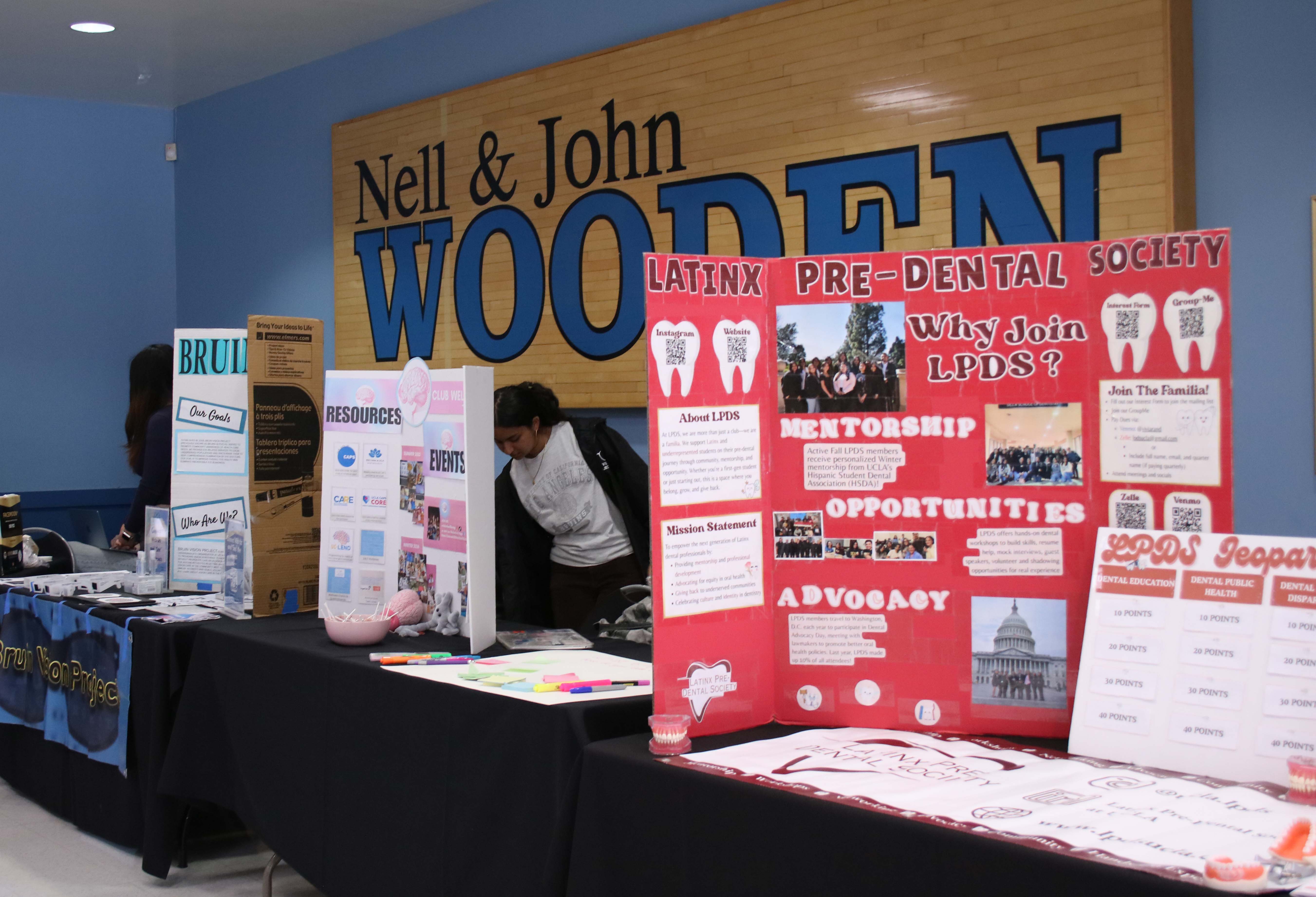
Bruin Vision Project, Club Wellbeing and Latinx Pre-Dental society are pictured from left to right at the health fair promoting various parts of health literacy from eye health to mental health to representation. (Crystal Tompkins/Daily Bruin senior staff)

By Alyssa Wong
April 21, 2026 6:02 p.m.
This post was updated April 21 at 11:03 p.m.
Health-centered UCLA student organizations hosted a fair promoting health literacy at Ackerman Union on Thursday.
The California Health Professional Student Alliance at UCLA – which advocates for healthcare equity – hosted the event in collaboration with the Student Wellness Commission’s Student Health Network, a coalition of health-related campus clubs. The clubs provided interactive activities and presentations on topics ranging from language barriers in vision care to skin protection and sun safety.
CaHPSA’s members sought to use the event to help students learn more about self-care, said Anand George, a member of CaHPSA’s Health Literacy Committee.
“As college students, we’re adults for the first time, and maintaining our mental and physical health should be of the utmost importance no matter what grades we get,” said George, a first-year neuroscience student.
Ai Lai, CaHPSA’s outreach director and a second-year biochemistry student, said the organization held the event in the middle of the day and in a central part of campus so students could attend on their way to class.
CaHPSA also hosted games at the event to increase accessibility for students, said George Beshay, a member of CaHPSA’s Health Literacy Committee. Beshay, a first-year biology student, added that one game involved asking students to guess whether a given food could spike a person’s blood sugar.
“Running this game, it simplified something that’s kind of hard to understand,” he said. “How can bread, for example, spike your blood sugar? Bread doesn’t taste all that sweet. (We are) trying to simplify a larger concept of blood sugar and glycogen levels in your body into this simpler game to really make sure people understand certain risk foods.”
Ashwin Babu, a third-year microbiology, immunology and molecular genetics student who attended the health fair, said he enjoyed learning about the World Health Organization and the American Diabetes Association’s dietary guidelines at the event.
“The best part about it is you get to see what you don’t know because there’s so many aspects to health, and you might think that you have a grasp of every little thing, but there’s really a lot that we can learn,” Babu said.
Dermatological – one of the clubs featured at the fair – participated in the event to raise awareness on sun safety, which is often overlooked by most people, said My Raquel Gonzales, Dermatological’s co-publicity officer. Gonzales added that she hoped to dispel the myth that the sun only affects people with lighter skin.
“Often, people may think that the sun really affects people with lighter skin, but in reality, the sun doesn’t discriminate against anyone, and it’s really important for people to understand any risks they might face,” said Gonzales, a third-year human biology and society student.
Heath Galiwango, a general member of Dermatological, said the club’s booth included a bracelet-making activity with ultraviolet-sensitive beads. The activity debunked the misconception that UV rays only exist if the sun is visible and that sunscreen isn’t necessary on overcast days, added Galiwango, a fourth-year human biology and society student.
“Given that today is overcast, what’s really, really special is that as soon as you step outside, … you’ll realize that the beads of your bracelet will actually change color, and that’s a sign that they’re reacting with the rays that are hidden by the clouds,” he said.
Peer learning opportunities can make events like Thursday’s health fair more relatable for students, George added.
Andrea Kang, a doctoral student in statistics and data science who attended the event, said she believes the health literacy fair was important given the recent rise of health misinformation. A survey from The Physicians Foundation, a nonprofit research group, found nearly 86% of physicians reported that the prevalence of health misinformation among patients has risen over the past five years.
Nallive Espadas, Student Health Network’s director, said she hopes students attending the fair apply their new understanding of health literacy when consuming media such as TikTok.
“Hearing information from someone who’s in a grade similar to mine, or like a year similar to mine, would make me understand and … make me interpret the information more openly,” said Espadas, a third-year public health student. “There’s a big emphasis on being able to communicate that in a language that we are all able to understand – maybe not using super heavy medical terminology – rather, being able to explain something and ultimately convey a message in words and vocabulary that we can all comprehend.”