Teresa Woodruff raises awareness about oncofertility in speaker series lecture
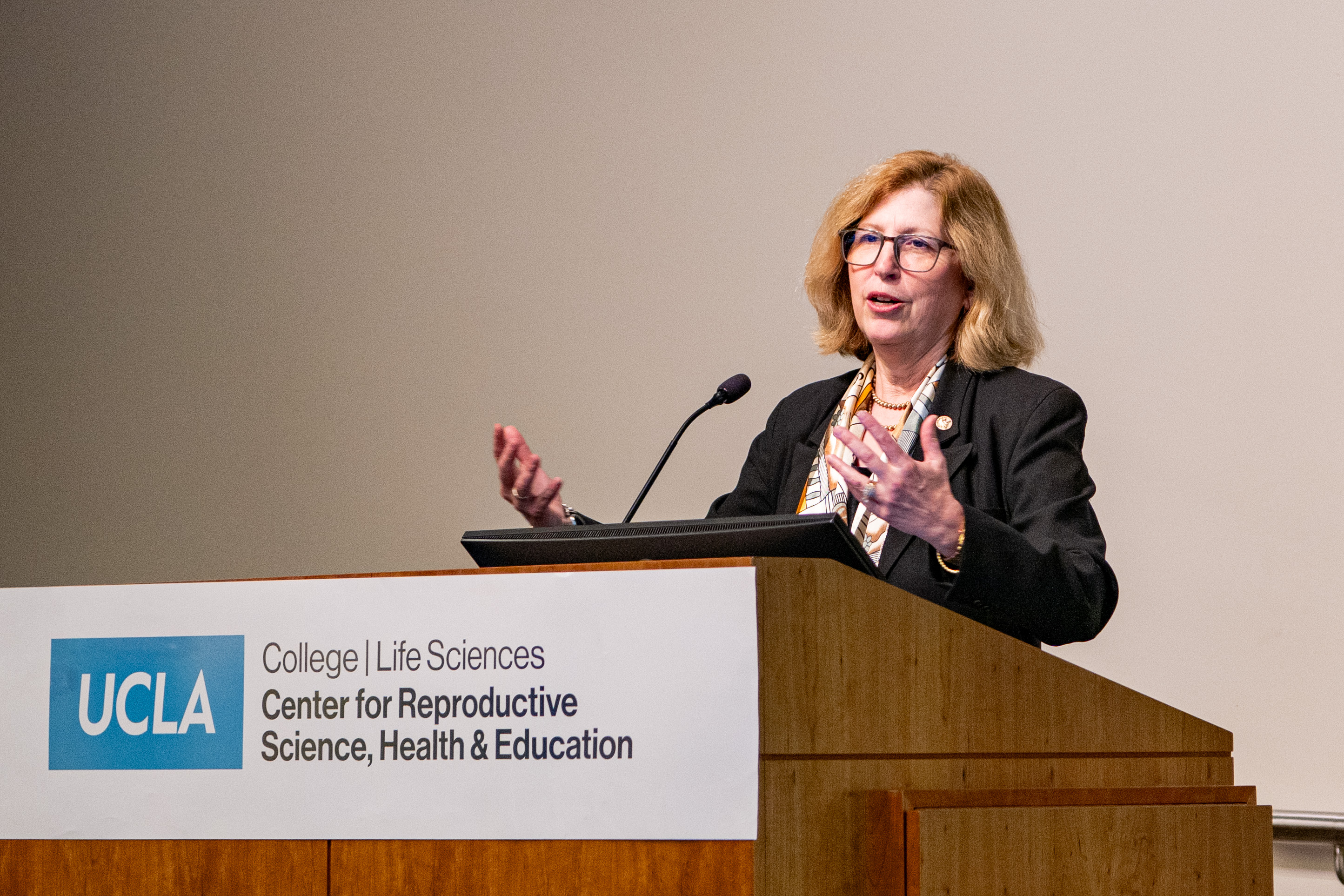
Woodruff spoke to raise awareness about reproductive health and oncofertility. (Jiah Jung/Daily Bruin)

By James Liao
April 15, 2026 7:46 p.m.
This post was updated April 16 at 11:38 p.m.
Scientist Teresa Woodruff has spent her career advancing a specialized field of medicine.
Woodruff – the president emerita of Michigan State University and a National Medal of Science recipient – works in oncofertility, a field focused on preserving patients’ abilities to have biological children following life-saving treatments such as chemotherapy. Woodruff gave a lecture at the Distinguished Speaker Series held by UCLA’s Center for Reproductive Science, Health and Education on April 8.
Woodruff is also the founder of the Oncofertility Consortium, which focuses on bridging oncology and reproductive medicine. The Distinguished Speaker Series brought in leading scientists to raise awareness about reproductive health, said Stephanie Kiesow-Edoh, the associate director of the UCLA Center for Reproductive Science, Health and Education.
The center’s events are free and open to anyone, not just UCLA students, she added.
“I think this has just been a really great way to have a lot of impact and to engage students in these discussions,” Kiesow-Edoh said.
Woodruff said her interest in oncofertility began with an encounter she had while working at Northwestern University’s cancer center, in which a mother brought her son to bank sperm before treatment with the hopes of preserving his ability to have children. The oncologist encouraged them to focus on survival rather than future fertility, Woodruff said.
“I thought that was wrong,” Woodruff said. “Since I’m a reproductive scientist, I thought I might be able to do something about it.”
Oncofertility seeks to address a widespread but often overlooked issue, Woodruff said. Each year, she said, about 1.5 million people in the United States are diagnosed with cancer. Around the globe, about 10 million people face losing their fertility during treatment, she added.
The pediatric cancer survival rate now exceeds 80%, thanks to advances in National Institutes of Health-funded treatments, Woodruff said. The same therapies that save lives can threaten fertility and disrupt normal hormonal development, meaning some young patients may not transition through puberty without medical intervention, she said.
“We’ve converted the field from a ‘no’ to a series of options that are life-extending for our cancer patients,” Woodruff said.
To develop those options, Woodruff said her lab created a method to grow ovarian follicles outside the body using alginate, a seaweed-derived material commonly found in ice cream. The technique, which preserves the follicle’s three-dimensional structure, produced the first recorded in-vitro ovulation and subsequent live births in mice, she added.
Human follicles grown using alginate later reached metaphase II, a critical stage of egg maturity that had never been achieved outside the body, Woodruff said.
The lab also identified a new marker for egg quality, Woodruff said. In the final hours of maturation, an egg accumulates 20 billion zinc atoms and releases them in a flash at the moment of fertilization, she added.
“There’s no other cell in biology that accrues a metal to a level of 20 billion zinc atoms,” Woodruff said.
The intensity of that flash – which Woodruff called the zinc spark – directly predicts the likelihood of a live birth, giving scientists the first non-invasive tool to assess whether an egg is viable, she said.
Woodruff said when oncofertility care was novel, there was no insurance coverage for patients or reimbursements for physicians who provided it.
While there is no federal policy protecting oncofertility care, 37 states – including California – now have oncofertility coverage mandates, Woodruff said.
Zain Al-Safi, an associate clinical professor in reproductive endocrinology and infertility at UCLA’s David Geffen School of Medicine, said although fertility preservation has become a standard part of care in recent years, it is not always discussed with patients before treatment.
“A lot of cancer patients have not had the discussion about future fertility when they are about to receive cancer treatments that could potentially sterilize them,” Al-Safi said. “So definitely more work needs to be done.”
Artin Khaky, a fourth-year molecular, cell and developmental biology student, said he had never heard of the covered topics in oncofertility before attending the lecture.
Ricky Huang, a fourth-year molecular, cell and developmental biology student, said the talk reinforced the importance of translating science into patient care.
“It’s important for your science to get somewhere,” Huang said. “She’s done a really good job of increasing education about reproductive care.”
For the roughly 150,000 young cancer patients diagnosed each year, oncofertility is an essential field, Woodruff said.
“Reproductive health is about the health of all of us,” Woodruff said.