Opinion: Politically unengaged UCLA students must confront cognitive dissonance
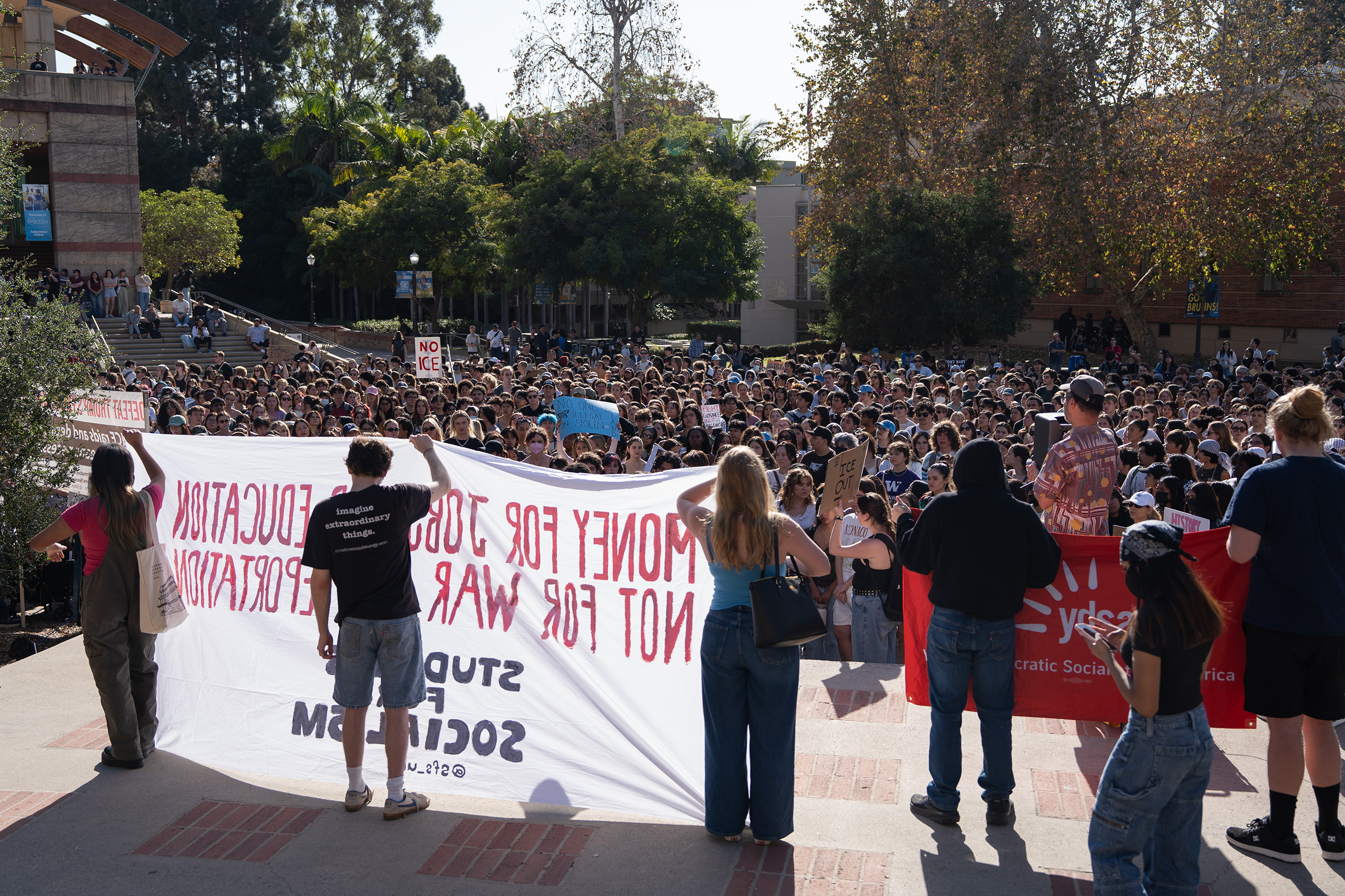
Students gathered at a protest against ICE are pictured. Columnist Brooke Osias argues we must not look away from politics, even when it make us uncomfortable. (Joice Ngo/Daily Bruin)

By Brooke Osias
Feb. 15, 2026 12:29 p.m.
This post was updated March 1 at 8:32 p.m.
When was the last time you procrastinated? Are you doing it right now?
For many college students, procrastination is one of the most common examples of cognitive dissonance: a psychological phenomenon that occurs when two beliefs, opinions or behaviors are contradictory, causing discomfort.
Procrastinating makes us uncomfortable because we know, intellectually, that we should be working. However, our actions do not reflect that.
Cognitive dissonance could also be the reason why you look away from the news.
Politics should make us uncomfortable. This discomfort is an indicator of both social awareness and shared humanity.
By recognizing cognitive dissonance and choosing to engage with it, we as UCLA students can expand our ability to think critically. This can push us to seek out information making us better-informed and more engaged citizens.
One reason politics triggers discomfort is that there are often contradictions between the sources we receive information from. It takes nuance and time to discern what is true about events documented by the media, and it often requires more effort to accept the weight and implications of those events.
The fatal shooting of Renee Nicole Good was one of many recent examples of this. The Trump administration’s statements contradicted the video footage of the incident. It is difficult to accept this kind of violence is happening and even more to see it being outright denied.
Especially in these instances of violence, discomfort stems from empathy. It’s an important sign that one is not yet desensitized to outrageous brutality or injustice.
By reacting apathetically to violence, we forget victims’ humanity as well as our own. Even though we do not have the capacity to fully engage all the time, it is important to remember these are human beings, not martyrs or statistics.
Rosemary Ruiz, a first-year political science student, said seeing racism throughout their childhood inspired them to work in their community and make change. Not everyone has the privilege to disengage from politics because it affects them directly.
Therefore, Bruins who can look away have an even greater responsibility to face their cognitive dissonance surrounding current events.
But cognitive dissonance isn’t always a result of witnessing misinformation or violence. We can also become uncomfortable when we know our beliefs aren’t aligning with our own actions.
Jinwon Kang, a third-year communication and sociology student, said he became more politically engaged as a result of seeing the Jan. 6 riots on the news as a 16-year-old.
“I thought to myself, ‘Wow, I really don’t know what’s going on in the world, in my own country,’” Kang said. “I need to stay engaged. I need to stay informed.”
This form of dissonance is often easier to fix because our actions belong to us. We can choose how much information we seek out and the kind of people we want to be.
Mia Carbone, a doctoral candidate studying communication, said it is easy for news to be pessimistic. Humans are made to prioritize negative information, even though there are also people making great efforts to better the world, she added.
“I think that discomfort should not be combined with apathy,” Carbone said, adding that students are not alone in their discomfort either. “I think that is a very real thing and it can be helpful in the sense of lighting a fire under you, but I think it also is OK to recognize there’s a lot going on in the world.”
If students are uncomfortable with the state of politics or current events, they have the opportunity to do something about it. Knowing that they are contributing can often ease that discomfort.
Some students choose to attend demonstrations, while others volunteer locally, contribute to clothing and food drives, boycott businesses or support events for charity. There are so many ways to participate and UCLA’s culture of civic engagement makes it easy.
Once we’ve acknowledged our discomfort, we have access to something much more valuable: hope.
Addressing gripes and frustrations in a communal setting is both validating and empowering.
Not only does connecting with others help us fight, but it gives us something to fight for. Solidarity helps us move toward something better: action stemming from love for community, not hate for the other.
Discomfort isn’t entirely useful on its own. But it is the crucial first step in changing how we see the world. Dissonance reveals that our world needs to be better.
Students have the power to make it that way.