UC funding increases under state budget, challenges remain
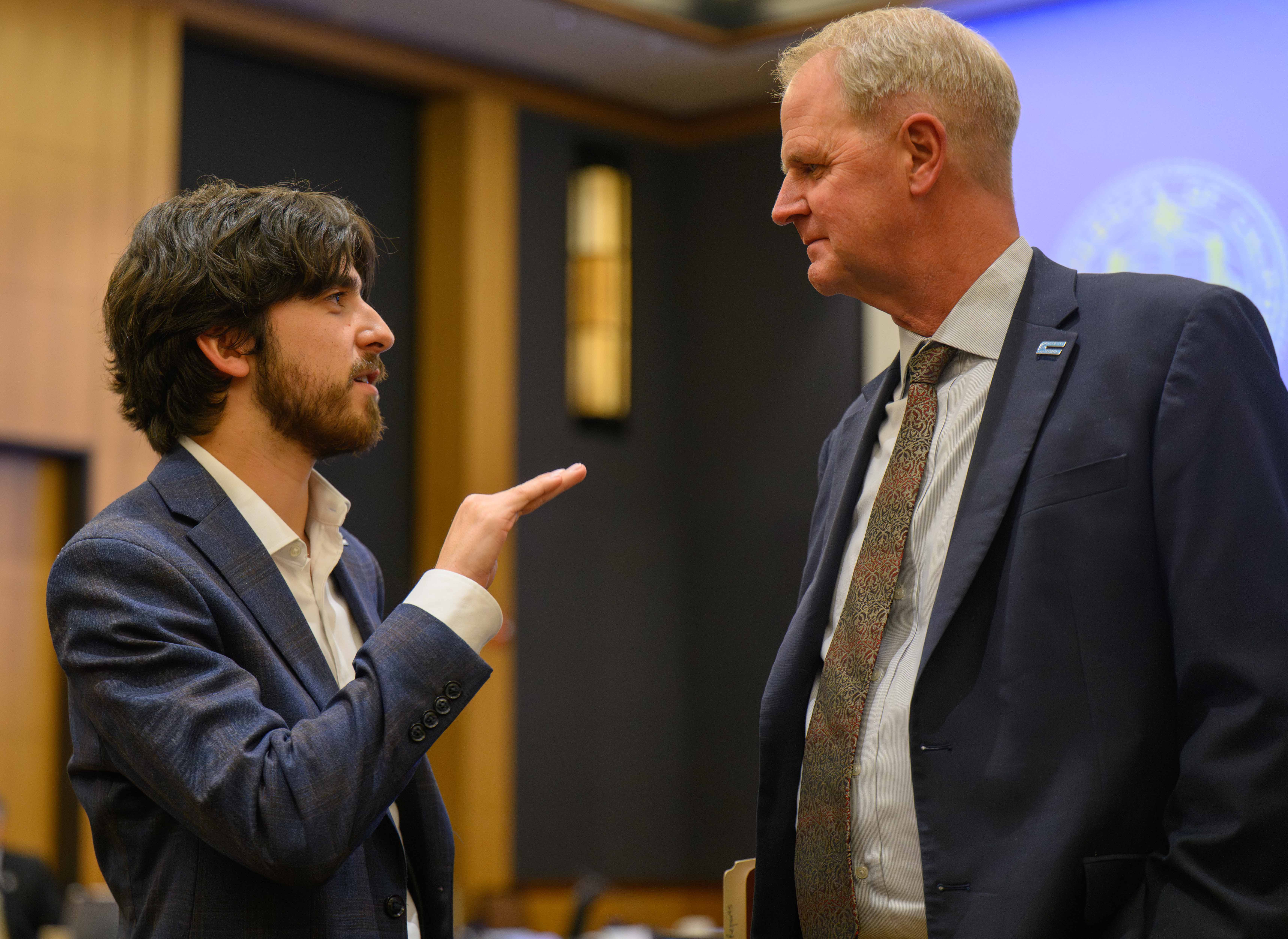
Nathan Brostrom, the UC’s executive vice president and chief financial officer, speaks with Miguel Craven, the student regent-designate. A UC Board of Regents committee highlighted a $12.3 billion discrepancy between 2026-27 state revenue projections made by Gov. Gavin Newsom and the Legislative Analyst’s Office at its Wednesday meeting. (Leydi Cris Cobo Cordon/Daily Bruin senior staff)

By Saya Mueller
Jan. 25, 2026 7:46 p.m.
This post was updated Jan. 27 at 10:11 p.m.
A UC Board of Regents committee highlighted a $12.3 billion discrepancy between 2026-27 state revenue projections made by Gov. Gavin Newsom and the Legislative Analyst’s Office at its Wednesday meeting.
The finance and capital strategies committee gave an overview of Newsom’s state and UC budget projections for the 2026-27 fiscal year. The regents met for its bimonthly meeting Tuesday and Wednesday at the Meyer and Renee Luskin Conference Center.
Nathan Brostrom, the UC’s executive vice president and chief financial officer, said Newsom’s first proposal for the 2026-27 budget included $5.3 billion in support from the state for the UC, a 7% increase – or $350.6 million – to the University’s ongoing budget compared to the 2025-26 budget year.
[Related: Proposed state budget includes $350 million increase to UC amid federal cuts]
The governor’s budget proposal was generally positive for the UC, but cost controls and securing outside grant funding are still areas of concern, said Caín Díaz, the associate vice president of budget analysis and planning.
The federal government has suspended and cut grants across the UC since the start of President Donald Trump’s second term, including by freezing $584 million in federal research funding to UCLA in late July. A federal judge temporarily restored the vast majority of UCLA’s funding in two rulings made in August and September.
More than $230 million in research grants remained suspended or terminated across the UC as of Jan. 8, according to the UC Office of the President.
“There is still some work to be done to control our costs, to identify opportunities for efficiencies and, of course, to advocate for additional support,” Díaz said.
A portion of the 7% increase in 2026-27 funding will go toward restoring deferred funds from the year prior, Díaz said. Newsom and the California State Legislature reached a final budget agreement for the 2025-26 fiscal year that deferred $130 million for the UC to the 2026-27 fiscal year.
[Related: Gov. Gavin Newsom, California State Legislature reach final state budget agreement]
The new ongoing funding would total $472.2 million for the 2026-27 fiscal year and $175.5 million for the 2027-28 fiscal year, according to the meeting slides.
While the proposed budget grants $773.1 million in alignment with the UC’s budget plan for current operations – with the largest portion being $292.8 million for asset management strategies and the Tuition Stability Plan, which keeps tuition flat for undergraduate students until they graduate or for up to six years – it reduces funding for student housing debt service by $8.1 million, according to the slides. Díaz added that an additional $212 million in requests from the UC was not granted.
“The budget for current operations projected over $930 million in expenditures attributable to new costs or investments,” Díaz said.
The governor’s state budget proposal is part of a yearlong budget process and will be reassessed in May based on the latest economic forecasts, according to the California budget website.
The proposed budget also includes a $444.6 million increase in funding for Cal Grants – a California-specific initiative to financially support in-state students – Díaz said. This comes alongside a reduction in funding for the Middle Class Scholarship, he added.
Brostrom said that while Newsom’s proposed budget outlines a stronger budget for higher education than seen in recent years, he is concerned about the governor’s budget prediction that revenues will exceed forecasts by $42.3 billion – which is $30 billion higher than projections from the Legislative Analyst’s Office. If revenues fail to meet projected totals, the UC would have to push to ensure it receives its allocation, he added.
“We are part of the increasingly dwindling discretionary portion of the state budget,” Brostrom said. “If revenues do not materialize as projected, we will need to advocate strongly to maintain this very, very favorable budget introduction.”
The University has also reached or exceeded many of the goals outlined in its multiyear compact with the governor, Brostrom said. The governor committed to providing the University with 5% annual base budget adjustments and considering supplementary funding over five years in exchange for the UC enrolling more Californians – along with completing other access-expanding initiatives.
The University decreased non-resident enrollment by almost 3,000 students across UC Berkeley, UCLA and UC San Diego over three years and also added more than 2,800 California residents in the same time period, Brostrom said.
Seventy-three percent of incoming California students will also benefit from debt-free pathways this year – an increase from the previous 63%, Brostrom added. About three of every four incoming students do not have to take out student loans to attend the UC, he said.
“This reflects both our own commitment to financial aid but also our partnership with the state,” Brostrom said.
Isha Khirwadkar, a student observer of the committee, asked the board to advocate for state support in addressing rising housing and living costs for students. Khirwadkar, a fourth-year cognitive science student at UC San Diego, added that she is concerned the budget will primarily benefit future classes rather than current students.
The UC allocates about $62 million of state funding to basic needs support, emergency housing, mental health services and other student services – not accounting for the funds individual campuses devote toward these causes – Brostrom said. He added that the UC acquired four buildings for UCLA to convert into student housing over the last several months.
“You’ll see it in your generation, not future generations,” Brostrom said.