Dancesport Club at UCLA brings competitive ballroom into the limelight
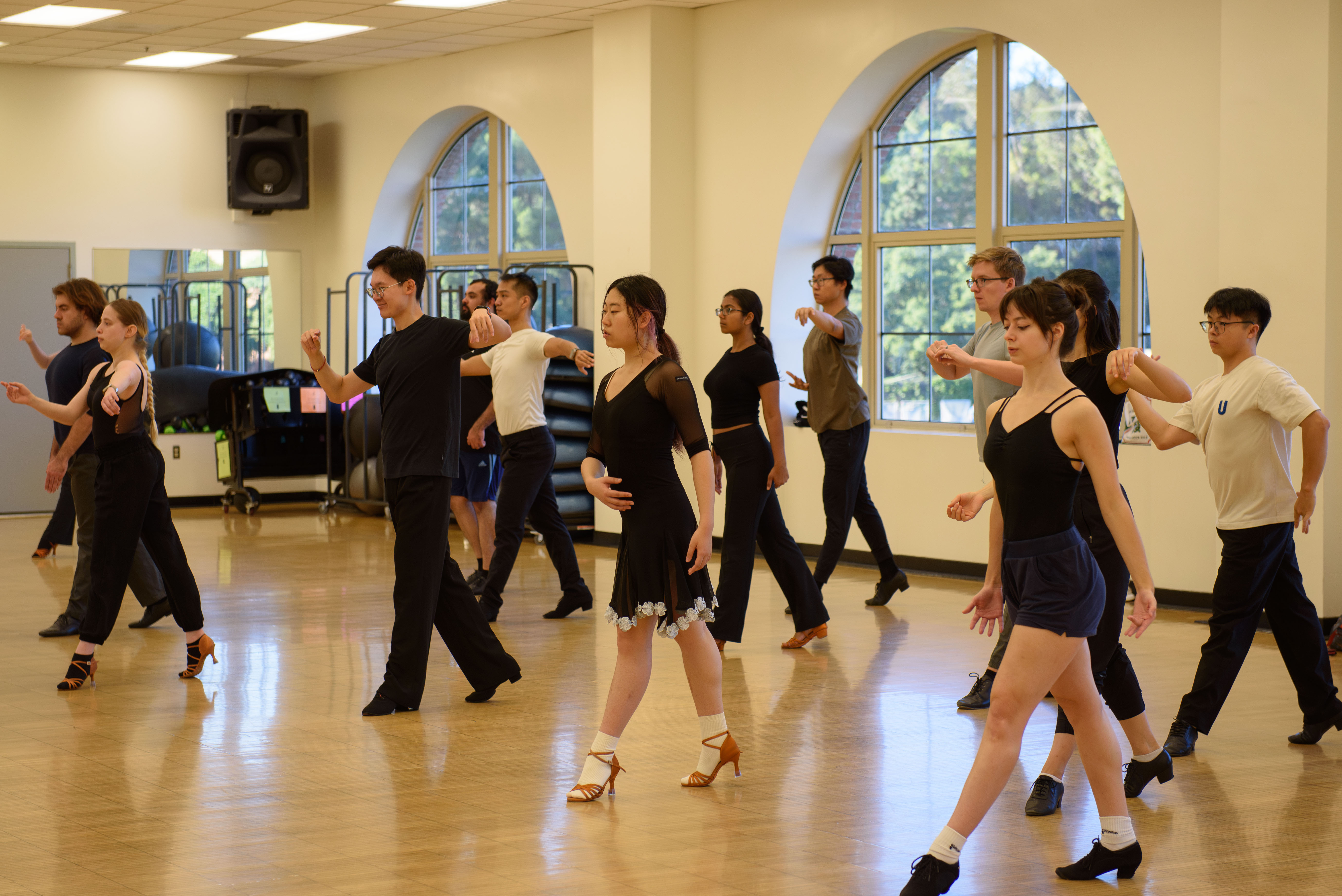
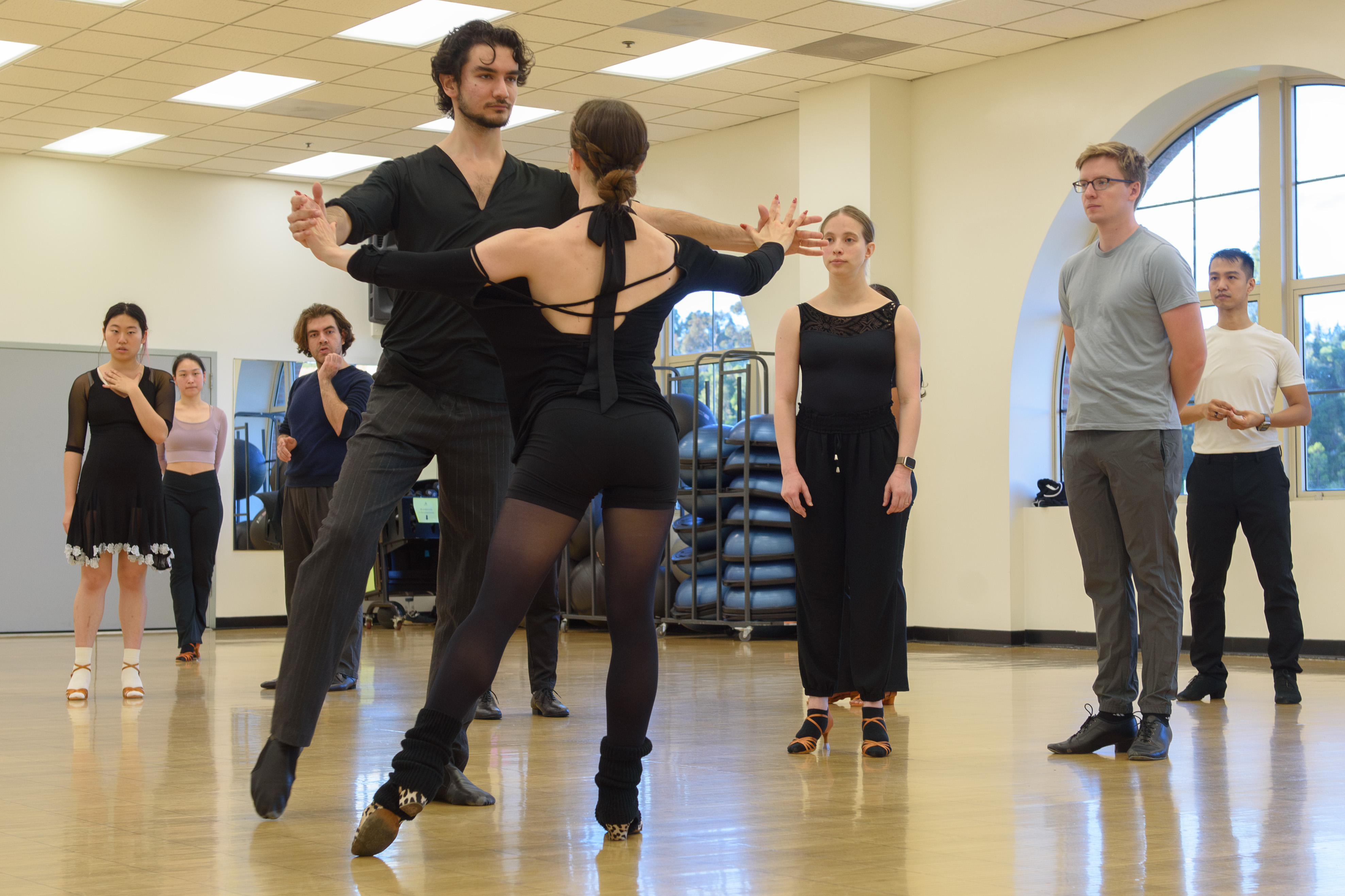
Members of Dancesport Club at UCLA are pictured during one of their fall rehearsals. This year, the group competed in the Claremont Showdown Nov. 15 and recently collaborated with UCLA’s Salsa Society during their practices. (Purvi Singhania/Daily Bruin)

By Julia Divers
Dec. 5, 2025 1:42 p.m.
This post was updated Jan. 6 at 8:29 p.m.
Members of Dancesport Club at UCLA are strutting into ballrooms of new opportunities.
Founded in 2016, DCU helps dancers of all skill levels explore the world of competitive ballroom dancing. The club holds three practices per week and works to be inclusive of members’ varying skill levels. This year, the group competed in the Claremont Showdown on Nov. 15 and recently collaborated with UCLA’s Salsa Society during their Nov. 19 and Nov. 20 practices. DCU’s club president and computer science graduate student, Hanger Yang, said joining the club fostered his curiosity for dance regardless of certain skill set expectations.
“I’m trying ballet for the first time, and I was trying hip-hop before as well,” Yang said. “I feel like there’s always this barriers of, ‘Oh, guys shouldn’t dance,’ … which is not really an issue.”
Yang said he joined DCU in 2019 as a first-year undergraduate student at UCLA, initially interested in hip-hop dancing and with no prior experience in dance. He said he began his leadership in the club as team captain during the first year of his Ph.D. program, and during his third year he became club president. In this role, Yang added that he helps coordinate events and enjoys being a student coach, in which he introduces beginners to dancesport, the name for competitive ballroom dance.
“Trying to organize events to help (members) make dance part of their lives is really fulfilling to me,” Yang said.
Nicholas John, a third-year biochemistry student, said he helps maintain the club’s community through social events as the club social chair. These include meals after practices, supporting members at competitions and their recent collaborations with Salsa Society, where both clubs learned each other’s styles, he added. John said he joined DCU in his first year at UCLA with no prior interest in dance. However, in search of a new activity and with a classmate’s encouragement, he joined the club. As a complete beginner, John said there was an initial physical learning curve to overcome.
“It feels so strange because (dance) requires mechanics that you just are not even used to ever thinking about in daily life,” John said. “They tell you to do something, … and your body just doesn’t listen. It feels so awkward, but it’s also fun because everyone’s learning too.”
[Related: Video game review: Despite flaws, ‘Just Dance 2026 Edition’ fosters fun, collaboration]
Marissa Li, John’s dance partner, is a second-year cognitive science student and said she also joined the club her first year at UCLA. Li said she was not nervous for her first competition last year, as the club emphasizes the enjoyment of newcomers’ first competitions. Li said she became club secretary during her second year at DCU, where she completes administrative tasks, such as note-taking during meetings, spreading information about events on social media and encouraging people to join the club.
Li herself joined the club after a few months of experience with dancesport the summer before her first year. She said the activity drew her back into dancing after the pandemic because she could apply the technical aspects of ballet and Chinese dance she had learned from earlier dance experiences while enjoying the variety of styles it encompasses.
Li said she was drawn to UCLA in part because of the robust dancesport culture. She added that she enjoys how the club allows her to work with professional coaches. A few of the coaches, she said, also began or resumed dancing in college or as adults, making them relatable to the collegiate dancers and committed to promoting dancesport. Li also said the coaches instilled in her the importance of drills in developing detailed skills, and John corroborated the value of these professional coaches in technical improvements.
“You can tell how much they enjoy it, even the most simple action, you can see how many thousands of hours they put into it, and how much they thought about it,” John said. “When they’re teaching you, they’ll describe every single muscle, … and they do it in a way that makes it more intuitive.”
[Related: UCLA Skate Club connects common interests, community with inclusive skate nights]
Yang said these professional coaches usually teach weekly Saturday classes for more advanced members, while student coaches like Yang teach Friday classes and Wednesday discussion-style sessions aimed at beginners. These practices help students develop skills at various levels and prepare for competition if they choose to compete, Yang added. The Claremont Showdown was the club’s first competition of the year, Yang said, and next quarter it will compete in Cal Poly’s Mustang Ball on Feb. 7-8, followed by UCSD’s “Dance By The Shores” at the end of that same month.
Yang, Li and John all said they plan to continue dancing in the club and beyond, even when their careers and studies may be their main priorities. Yang and John said dance has become a welcome break and stress reliever from their STEM studies, even when preparing for competitions can be busy.
“Dance really shines because it brings people closer and brings people to notice the things that are more important,” Yang said. “For anybody who wants to join or is already in it, just dance more – try it out, and really feel the charm of dancing.”