Yeh Lab researches Dark-eyed Juncos, adaptation to urban environments
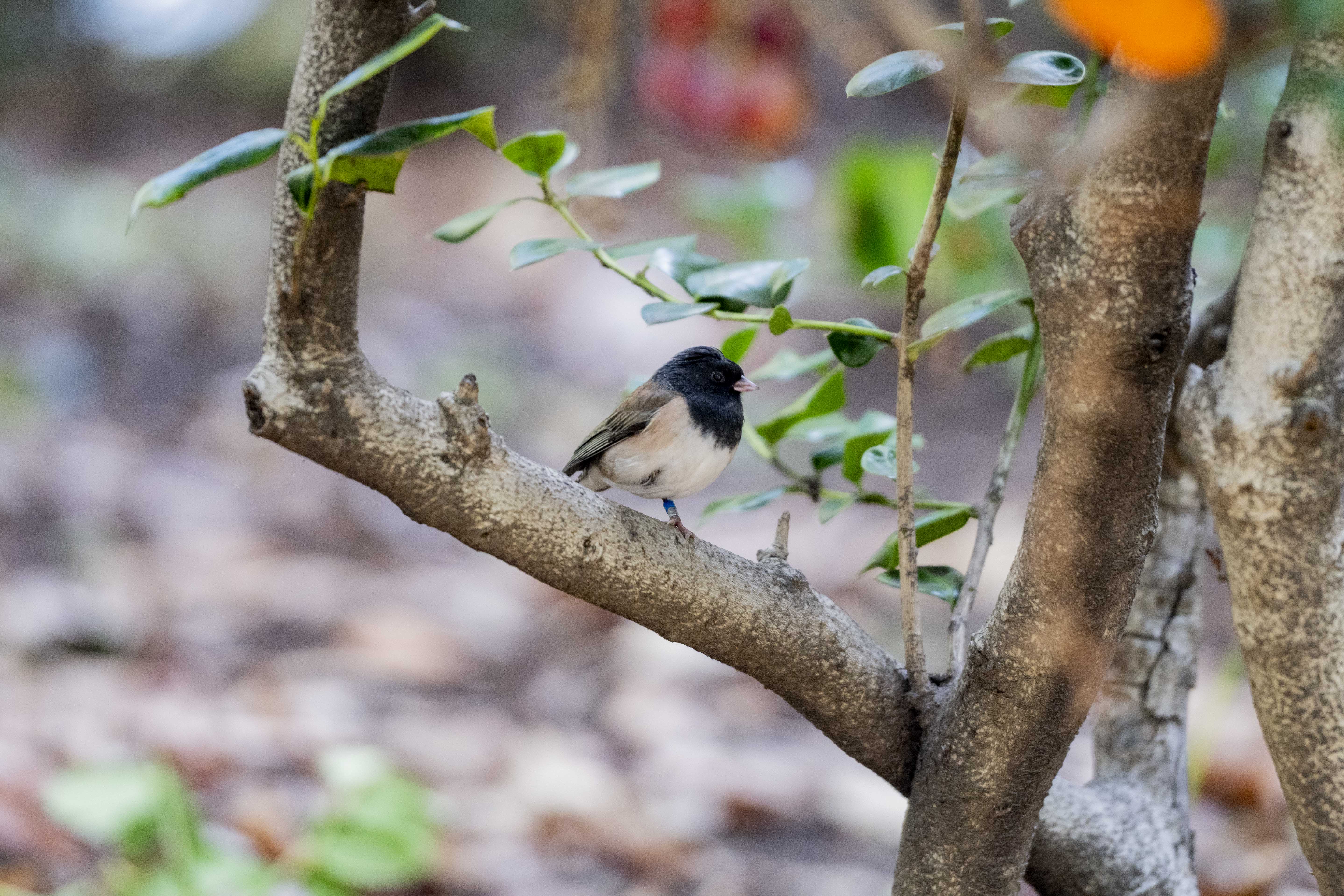
A Dark-eyed Junco, a kind of sparrow, is perched on a tree branch. The Yeh lab evaluates how Juncos respond and adapt to urban environments, particularly on UCLA’s campus. (Crystal Tompkins/Daily Bruin senior staff)

By Reese Dahlgren
Nov. 3, 2025 9:30 p.m.
This post was updated Nov. 6 at 11:17 p.m.
Most people would not think twice about seeing a bird on UCLA’s campus.
However, for researchers in the Yeh Lab, many of the birds are anything but ordinary.
The lab evaluates how Dark-eyed Junco birds respond and adapt to urban environments, particularly on UCLA campus. Pamela Yeh, the lab’s principal investigator, said in an emailed statement that the Juncos – with names like “Jericho,” “Fish” and “Long Island Iced Tea” – are part of the nearly 30-year-old research project she started at UC San Diego in 1997.
“How I know this campus is through Junco territories,” Joey Di Liberto, a doctoral student in the Department of Ecology and Evolutionary Biology, said. “I can tell you that this is Long Island Ice Tea’s territory, down there is Fish – they get into fights quite often.”
Many of the Juncos – a kind of sparrow – reside on campus year-round, while others migrate to more common habitats for the breeding season, like montane forests in Canada or Washington, Di Liberto said.
Sierra Glassman, a graduate student in the ecology and evolutionary biology department, said many Juncos at UCLA have colorful bands attached to their legs – which the lab uses to identify individual birds.
Catching and identifying the Dark-eyed Juncos on campus starts with knowing where the birds are, she said.
Hatch-years – birds that hatch during the current year – tend to be spotted around Janss Steps because the area is wide and grassy, Glassman said. She added that, alongside undergraduate students, the researchers survey to see where nests and unbanded birds are during the breeding season between February and July.
Undergraduate student researchers often help the lab to identify which birds need to be banded, Glassman said.
“On the UCLA campus, we have a bunch of undergrads helping us,” she said. “People are assigned to ‘cores’ on campus that they monitor for Juncos to see which specific Juncos are there and who needs to be banded, who’s using the territory, who’s making nests.”
Di Liberto, who researches trends in bird behavior and morphology in urban environments, said the lab’s goal is to maintain a banded population across the whole campus. Once the researchers have identified a target bird, he added that they set up a mist net – which the Juncos have a difficult time seeing – and play aggressive Junco noises on a speaker to lure the bird into the net.
He said it can be challenging to get the birds to fly into the net, especially in an urban environment. In an area where there are few trees or bushes but many buildings and cars, the researchers have to get creative, Di Liberto added.
“One time I had to tie it (the net) to a car,” he said. “Or, very commonly, to trash cans because you can move them around.”
Di Liberto added that his goal is to ensure students are getting the most out of the banding experience. Being able to tag many birds around campus is a unique experience at UCLA, Di Liberto said.
“I’m always trying to think about, ‘How can we get the best experience for the people who – like the undergrads and other masters students – are trying to learn?’” he said.
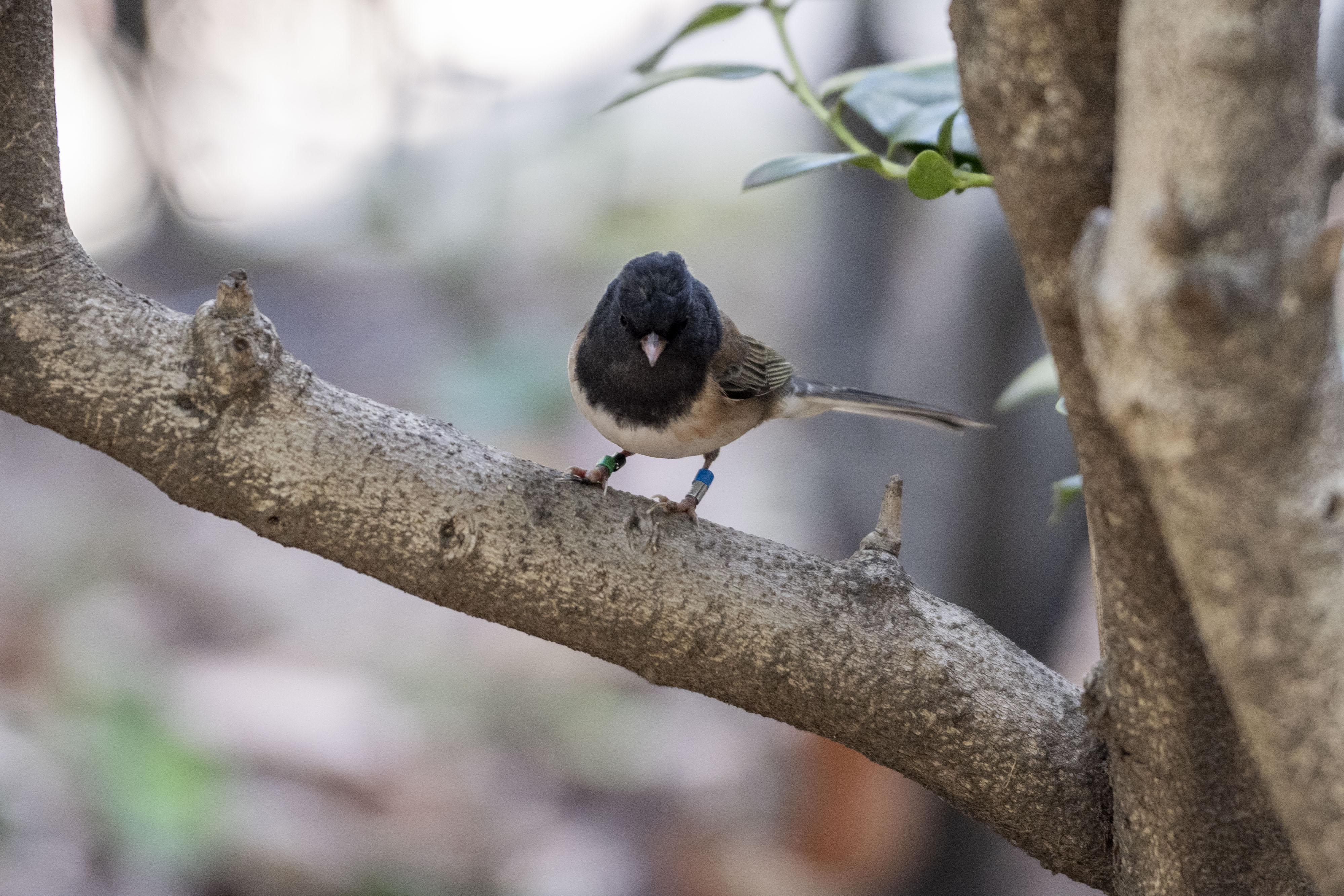
Alex Fu, a fourth-year environmental science student in the Yeh Lab, said after a bird is caught, the researchers give each bird a government-mandated aluminum band and three color bands. This gives each bird a unique color combination to make the identification process easier, Fu added.
“For most people, by the end of one breeding season, they’ll know all of the birds in their core like the back of their hands,” he said.
Maintaining the study population of birds is a slow process as the team must continue banding and finding Junco nests every year to manage the study population, Fu said.
Chase, a male Junco that resided near Kerckhoff Coffee House Patio, inspired Fu to get involved in the research project, he said. Fu added that while most birds are monogamous pairs, Chase was known to have two female partners at the same time – which was relatively unheard of in the wild.
“There’s a lot of relationship drama with the Juncos,” he said.
Glassman said the banding process has brought her memorable moments – including accidental encounters with police.
“There was a funny time me and Joey were setting up a net in the sculpture garden and a policeman stopped by,” Glassman said. “He thought that we were USC students tagging a sculpture because it was right before a USC game.”
Di Liberto said through his research, he has noticed Junco territoriality differs between urban and nonurban environments. He added that in the nonurban sites he has studied, Juncos tend to exhibit aggression more vocally, whereas they sing less at UCLA.
“What we think is that certain physical characteristics of the environment, even more so than urban, montane or rural, are driving differences in this behavior,” Di Liberto said.
The lab’s research can serve as a framework for how birds and other animals adapt to cities, Fu said. He added that as urbanization continues to be a driving force globally, the research can provide insight into how animals adapt to human-dominated environments.
“Evolution isn’t a millions of years process, necessarily,” Fu said. “It could be happening right before our eyes in even a human lifespan.”