Students share perspectives, reasoning ahead of Proposition 50 special election
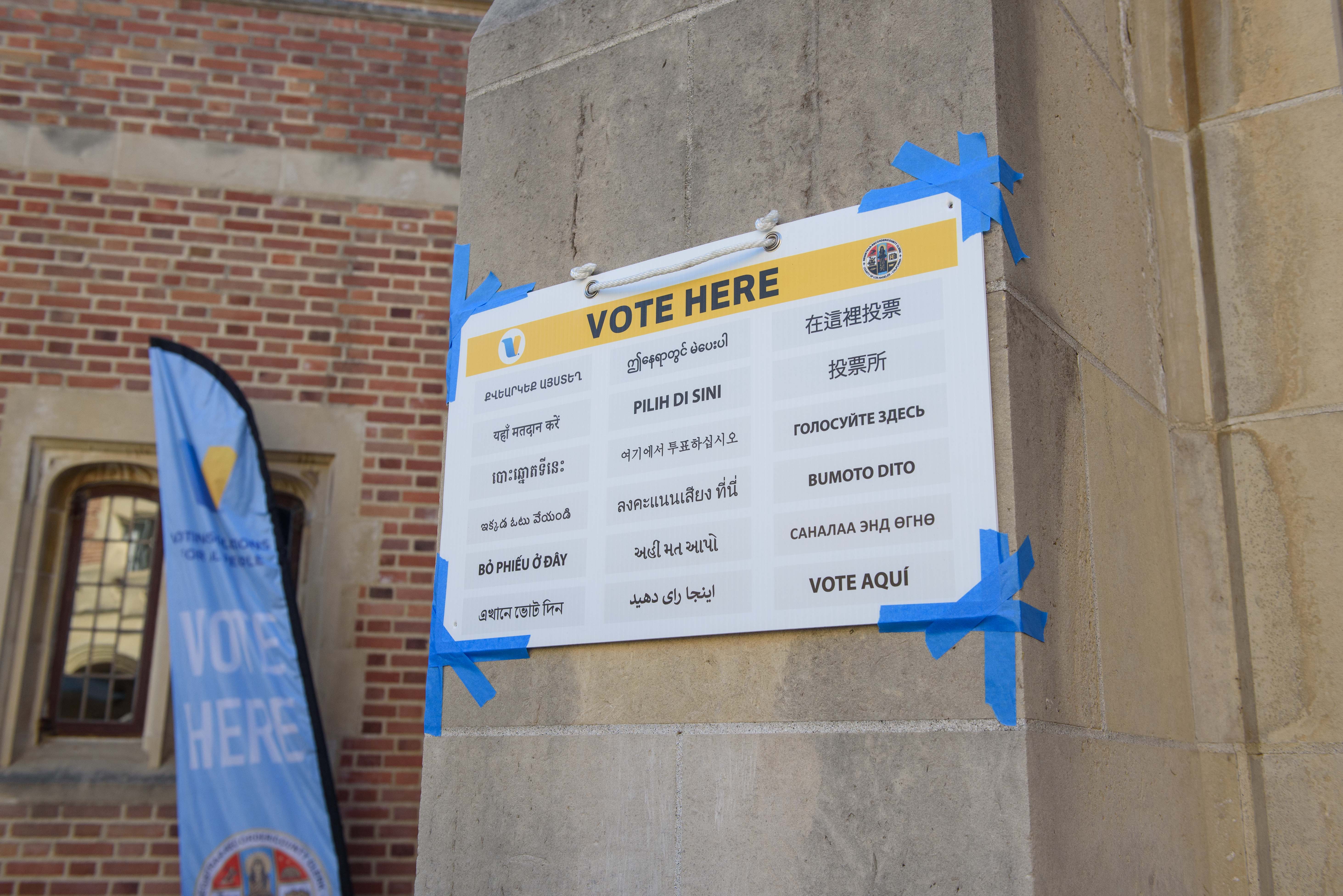
A sign, which reads “vote here,” is pictured. UCLA students are canvassing and casting early ballots as the Nov. 4 deadline to vote on Proposition 50 approaches. (Leydi Cris Cobo Cordon/Daily Bruin senior staff)

By Delilah Brumer
Nov. 1, 2025 5:10 p.m.
This post was updated Nov. 2 at 11:00 p.m.
UCLA students are canvassing and casting early ballots as the Nov. 4 deadline to vote on Proposition 50 approaches.
The proposition would change how California determines the boundaries of congressional districts for the next three election cycles by temporarily granting redistricting rights to the state legislature, rather than California’s independent nonpartisan redistricting commission, until 2030. The ballot measure was proposed by Gov. Gavin Newsom and California Democrats to counter a redistricting push by Texas Republicans, which intended to give the party five more seats and has been supported by President Donald Trump, according to the Los Angeles Times.
California currently has 43 Democrats and nine Republicans in the U.S. House of Representatives. Proposition 50 would allow for five more seats to be “competitive or easily winnable” for Democrats, according to the LA Times. There are currently 219 and 213 Republicans and Democrats in the House, respectively, as well as three vacancies – of which two seats were formerly filled by Democrats.
Kristian Suazo, a third-year political science student, said he supports Proposition 50 as a way to balance against Texas’ redistricting push. Suazo knocked on more than 200 doors this fall throughout his Orange County hometown in support of Proposition 50, as a canvasser for Democratic U.S. Congressman Mike Levin.
“If Texas is doing it, then California has to level the playing field,” Suazo said. “We can’t allow one side to just openly steal the next election.”
The measure’s proposed congressional maps would change the district Suazo lives in – California District 40, which could be considered somewhat of a swing district – to more of a Republican stronghold, which he said he does not want for the district. But this doesn’t deter him from voting “yes” on Proposition 50. He said that “in the long run, it’s more important to see free and fair elections than for my own self-interest of my own seat and of my own district.”
Andrew Escanuelas, a fourth-year political science student, said he believes Proposition 50 is a “power grab” by Democrats and plans to vote “no” on the measure. Escanuelas added that, as a conservative-leaning student from the Inland Empire, he is concerned that Proposition 50 would “change up my area to reflect the views of LA or San Francisco.”
“Especially in a state that doesn’t reflect my views that often, it’s better to just make sure, to let everyone know that we still exist, we’re still out here – and we need to be properly represented,” Escanuelas said.
Betty Mogollon, the chapter chair of California Public Interest Research Group at UCLA, said the advocacy group has spent weeks tabling to encourage students to become first-time voters. Proposition 50 will ensure the voices of the Latino community and people of color as a whole are not “constrained or constricted” by the Trump administration, the third-year psychology and sociology student added.
Black and Latino advocacy groups – including the NAACP – have sued Texas for its new maps, alleging that they diminish the electoral power of minority voters.
The redrawn Proposition 50 districts, however, largely match California’s current map in racial representation. The notable difference is that, under Proposition 50, Latino voters would pick up an additional “influence district” – a region where a minority group does not make up the majority of voters but still can substantially impact election results – according to an analysis by the Public Policy Institute of California.
“The current administration that we’re under has impacted my community as a Latin person, especially one that is first generation, and it is so important for us to have diversity,” Mogollon said.
Bruin Democrats has also been working to shore up support for Proposition 50 – by leading phone banking efforts, tabling with other campus organizations and canvassing across the Westside and Greater Los Angeles area, said Adam Peddie, the organization’s external vice president.
Elizabeth Tran, a first-year microbiology, immunology and molecular genetics student, said she believes Proposition 50 is a form of gerrymandering. The San Diego resident, however, said she plans to vote “yes” on the measure because “it hurts to see that many Republicans overshadowing us (Democrats).”
“You have to fight fire with fire,” Tran said. “I don’t think that it’s wrong in this case, because if you’re trying to help your cause, it needs to happen.”
Los Angeles residents can vote in person Nov. 4 in Kerckhoff Hall Grand Salon and Hammer Museum’s Bay-Nimoy Studio, among other locations across the county. Voters can also submit a vote-by-mail ballot as long as it is postmarked by Election Day.